Supreme Court Appoints Amicus for Himachal Ecology
Source:The Hindu ↗
Why It Matters
The active intervention of the judiciary highlights the urgent need to balance infrastructure and tourism development with environmental conservation in ecologically fragile regions like the Himalayas. This is highly relevant for GS-III (Environment, Disaster Management) and GS-II (Role of Judiciary).
Summary
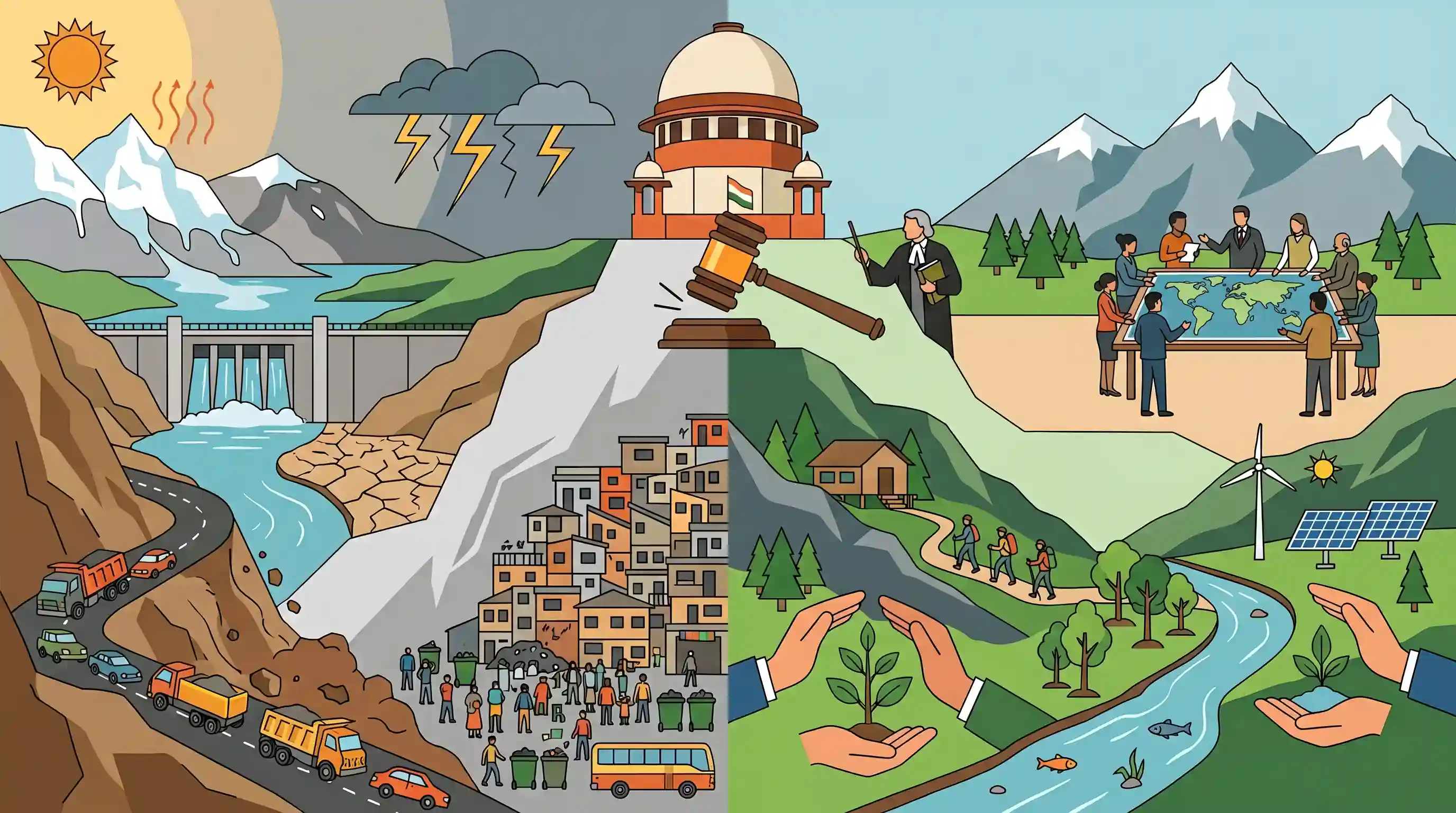
The Supreme Court took suo motu cognizance of the severe ecological imbalance in Himachal Pradesh, appointing an amicus curiae to assist in the matter. The Court observed that rapid infrastructure development—including hydropower projects, four-lane roads, and unchecked tourism—is straining the fragile Himalayan ecosystem. Highlighting the alarming impacts of climate change, the SC urged all Himalayan states to pool their expertise for ecologically sensitive development and underscored both the Centre's and the State's obligation to prevent further environmental deterioration.
Key Points
- The Supreme Court has appointed an amicus curiae in a suo motu case concerning the severe ecological imbalance in Himachal Pradesh.
- The Court identified hydropower projects, four-lane roads, deforestation, multi-storey buildings, and uncontrolled tourism as primary drivers of environmental destruction in the state.
- Warning that climate change has a visible and alarming impact, the SC noted the state might "vanish in thin air" without corrective measures.
- The SC suggested that all Himalayan states collaborate to share resources and expertise, ensuring development plans align with the region\'s unique ecological vulnerabilities.
- The SC also upheld the state\'s notification declaring certain regions as "green areas" to restrict unchecked construction activities.
Important Terms
Suo Motu Cognizance

The power of a court to take notice of a matter on its own motion, without a formal petition or complaint by an external party.
UPSC context
GS Paper II: Judiciary. Tests knowledge of judicial reach and protection of public interest where executive action is lacking.
Amicus Curiae
A 'friend of the court'—a neutral legal expert appointed to assist the court by providing specialized information, analysis, or perspective on a complex case.
UPSC context
GS Paper II: Judiciary/Law. Relevant for understanding how courts handle technical environmental and constitutional matters.
Fragile Himalayan Ecosystem
A unique, bio-diverse, and geologically unstable environment. In the Himalayan context, it is highly susceptible to disasters like landslides and flash floods due to steep terrain and tectonic activity.
UPSC context
GS Paper I & III: Geography/Environment. Crucial for disaster management and sustainable development questions.
Green Area Notification
A legal declaration by the state government (e.g., under Town and Country Planning acts) that designates specific regions as non-construction zones to preserve green cover and ecological balance.
UPSC context
GS Paper III: Environment. Important for understanding land-use policy and state-level conservation tools.
Judicial Activism
The judiciary's proactive role in protecting citizens' rights and the environment, often by issuing directives to the executive or initiating cases of public importance.
UPSC context
GS Paper II: Polity. A core topic examining the balance of power between the Judiciary and the Executive.
Sustainable Development
Development that meets current needs without compromising future generations, balancing economic growth with environmental protection—a core theme in the Himachal ecological crisis case.
UPSC context
GS Paper III: Environment/Economy. Tests the ability to argue the trade-off between revenue generation and ecological preservation.
Locus Standi
The legal right of a party to bring a lawsuit to court based on having a sufficient connection to and harm from the law or action challenged.
UPSC context
GS Paper II: Judiciary. Relevant for PILs where the traditional requirement of personal injury is often relaxed.
Public Interest Litigation (PIL)
Legal action initiated in a court of law for the protection of 'Public Interest', such as environment, health, or human rights, often by a third party.
UPSC context
GS Paper II: Judiciary. Essential for understanding the evolution of environmental jurisprudence in India.
Prelims Trap
"Green Area notifications in states are issued by the MoEFCC under the Environment (Protection) Act, 1986."
Green Area notifications are issued by State Town and Country Planning departments to restrict local construction, unlike Eco-Sensitive Zones (ESZs) which are notified by the MoEFCC.
Static Concepts Connected
What is 'Carrying Capacity' in the context of Himalayan ecology?
- Definition: The maximum population size or level of developmental activity an ecosystem can sustain indefinitely without degrading its natural resources.
- Ecological Assessment: Involves scientific evaluation of geological stability, water availability, and biodiversity to put a hard cap on unchecked tourism and urbanization in fragile regions.
What is the constitutional basis for judicial intervention in environmental matters?
- Article 21: The Supreme Court has expansively interpreted the Right to Life to include the fundamental right to a clean, healthy, and safe environment.
- DPSP & Duties: Articles 48A (State's duty to protect environment) and 51A(g) (Citizen's duty) serve as foundational principles for the SC's suo motu PILs and directives.
- Amicus Curiae: An impartial legal expert appointed to assist the Court in complex cases (like ecological collapse) where unrepresented public interests are at stake.
Cross-Topic Patterns
Carrying Capacity & Disaster Management
Unscientific slope cutting for four-lane highways and unregulated hydropower projects directly link to recent Himalayan disasters, mirroring patterns seen in the Joshimath subsidence and Sikkim GLOFs.
Federalism in Environmental Governance
The SC's push for Himalayan states to pool expertise highlights the tension between state-level revenue generation (tourism/power) and national ecological security mandates.

Expect a multi-statement Prelims question distinguishing State "Green Area" zoning powers from MoEFCC "Eco-Sensitive Zones" in 2026.
Linked PYQs · 4
Linked PYQs · 4
- 2016MainsGS3
Rehabilitation of human settlements is one of the important environmental impacts which always attracts controversy while planning major projects. Discuss the measures to be adopted to mitigate the impact of the recent incidents of cloudbursts in many places of Uttarakhand.
- 2022MainsGS2
“The most significant achievement of modern law in India is the constitutionalization of environmental problems by the Supreme Court.” Discuss this statement with the help of relevant case laws.
- 2016MainsGS1
The Himalayas are highly prone to landslides. Discuss the causes and suggest suitable measures of mitigation.
- 2021MainsGS1
Differentiate the causes of landslides in the Himalayan region and Western Ghats.
