Supreme Court Clarifies Creamy Layer Norms for OBC Reservation
Source:Indian Express ↗
Why It Matters
Crucial for understanding the evolving judicial interpretation of social justice, reservation policy, and the application of the creamy layer principle to public sector employees in India.
Summary
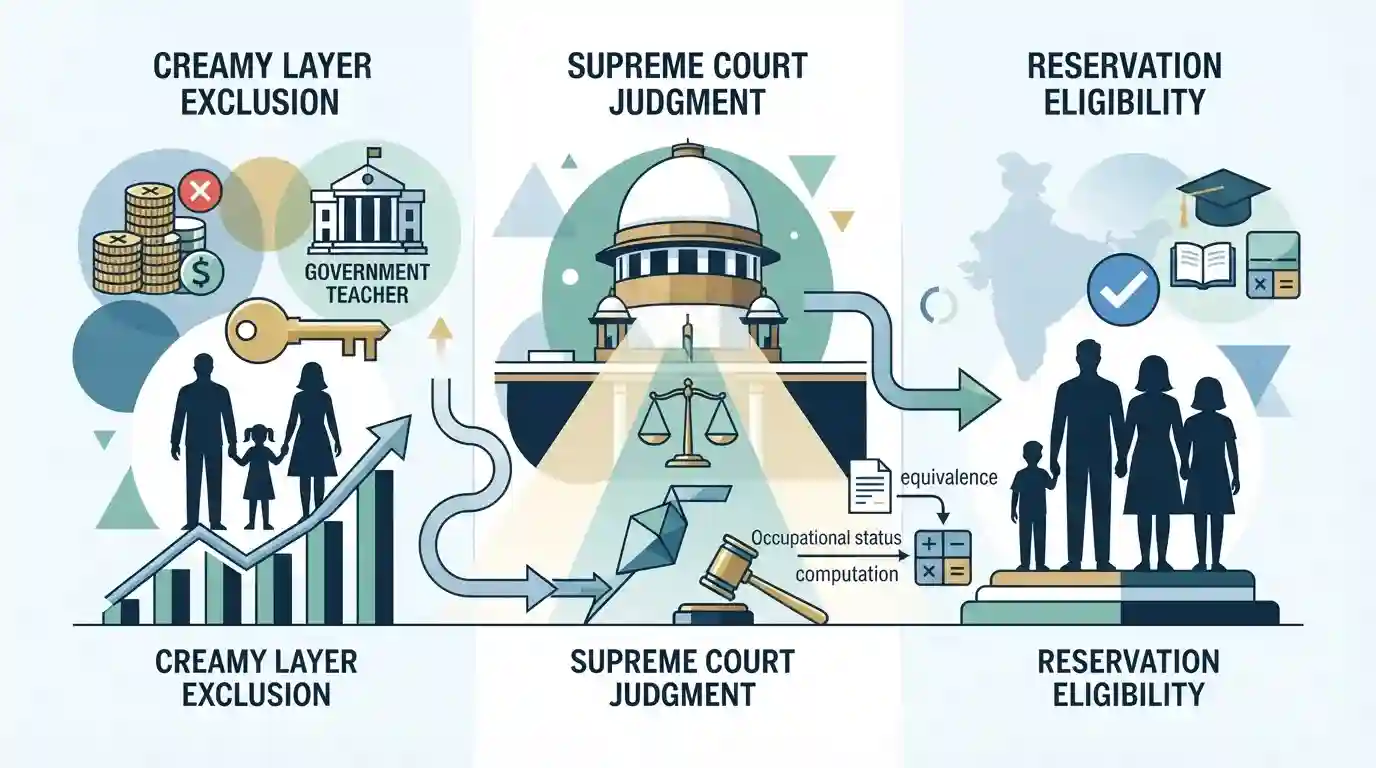
The Supreme Court of India delivered a crucial ruling regarding the creamy layer criteria for Other Backward Classes (OBC) reservations, specifically impacting the children of government teachers. The judgment clarifies how occupational status and income equivalence are computed for public servants, preventing anomalies in determining reservation eligibility and ensuring the creamy layer mechanism targets those genuinely requiring affirmative action.
Key Points
- The Supreme Court clarified rules concerning the creamy layer exclusion for Other Backward Classes (OBCs) regarding government employment, specifically impacting the children of government teachers.
- The ruling addresses ambiguities in calculating income thresholds and status equivalence between public sector employment and constitutional/executive positions.
- It ensures fairer implementation of reservation benefits by preventing arbitrary classification while maintaining the core objectives of the creamy layer concept.
Important Terms
Creamy Layer

A judicial principle established by the Supreme Court to exclude socially and economically advanced individuals among Other Backward Classes from availing reservation benefits.
UPSC context
UPSC GS Paper 2 (Social Justice/Constitutional Law): Tests understanding of affirmative action policies, social equity, and inclusion mechanisms for backward classes.
Indra Sawhney Judgment
The landmark 1992 Supreme Court judgment that upheld the 27 percent reservation for OBCs while mandating the exclusion of the creamy layer.
UPSC context
UPSC GS Paper 2 (Polity and Governance): Core judicial precedent regarding the constitutional limits and parameters of reservations in India.
Prelims Trap
Parental income alone determines an Other Backward Classes (OBC) candidate's creamy layer status.
Aspirants often assume that total parental salary/income alone determines OBC creamy layer status, ignoring that salary and agricultural income are specifically excluded under original DoPT guidelines where status equivalence applies.
Static Concepts Connected
What are the key constitutional provisions and judicial precedents governing the 'creamy layer' in OBC reservations?
- Indra Sawhney Case: Originates from the landmark 1992 nine-judge bench ruling which upheld 27% OBC quota subject to excluding advanced sections.
- Constitutional Basis: Article 16(4) enables the State to make provisions for the reservation of appointments in favor of any backward class of citizens.
- DoPT Guidelines: Excludes salary and agricultural income from the gross annual income test; primary criterion is rank, status, and occupational equivalence.
Cross-Topic Patterns
Judicial Review vs Executive Circulars
The creamy layer debate connects judicial review under Article 13/32 with administrative law, specifically how executive circulars cannot override constitutional mandates set in Indra Sawhney.
Affirmative Action and Federal Governance
OBC reservation sub-categorization and creamy layer norms intersect directly with federal census data gaps and the constitutional mandate for socio-economic justice under Article 38.

Expect a statement-based question combining Indra Sawhney creamy layer norms, salary exclusion rules, and retrospective vs prospective overruling.
Linked PYQs · 3
Linked PYQs · 3
- 2022MainsGS2
Discuss the role of the National Commission for Backward Classes in the wake of its transformation from a statutory body to a constitutional body.
- 2020PrelimsGS1
In India, Legal Services Authorities provide free legal services to which of the following type of citizens? 1. Person with an annual income of less than ₹ 1,00,000 2. Transgender with an annual income of less than ₹ 2,00,000 3. Member of Other Backward Classes (OBC) with an annual income of less than ₹ 3,00,000 4. All Senior Citizens Select the correct answer using the code given below:
- 2023PrelimsGS1
Consider the following statements: Statement-I: The Supreme Court of India has held in some judgements that the reservation policies made under Article 16(4) of the Constitution of India would be limited by Article 335 for maintenance of efficiency of administration. Statement-II: Article 335 of the Constitution of India defines the term 'efficiency of administration'. Which one of the following is correct in respect of the above statements?
