Supreme Court Forms Panel to Draft Yamuna Rejuvenation Plan
Source:The Hindu ↗
Why It Matters
Highlights the continuing challenge of river pollution in India and the crucial role of the judiciary in driving coordinated executive action across multiple states to tackle environmental degradation. Relevant for questions on environmental governance, urban pollution, and river rejuvenation schemes.
Summary
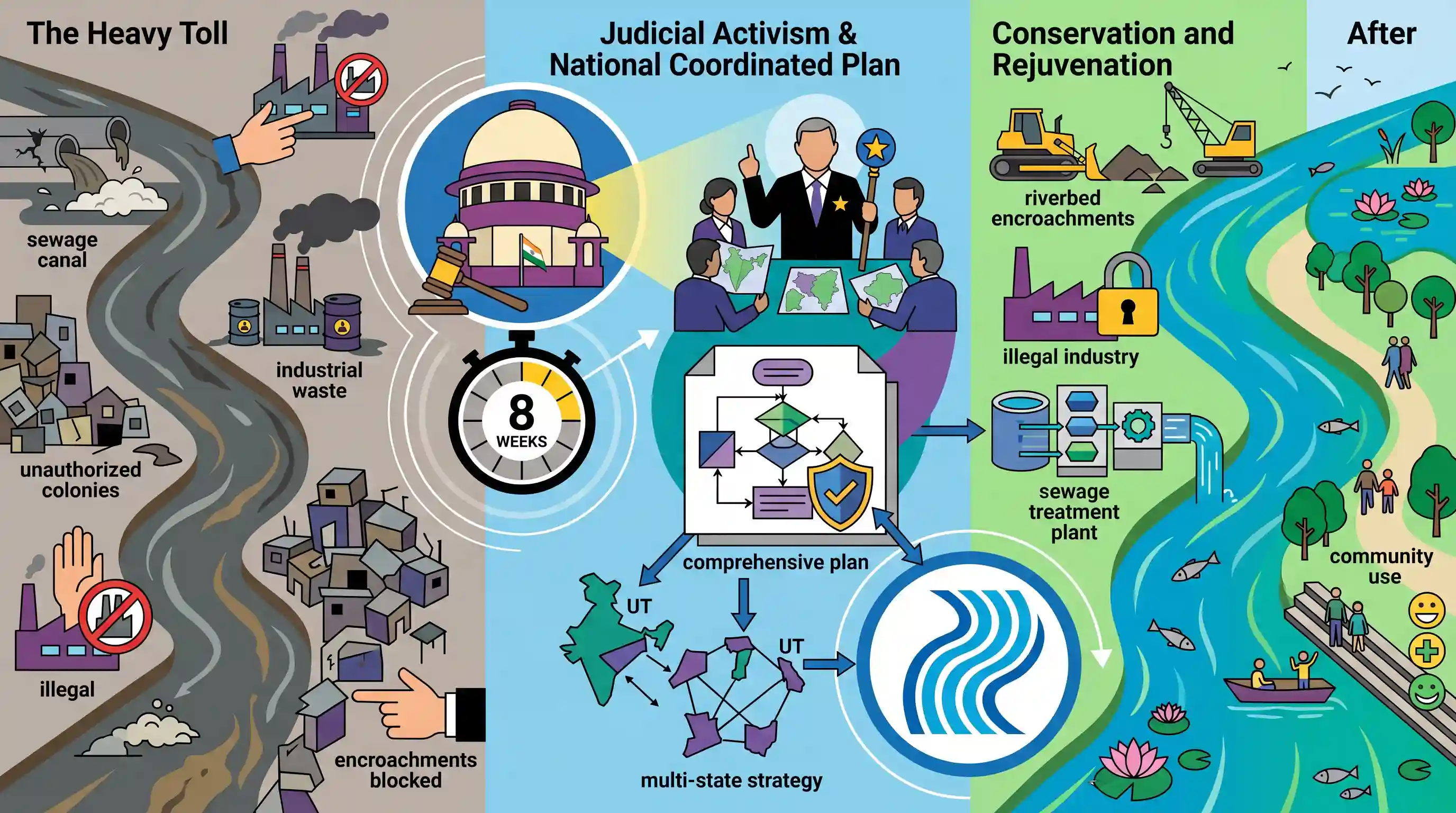
The Supreme Court of India has constituted a high-level committee led by the Union Home Secretary to formulate a comprehensive "Yamuna Action Plan" within eight weeks to rejuvenate the heavily polluted Yamuna river. Noting that the river has been reduced to a "sewage canal", the Court stressed the need for a long-term, multi-state strategy akin to the Namami Gange programme. The initiative requires coordinated action across riparian States and demands tough measures, including the removal of riverbed encroachments, closure of illegal industries, and management of untreated sewage from unauthorized colonies.
Key Points
- The Supreme Court constituted a high-level panel headed by the Union Home Secretary to draft a comprehensive "Yamuna Action Plan" within eight weeks.
- The panel includes Chief Secretaries of all States and UTs through which the Yamuna flows to ensure coordinated, multi-state action.
- The Court observed that the Yamuna has become a "sewage canal" and emphasized the need for a holistic rejuvenation strategy similar to the Namami Gange programme.
- Cleaning the river will require "hard decisions" such as closing illegal polluting industries, removing encroachments, and relocating unauthorized colonies.
- Amicus curiae recommendations included geo-tagging of Sewage Treatment Plants (STPs) and making real-time water quality data accessible to the public.
Important Terms
Yamuna Action Plan (YAP)

A multi-phase bilateral project between India and Japan (JICA) initiated in 1993 to reduce pollution in the Yamuna through sewage infrastructure and sanitation improvements.
UPSC context
GS-III Environment & GS-II Governance; tests knowledge of river restoration schemes and international cooperation in pollution abatement.
Namami Gange Programme
A flagship 'Integrated Conservation Mission' launched in 2014 to achieve effective pollution abatement and rejuvenation of the National River Ganga and its tributaries.
UPSC context
GS-III Conservation; tests understanding of integrated river basin management and holistic environmental policies.
Judicial Activism
A judicial philosophy where courts take a proactive role in directing government policy to protect rights, often filling governance gaps in environmental protection.
UPSC context
GS-II Polity; tests understanding of the separation of powers and the court’s intervention in executive failures.
Riparian States
States situated along the banks of a river (e.g., Haryana, Delhi, UP for Yamuna) that must coordinate for inter-state water management and pollution control.
UPSC context
GS-II Federalism & GS-III Environment; tests knowledge of cooperative federalism in managing shared natural resources.
Public Interest Litigation (PIL)
A legal tool allowing any citizen or group to file a petition in higher courts for the protection of public interest, extensively used for environmental justice.
UPSC context
GS-II Polity; tests knowledge of judicial tools that expand access to justice and enforce fundamental rights.
National Mission for Clean Ganga (NMCG)
The implementation arm of the National Ganga Council responsible for executing rejuvenation projects and ensuring the ecological flow of the Ganga and its tributaries.
UPSC context
GS-III Environment; tests understanding of specialized administrative bodies for environmental conservation.
Prelims Trap
The Supreme Court constituted a Yamuna Action Plan panel headed by the Secretary of the Ministry of Jal Shakti.
The panel is deliberately headed by the Union Home Secretary, not Jal Shakti, to ensure tough enforcement (evictions, multi-state coordination) using the security apparatus.
Static Concepts Connected
What are the key geographical features and tributaries of the Yamuna River?
- Origin: Rises from the Yamunotri glacier on the southwestern slopes of the Banderpoonch peaks in the Lower Himalayas (Uttarakhand).
- Riparian States: The main river flows through Uttarakhand, Himachal Pradesh, Haryana, Delhi, and Uttar Pradesh before joining the Ganga at Prayagraj.
- Major Tributaries: Right-bank tributaries include the Chambal, Sind, Betwa, and Ken. Major left-bank tributaries include the Tons, Hindon, and Giri.
How is the Namami Gange programme structurally governed?
- Apex Council: The National Ganga Council (NGC), headed by the Prime Minister, provides overarching policy direction, replacing the former NGRBA.
- Implementation Agency: The National Mission for Clean Ganga (NMCG) acts as the implementation arm under the Ministry of Jal Shakti.
- State Committees: State Ganga Committees (SGCs) oversee implementation in riparian states, typically headed by their respective Chief Secretaries.
Cross-Topic Patterns
Judicial Activism vs. Executive Paralysis
The SC’s direct constitution of a multi-state administrative committee highlights chronic executive failure in enforcing the Water Act, triggering judicial intervention under Article 21 (Right to clean environment).
Urban Planning & Floodplain Ecology
Directives to clear unauthorized colonies link river pollution directly to urban flooding (GS1/GS3). Encroached floodplains destroy natural hydrological buffers, compounding disaster vulnerability in megacities.

Yamuna's right-bank tributaries (Chambal, Betwa) combined with JICA funding for the Yamuna Action Plan is prime for a 2026 prelims MCQ.
Linked PYQs · 5
Linked PYQs · 5
- 2024MainsGS3
Industrial pollution of river water is a significant environmental issue in India. Discuss the various mitigation measures to deal with this problem and also the government's initiatives in this regard.
- 2015MainsGS3
Discuss the Namami Gange and National Mission for Clean Ganga (NMCG) programmes and causes of mixed results from the previous schemes. What quantum leaps can help preserve the river Ganga better than incremental inputs?
- 2022MainsGS2
“The most significant achievement of modern law in India is the constitutionalization of environmental problems by the Supreme Court.” Discuss this statement with the help of relevant case laws.
- 2013MainsGS3
Enumerate the National Water Policy of India. Taking river Ganges as an example, discuss the strategies which may be adopted for river water pollution control and management. What are the legal provisions of management and handling of hazardous wastes in India?
- 2021MainsGS1
What are the environmental implications of the reclamation of water bodies into urban land use ? Explain with examples.
