Supreme Court Upholds GST Levy on Organised Online Gaming
Source:The Hindu ↗
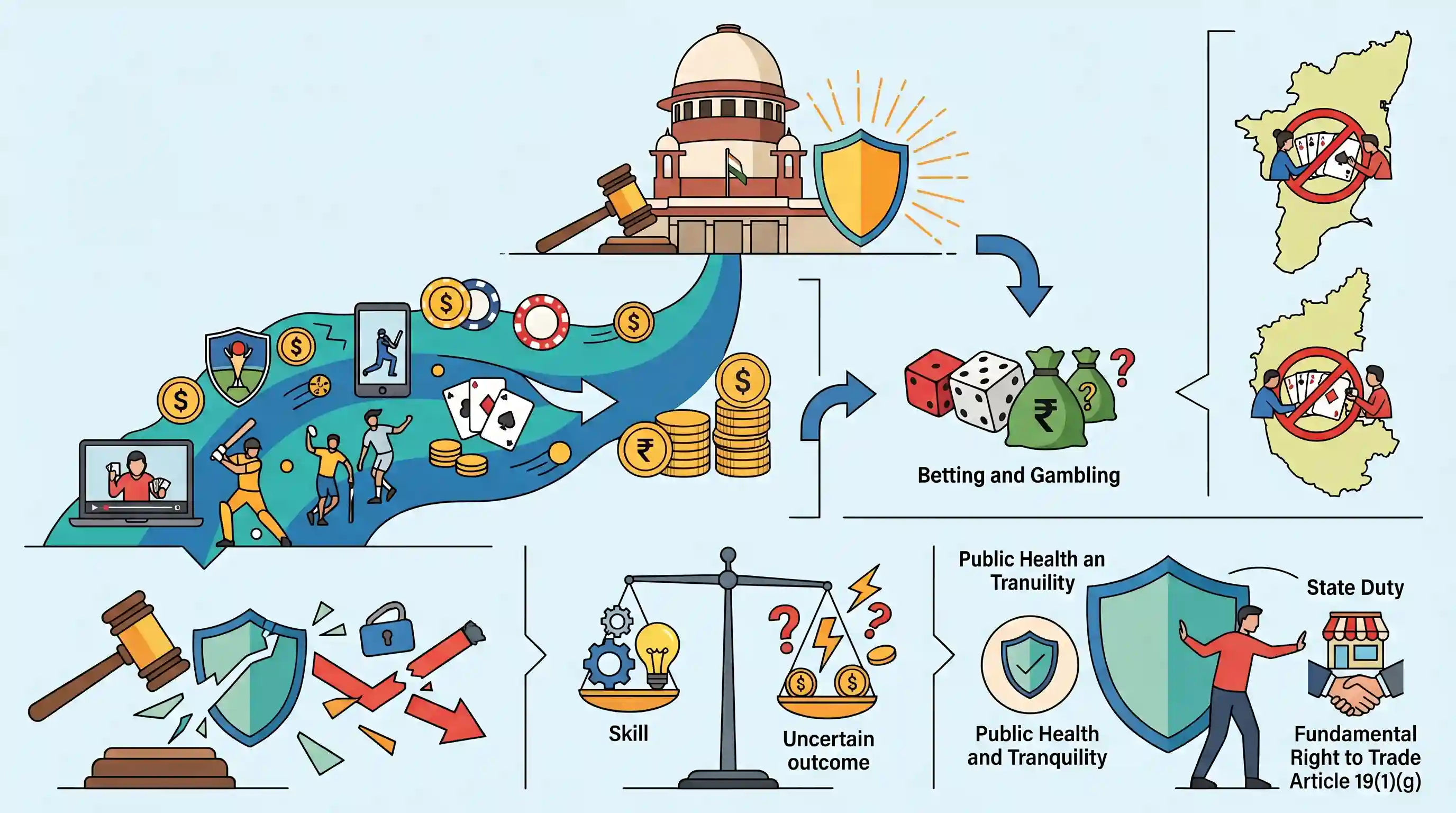
Why It Matters
This landmark judgment settles a protracted legal and economic debate over the taxation of India's booming online gaming sector. It clearly establishes the boundaries between a citizen's right to trade and the State's power to impose reasonable restrictions for public welfare, setting a significant precedent for the regulation and taxation of digital economies.
Summary
The Supreme Court of India has confirmed that organised online gaming activities and fantasy sports involving monetary stakes fall under the Goods and Services Tax (GST) regime, categorised as 'betting and gambling'. A Bench comprising Justices J.B. Pardiwala and R. Mahadevan dismissed challenges from gaming companies, ruling that the presence of skill does not negate the uncertain outcome and monetary risk involved. Furthermore, the Court upheld state laws in Tamil Nadu and Karnataka banning stakes-based online games like rummy and poker, emphasizing that the State's duty to safeguard public health and tranquility overrides the fundamental right to trade under Article 19(1)(g).
Key Points
- The Supreme Court upheld the constitutional validity of levying GST on actionable claims arising from organised online gaming and fantasy sports.
- The Court ruled that despite involving skill, the substantial monetary stakes and uncertain outcomes classify these activities as 'betting and gambling' for GST purposes.
- Challenges claiming infringement of the fundamental right to practice trade or business (Article 19(1)(g)) were dismissed, with the Court prioritising the State's duty to protect public health and prevent financial ruin.
- The Supreme Court set aside High Court decisions that had struck down Tamil Nadu and Karnataka laws banning online games like rummy and poker when played for stakes.
- The Court distinguished online gaming from horse racing, noting that horse racing is heavily regulated by the State, while online gaming operates with a 'veil of invisibility'.
Important Terms
GST Council

Constitutional body (Article 279A) chaired by the Union Finance Minister that makes recommendations on GST rates, exemptions, and administrative rules. It ensures a cooperative federalist approach to indirect taxation.
UPSC context
Paper-II/III: Important for Fiscal Federalism, Constitutional Bodies, and the evolution of India's indirect tax regime.
Article 19(1)(g)
A fundamental right ensuring all citizens have the freedom to practice any profession or carry on any occupation, trade, or business, subject to 'reasonable restrictions' under Article 19(6).
UPSC context
Paper-II: Fundamental Rights. Tests the balance between individual economic liberty and the State's power to impose restrictions for public interest.
Entry 34 of the State List (List II)
Under the Seventh Schedule, Entry 34 gives state legislatures the exclusive power to make laws regarding betting and gambling, reflecting the decentralized control over public morality and order.
UPSC context
Paper-II: Federal Structure and Seventh Schedule. Relevant for understanding the division of legislative powers between Centre and States.
Res Extra Commercium
A legal doctrine meaning 'things outside commerce.' It refers to activities like gambling or intoxicants that are considered socially harmful and thus not protected as fundamental rights under Article 19.
UPSC context
Paper-II: Judiciary and Fundamental Rights. Tests understanding of judicial interpretations that limit the scope of 'trade and business' rights.
Actionable Claim
Defined under the Transfer of Property Act, 1882, it refers to a claim to any debt or beneficial interest in movable property. In GST, certain actionable claims like lottery and betting are taxable.
UPSC context
Paper-III: Taxation. Important for understanding the technical scope of 'supply' and 'goods' under the GST framework.
Retrospective Taxation
A tax law that applies to transactions or income from a period prior to the law's enactment. The SC recently ruled that 2023 GST amendments were 'clarificatory' and thus retrospective.
UPSC context
Paper-III: Indian Economy. Key for discussions on ease of doing business, tax certainty, and the power of the legislature.
Prelims Trap
"Under the CGST Act, all actionable claims are classified under Schedule III and are exempt from the GST regime."
Aspirants forget the exceptions. While Schedule III excludes most actionable claims, lottery, betting, gambling, and online money gaming explicitly attract 28% GST.
Static Concepts Connected
How are 'actionable claims' treated under the GST framework?
- Definition: The CGST Act defines 'goods' to include movable property and actionable claims, while specifically excluding money and securities.
- General Rule: Under Schedule III, most actionable claims are treated as neither goods nor services, keeping them outside the GST net.
- Key Exceptions: Lottery, betting, gambling, horse racing, and online money gaming are explicitly taxed under GST (typically at 28% on face value).
What is the constitutional basis for state laws banning online gaming?
- Entry 34: The subject of 'betting and gambling' falls exclusively under Entry 34 of the State List (List II) of the Seventh Schedule.
- Article 19(1)(g): While citizens have a fundamental right to trade, the State can impose 'reasonable restrictions' to prevent financial ruin and protect public health.
Cross-Topic Patterns
Article 19(1)(g) vs. State Morality
The SC prioritized the State's duty to prevent financial ruin over the fundamental right to trade, drawing parallels to established constitutional jurisprudence on alcohol prohibitions.
Digital Economy vs. State List
Borderless digital platforms face compliance fragmentation as individual states (like TN and Karnataka) leverage Entry 34 to enact localized bans on stakes-based online gaming.

Expect a Prelims multi-statement question mixing GST Schedule III exceptions (actionable claims) with State List powers on gambling.
Linked PYQs · 3
Linked PYQs · 3
- 2018PrelimsGS1
Consider the following items : 1. Cereal grains hulled 2. Chicken eggs cooked 3. Fish processed and canned 4. Newspapers containing advertising material Which of the above items is/are exempted under GST (Goods and Services Tax)?
- 2018PrelimsGS1
With reference to India's decision to levy an equalization tax of 6% on online advertisement services offered by non-resident entities, which of the following statements is/are correct? 1. It is introduced as a part of the Income Tax Act. 2. Non-resident entities that offer advertisement services in India can claim a tax credit in their home country under the "Double Taxation Avoidance Agreements". Select the correct answer using the code given below:
- 2023MainsGS2
“The Constitution of India is a living instrument with capabilities of enormous dynamism. It is a constitution made for a progressive society.” Illustrate with special reference to the expanding horizons of the right to life and personal liberty.
