Supreme Court raises concerns over self declaration caste census
Source:Indian Express ↗
Why It Matters
The ongoing debate over conducting a nationwide caste census and the methodologies of enumeration (such as self-declaration) are critical to India's reservation policies and social justice architecture. Understanding the empirical challenges involved is vital for assessing the implementation and efficacy of affirmative action.
Summary
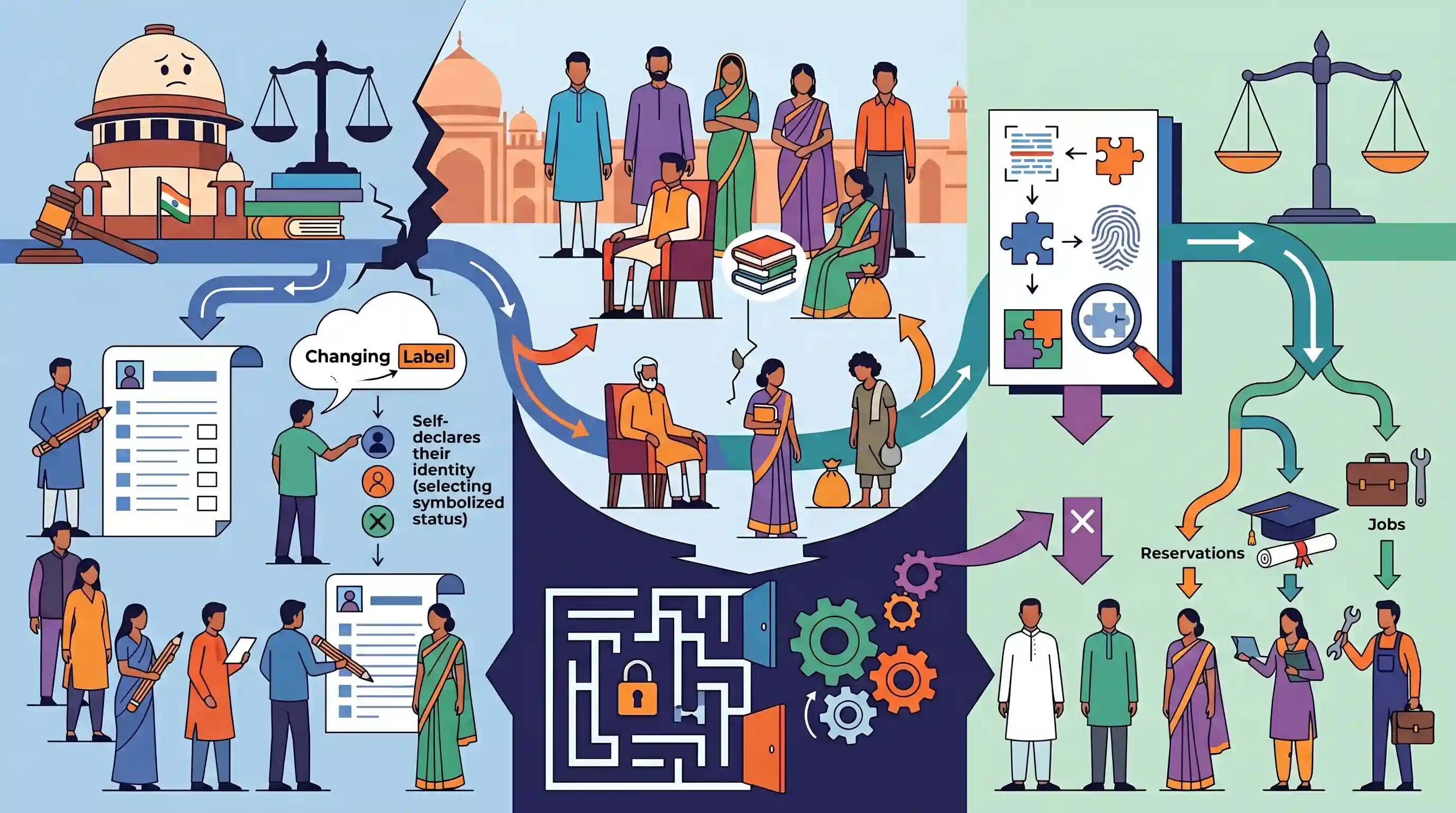
The Supreme Court of India expressed in-principle agreement with concerns surrounding the potential inaccuracy of relying on "self-declaration" for enumerating castes in a census. The Court noted that self-declaration could lead to manipulation of caste identities by individuals seeking to falsely claim a marginalized status to gain socio-economic benefits, such as reservations. The observations highlight the empirical and administrative challenges in conducting a nationwide socio-economic caste census (SECC) and emphasize the need for robust verification mechanisms to preserve the integrity of affirmative action programs.
Key Points
- The Supreme Court acknowledged concerns over the reliability of using 'self-declaration' for caste enumeration in any census.
- Relying solely on self-declaration could lead to the manipulation of caste identities by individuals falsely claiming a marginalized status to access reservation benefits.
- The observations arrive amidst increasing political demands for a nationwide caste census to accurately determine the population of Other Backward Classes (OBCs) and recalibrate affirmative action policies.
- Ensuring data integrity in caste enumeration is critical, as flawed data could compromise the objectives of state welfare schemes and social justice initiatives.
Important Terms
Census Act, 1948

The central legislation providing the legal framework for India's decennial population census. It mandates citizen cooperation and ensures strict confidentiality of individual data, protecting it from disclosure even to courts.
UPSC context
GS Paper II (Governance). Essential for understanding the legal authority behind demographic data used for planning and delimitation.
Socio-Economic Caste Census (SECC)
A survey intended to identify welfare beneficiaries using socio-economic deprivation indicators. Unlike the regular census, it captures detailed caste identities and its data is non-confidential to allow state targeting.
UPSC context
GS Paper II (Social Justice). Crucial for debates on evidence-based policy-making and the accuracy of caste-based population data.
National Commission for Backward Classes (NCBC)
A constitutional body under Article 338B (102nd Amendment) that investigates safeguards and promotes welfare for Socially and Educationally Backward Classes (SEBCs/OBCs).
UPSC context
GS Paper II (Polity). Tests knowledge of constitutional bodies and the evolution of the OBC list (102nd/105th Amendments).
Affirmative Action
Compensatory policies, including reservations, aimed at ensuring representation and socio-economic equity for historically marginalized groups like SCs, STs, and OBCs.
UPSC context
GS Paper II (Social Justice). Core concept for analyzing Articles 15 and 16 and the 'creamy layer' doctrine.
Supreme Court of India
The apex judicial body in India. In the context of the census, it monitors that state data collection methods maintain scientific rigor to ensure the integrity of constitutional benefits.
UPSC context
GS Paper II (Judiciary). Tests the Court's role in overseeing executive processes that impact social justice and fundamental rights.
Prelims Trap
Caste data collected in the SECC 2011 forms the empirical basis for current OBC reservations.
False. SECC 2011 caste data yielded 46 lakh unclassified entries due to open-ended self-declaration. It was never published; OBC quotas still rely on 1931 baseline data.
Static Concepts Connected
How does the decadal Census legally differ from the SECC?
- Statutory backing: The decadal Census is conducted under the statutory backing of the Census Act, 1948. SECC was an executive exercise.
- Data confidentiality: Census Act mandates strict confidentiality; personal data cannot be accessed even by courts. SECC data is open for government departments to identify welfare beneficiaries.
Which constitutional articles govern the identification and welfare of Backward Classes?
- Article 340: Empowers the President to appoint a commission to investigate the conditions of socially and educationally backward classes.
- Article 338B: Inserted via the 102nd Constitutional Amendment, giving constitutional status to the National Commission for Backward Classes (NCBC).
- Articles 15(4) & 16(4): Enable the State to make special provisions, including reservations in education and public employment, for the advancement of SEBCs.
Cross-Topic Patterns
State Surveys vs. Union Census power
Friction between state-led 'caste surveys' and the Union's exclusive constitutional domain over the 'Census' (Entry 69, Union List) creates a recurrent federalism dispute.
Empirical Data and the 50% Quota Ceiling
Demands for a caste census are legally intertwined with attempts to breach the Indra Sawhney 50% quota ceiling, as courts demand quantifiable data to justify reservation expansions.

Caste census debates make a 2026 Prelims question on the legal differences between the Census Act 1948 and SECC highly probable.
Linked PYQs · 3
Linked PYQs · 3
- 2022MainsGS2
Discuss the role of the National Commission for Backward Classes in the wake of its transformation from a statutory body to a constitutional body.
- 2018MainsGS1
Caste system is assuming new identities and associational forms. Hence, caste system cannot be eradicated in India." Comment.
- 2022MainsGS1
Analyse the salience of 'sect' in Indian society vis-a-vis caste, region and religion.
