Judicial Scrutiny on Self Declaration for Caste Census
Source:Indian Express ↗
Why It Matters
Understanding the complexities of demographic enumeration is vital for UPSC aspirants, as caste census data directly impacts reservation policies, welfare targeting, and constitutional mandates for social justice (GS Paper 1 and 2). The Supreme Court's scrutiny highlights the governance challenge of balancing empirical data collection with sociological realities.
Summary
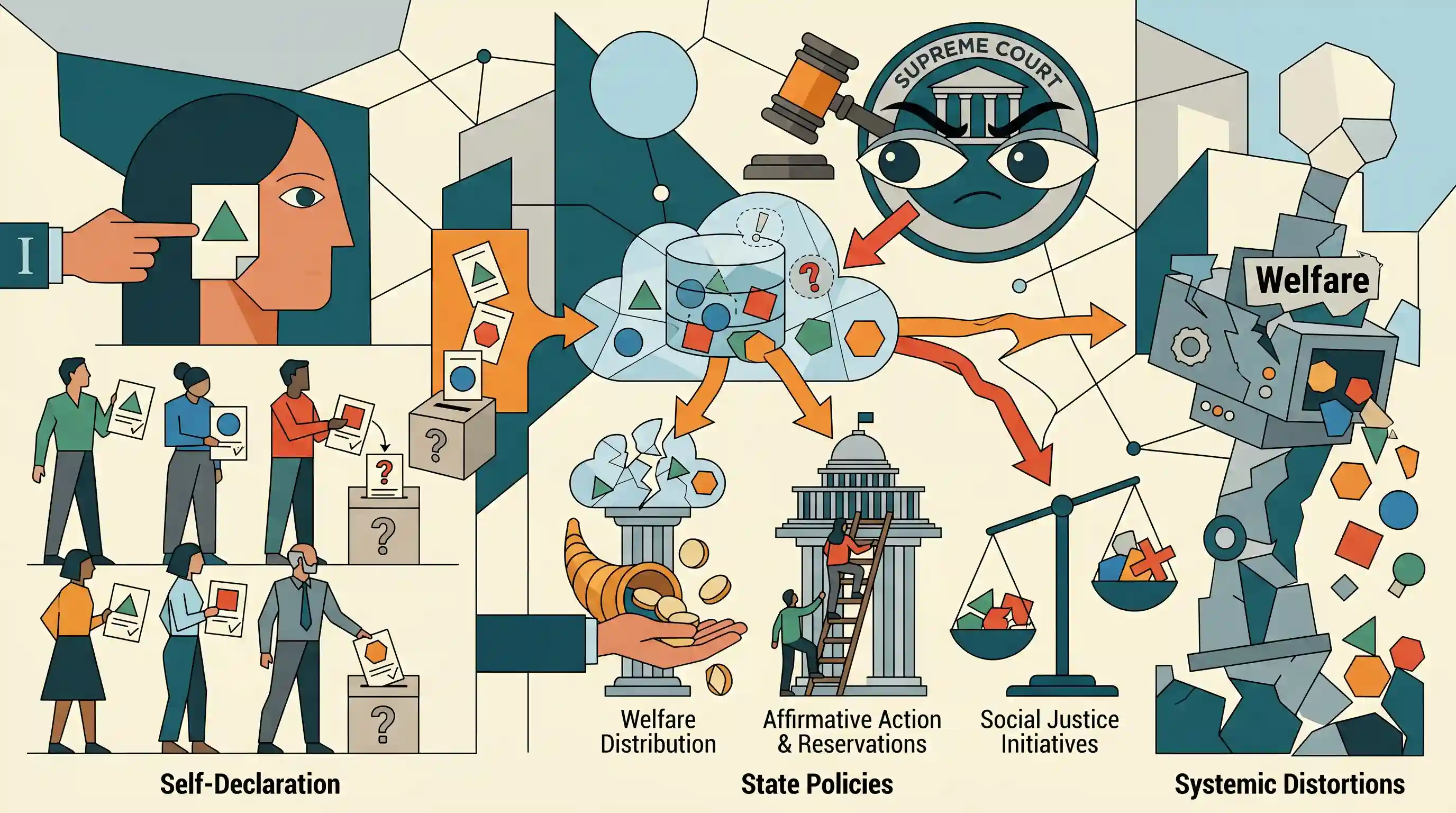
The Supreme Court has acknowledged valid concerns over using a purely self-declaration-based approach for caste enumeration in census exercises. The Court noted that relying entirely on self-identification without independent verification could compromise the accuracy of the demographic data. Given that such data directly informs state policies on affirmative action, reservations, and welfare distribution, inaccurate enumeration could lead to systemic distortions in social justice initiatives.
Key Points
- The Supreme Court of India agreed in principle with concerns regarding the sole reliance on self-declaration for determining caste identity during a census.
- Self-declaration of caste without adequate verification mechanisms may lead to inaccurate data, manipulation, or inflated numbers for certain communities.
- The integrity of caste data is essential, as this demographic information forms the foundational basis for affirmative action, reservation quotas, and targeted social welfare schemes.
- The observation adds a methodological dimension to the ongoing socio-political demand for a comprehensive nationwide caste census.
Important Terms
Socio-Economic Caste Census (SECC)

A 2011 survey identifying households' socio-economic status and caste identities. Unlike the regular Census, its data is not confidential and is used to target beneficiaries for various welfare schemes and identify social deprivation.
UPSC context
GS Paper II: Governance & Social Justice; tests understanding of data-driven policy-making and the distinction between the decennial Census and SECC.
Census Act, 1948
The 1948 legislation providing the legal framework for conducting the decennial Census. It mandates data confidentiality and empowers the Central Government to notify the census schedule and questionnaire.
UPSC context
GS Paper II: Polity & Governance; essential for questions on the statutory basis of demographic enumeration and privacy vs. administrative data.
Affirmative Action
Policies, such as reservations in education and employment, designed to address historical discrimination and social inequality faced by marginalized groups like SCs, STs, and OBCs (Articles 15 and 16).
UPSC context
GS Paper II: Social Justice; core theme regarding constitutional provisions for uplifting backward classes and the role of data in reservations.
Social Justice
A constitutional objective (Preamble) ensuring the equitable distribution of resources and opportunities. It involves protecting the rights of marginalized sections to achieve a balanced and inclusive social order.
UPSC context
GS Paper II: Polity/Social Justice; foundational concept for evaluating welfare schemes and the judiciary’s role in protecting marginalized groups.
Public Interest Litigation (PIL)
A legal tool allowing any citizen to file a case in the Supreme Court or High Courts to seek legal remedy for public interest or group grievances.
UPSC context
GS Paper II: Judiciary; tests knowledge of judicial activism and how individual citizens can influence national policies like the Census.
Registrar General and Census Commissioner of India
The authority under the Ministry of Home Affairs responsible for conducting the decennial Census and managing vital statistics like births and deaths across the country.
UPSC context
GS Paper II: Governance; relevant for understanding the executive machinery behind national data collection and the Census Act's administration.
Prelims Trap
"The Socio-Economic and Caste Census (SECC) of 2011 was conducted under the statutory provisions of the Census Act, 1948."
SECC 2011 was an administrative exercise conducted by the Ministries of Rural Development and MoHUA. It was explicitly kept outside the statutory framework of the Census Act, 1948.
Static Concepts Connected
How does the SECC 2011 fundamentally differ from the regular Decennial Census?
- Statutory backing: The decennial Census is conducted under the Census Act, 1948. The SECC was an administrative exercise without this explicit statutory backing.
- Data confidentiality: Under Section 15 of the Census Act, individual data is strictly confidential. SECC data is deliberately open for state departments to identify welfare beneficiaries.
- Scope of enumeration: Since 1951, the regular Census only enumerates SCs and STs. SECC 2011 attempted to enumerate all castes, tribes, and religions, alongside socio-economic indicators.
What is the constitutional and judicial basis for requiring "quantifiable data" on caste?
- Constitutional mandate: Article 16(4) allows the state to provide reservations if a backward class is "not adequately represented," inherently requiring data to prove inadequacy.
- Judicial precedent: In Indra Sawhney (1992) and later M. Nagaraj (2006), the SC mandated the state to show "quantifiable data" demonstrating backwardness and inadequate representation to legally justify quotas.
Cross-Topic Patterns
State surveys vs. Union List
States like Bihar conduct caste "surveys" via executive orders because the "Census" is strictly a Union List subject (Entry 69), highlighting a recurring federalism and constitutional loophole.
SC sub-categorization requires empirical data
The Supreme Court's recent landmark verdict allowing sub-categorization within Scheduled Castes legally necessitates granular, verified caste data to prevent arbitrary redistribution of quotas.

Expect a 2026 Prelims question contrasting the Census Act 1948 (Union List, strict confidentiality) with SECC (administrative, open data).
Linked PYQs · 3
Linked PYQs · 3
- 2018MainsGS1
Caste system is assuming new identities and associational forms. Hence, caste system cannot be eradicated in India." Comment.
- 2023MainsGS1
Why is caste identity in India both fluid and static?
- 2023MainsGS2
“Development and welfare schemes for the vulnerable, by its nature, are discriminatory in approach.” Do you agree? Give reasons for your answer.
