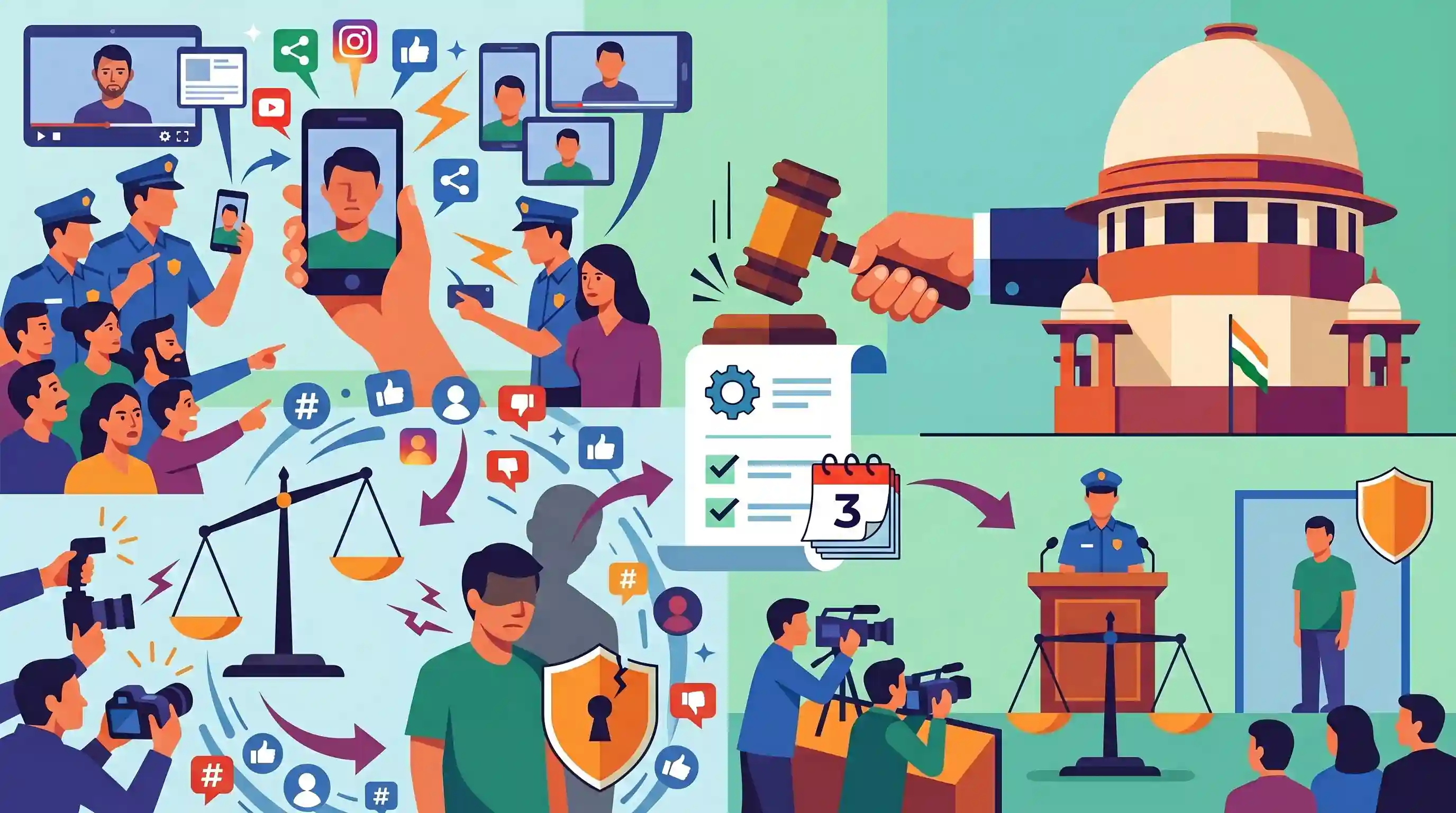
Supreme Court Ruling on Police Media Trials and Fair Trial
Source:The Hindu ↗
Why It Matters
This judgment highlights the tension between law enforcement optics and the fundamental constitutional rights of the accused. It is highly relevant for GS2 (Fundamental Rights, Judiciary, Governance) and GS4 (Police ethics, Code of conduct, Ethical issues in digital communication).
Summary
The Supreme Court of India has sharply criticized the practice of police personnel uploading videos and images of accused persons on social media, observing that it directly threatens the right to a fair trial and violates the dignity and privacy of individuals guaranteed under Article 21. Emphasizing the harm of 'media trials' and the unchecked power of atomised social media platforms, the Court noted that such actions by law enforcement create public bias before the law takes its course. Consequently, the SC has ordered all States and Union Territories to implement strict Standard Operating Procedures (SOPs) regulating police media briefings within a three-month deadline.
Key Points
- The Supreme Court expressed severe concern over police personnel uploading videos and images of accused individuals on social media, emphasizing it violates their dignity and right to a fair trial.
- Such practices trigger unwarranted 'media trials' and foster public bias, severely compromising the judicial process and violating Article 21 of the Constitution.
- The Court highlighted the dangers posed by atomised social media and individuals masquerading as journalists who often extort and act as blackmailers.
- The Supreme Court directed all States and Union Territories to frame and finalize Standard Operating Procedures (SOPs) for police media briefings within three months to regulate such conduct.
Important Terms
Article 21 of the Indian Constitution

A fundamental right protecting life and personal liberty. In this context, it encompasses the right to a fair trial, personal dignity, and privacy against arbitrary state actions.
UPSC context
GS-II: Fundamental Rights. Tests understanding of how "liberty" expands to include dignity and protection from media-led prejudice.
Media Trial
Prejudicial news coverage that creates a public perception of guilt or innocence before a judicial verdict, often undermining the legal principle of 'presumption of innocence.'
UPSC context
GS-II: Role of Media/Judiciary. Tests the balance between Freedom of Speech (Art 19) and Fair Trial (Art 21).
Right to a Fair Trial
A core component of natural justice ensuring the accused is tried by an impartial court based on evidence, free from external bias or public pressure.
UPSC context
GS-II: Judiciary. Central to the criminal justice system and the protection of civil liberties against executive overreach.
Standard Operating Procedure (SOP) for Police Briefings
A mandatory manual ordered by the Supreme Court to regulate police-media interactions, replacing individual discretion with institutional discipline based on legality, necessity, and proportionality.
UPSC context
GS-II: Governance/Administrative Reforms. Relevant for questions on police reforms and the execution of judicial directions.
Police Accountability
The obligation of law enforcement to remain answerable for their actions, particularly regarding the use of social media and the protection of an accused's constitutional rights.
UPSC context
GS-II: Governance & GS-III: Internal Security. Crucial for understanding the rule of law and democratic policing.
Right to Privacy
An intrinsic part of Article 21 (upheld in the Puttaswamy judgment) that protects individuals from the unauthorized public disclosure of their private images or identities by state agencies.
UPSC context
GS-II: Constitution. Often tested in the context of emerging digital challenges and state surveillance/conduct.
Prelims Trap
The Right to a fair trial is explicitly mentioned as a Fundamental Right under Article 21.
The right to a fair trial is an *implicit* right deduced by the judiciary under Article 21, not explicitly written anywhere in the constitutional text.
Static Concepts Connected
How does the Constitution protect an accused from media trials?
- Article 21: Guarantees implicit rights to a fair trial, dignity, and privacy (Puttaswamy judgment), which protect the presumption of innocence.
- Article 19(2): Allows reasonable restrictions on the freedom of speech and press on the grounds of 'Contempt of Court'.
What are the core Prakash Singh (2006) directives for police reform?
- Separation of roles: Mandates dividing police functions into investigation and law & order to ensure objective, uncompromised probes.
- Complaints Authority: Requires setting up Police Complaints Authorities at state and district levels to investigate police misconduct and abuses.
Cross-Topic Patterns
Civil service anonymity vs Digital Clout
The pursuit of social media clout by law enforcement contradicts the foundational GS4 values of civil service anonymity, objectivity, and institutional integrity.
Criminal Contempt vs Article 19
Parallel media trials by police prejudice pending judicial proceedings, creating grounds for criminal contempt of court and clashing with Article 19(1)(a).

Expect a GS2 Mains question assessing how premature police media briefings and 'media trials' violate the right to a fair trial.
Linked PYQs · 5
Linked PYQs · 5
- 2024MainsGS2
Right to privacy is intrinsic to life and personal liberty and is inherently protected under Article 21 of the constitution. Explain. In this reference discuss the law relating to D.N.A. testing of child in the womb to establish its paternity.
- 2017MainsGS2
Examine the scope of Fundamental Rights in the light of the latest judgement of the Supreme Court on Right to Privacy.
- 2025MainsGS4
In the present digital age, social media has revolutionised our way of communication and interaction. However, it has raised several ethical issues and challenges. Describe the key ethical dilemmas in this regard.
- 2018MainsGS4
Distinguish between "Code of ethics" and "Code of conduct" with suitable examples.
- 2024MainsGS4
“The 'Code of Conduct' and 'Code of Ethics' are the sources of guidance in public administration. There is code of conduct already in operation, whereas code of ethics is not yet put in place. Suggest a suitable model for code of ethics to maintain integrity, probity and transparency in governance.”
