Supreme Court Collegium recommendations for High Court Chief Justices
Source:The Hindu ↗
Why It Matters
Understanding the functioning of the Supreme Court Collegium is crucial for UPSC aspirants, as it frequently forms the basis for questions regarding judicial independence, transparency in appointments, and the balance of power between the executive and judiciary (Article 124 and 217).
Summary
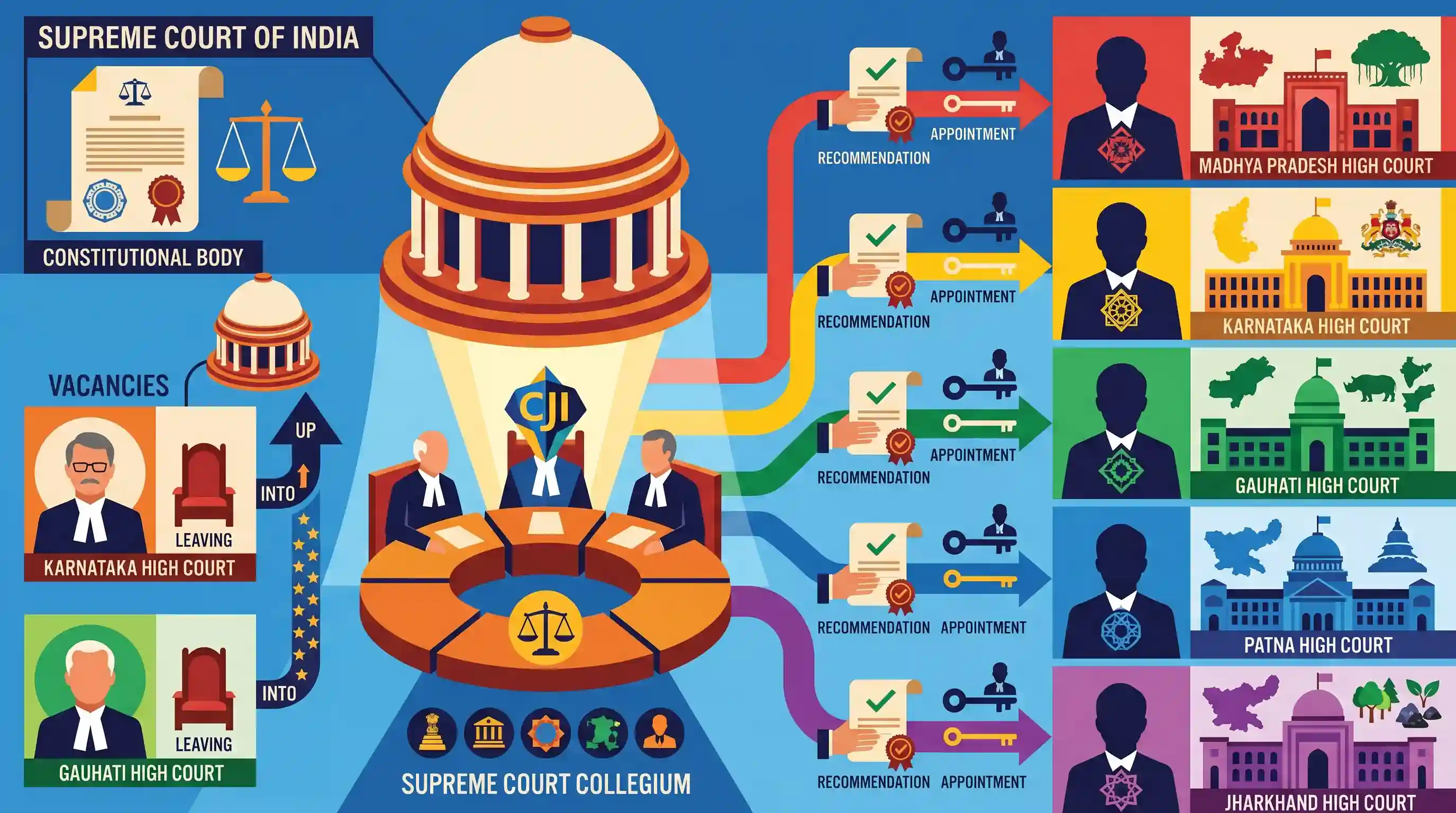
The Supreme Court Collegium, led by Chief Justice of India B.R. Gavai, has recommended the appointment of new Chief Justices for the High Courts of Madhya Pradesh, Karnataka, Gauhati, Patna, and Jharkhand. The recommended judges are Justice Sanjeev Sachdeva, Justice Vibhu Bakhru, Justice Ashutosh Kumar, Justice Vipul Manubhai Pancholi, and Justice Tarlok Singh Chauhan. These vacancies partially arose after the Collegium recommended elevating the current Chief Justices of the Karnataka and Gauhati High Courts to the Supreme Court.
Key Points
- The Supreme Court Collegium, headed by CJI B.R. Gavai, recommended five judges as Chief Justices for the High Courts of Madhya Pradesh, Karnataka, Gauhati, Patna, and Jharkhand.
- Justices Sanjeev Sachdeva, Vibhu Bakhru, Ashutosh Kumar, Vipul Manubhai Pancholi, and Tarlok Singh Chauhan were recommended for elevation as Chief Justices.
- The recommendations followed the proposed elevation of Karnataka HC CJ N.V. Anjaria and Gauhati HC CJ Vijay Bishnoi to the Supreme Court.
- The process highlights the functioning of the Supreme Court Collegium in overseeing appointments and transfers across the higher judiciary in India.
Important Terms
Supreme Court Collegium

A system evolved through Supreme Court judgments (not found in the Constitution) where a committee of senior judges recommends the appointment and transfer of judges to the higher judiciary.
UPSC context
GS Paper II: Judiciary. Key for understanding the 'Independence of Judiciary' and the separation of powers between the Executive and Judiciary.
Article 217
The constitutional provision governing the appointment of High Court judges by the President, involving consultation with the Chief Justice of India and the Governor of the State.
UPSC context
GS Paper II: Constitutional Provisions. Tests knowledge of the specific legal procedure and authorities involved in appointing state-level higher judiciary.
Three Judges Cases
A series of landmark judicial rulings (1981, 1993, 1998) that established judicial primacy in appointments by interpreting 'consultation' as 'concurrence' with the CJI's opinion.
UPSC context
GS Paper II: Judiciary. Essential historical context for how the current appointment system replaced executive-led processes.
Gauhati High Court
A High Court with a unique multi-state jurisdiction, currently serving Assam, Nagaland, Mizoram, and Arunachal Pradesh, making it geographically one of India's largest judicial divisions.
UPSC context
GS Paper II: Federalism & Judiciary. Important for questions on 'Common High Courts' (Article 231) and North-East administrative structure.
Memorandum of Procedure (MoP)
The administrative agreement between the Judiciary and the Government that outlines the specific steps and criteria for implementing the Collegium's recommendations for judicial appointments.
UPSC context
GS Paper II: Governance/Judiciary. Relevant for discussions on judicial reforms, transparency, and the ongoing friction between the Law Ministry and Collegium.
Chief Justice of India (CJI)
The head of the Indian federal judiciary and the Supreme Court, responsible for leading the Collegium and allocating cases as the 'master of the roster.'
UPSC context
GS Paper II: Executive & Judiciary. Tests understanding of the CJI's administrative vs. judicial powers and their role in constitutional appointments.
Prelims Trap
The Collegium for appointing High Court Chief Justices comprises the CJI and four senior-most Supreme Court judges.
For High Court appointments and transfers, the Collegium consists of the CJI and only TWO senior-most judges. The CJI+4 formula is for Supreme Court appointments.
Static Concepts Connected
What is the procedure to appoint a High Court Chief Justice?
- Article 217: Appointed by the President after consulting the Chief Justice of India and the concerned State's Governor.
- HC Collegium: The proposal is initiated by the CJI, backed by a Collegium of the CJI and two senior-most SC judges.
- Outside State Convention: By convention and policy, the Chief Justice of a High Court is typically appointed from outside their parent state to ensure impartiality.
What happens if the Government disagrees with a Collegium recommendation?
- Reconsideration: The Executive can return a recommendation to the Collegium for reconsideration, citing specific intelligence or objections.
- Binding Reiteration: If the Collegium unanimously reiterates the name, the government is constitutionally bound to accept it and issue the appointment warrant.
- No Time Limit: A major point of friction is that neither the Constitution nor the MoP prescribes a fixed time limit for the government to clear files.
Cross-Topic Patterns
Judicial Vacancies & Case Pendency
Delays in finalizing Collegium recommendations by the executive often exacerbate the mounting backlog of cases, a persistent theme in GS2 governance and justice delivery.
NJAC vs Collegium Debate
Every major appointment cycle revitalizes the GS2 debate on judicial accountability versus independence, often referencing the struck-down 99th Constitutional Amendment (NJAC).

Expect a Prelims trap mixing Art 217 (Governor's consultative role) with the MoP rules or the CJI+2 composition for HC appointments.
Linked PYQs · 3
Linked PYQs · 3
- 2025MainsGS2
Discuss the evolution of collegium system in India. Critically examine the advantages and disadvantages of the system of appointment of the Judges of the Supreme Court of India and that of the USA.
- 2017MainsGS2
Critically examine the Supreme Court's judgement on 'National Judicial Appointments Commission Act, 2014' with reference to appointment of judges of higher judiciary in India.
- 2012PrelimsGS1
What is the provision to safeguard the autonomy of the Supreme Court of India? 1. While appointing the Supreme Court Judges, the President of India has to consult the Chief Justice of India. 2. The Supreme Court Judges can be removed by the Chief Justice of India only. 3. The salaries of the Judges are charged on the Consolidated Fund of India to which the legislature does not have to vote. 4. All appointments of officers and staffs of the Supreme Court of India are made by the Government only after consulting the Chief Justice of India. Which of the statements given above is/are correct?
