Supreme Court Collegium recommends new Chief Justices for High Courts
Source:The Hindu ↗
Why It Matters
The Collegium system and the appointment of judges to High Courts (under Article 217) are core constitutional topics frequently tested in civil services exams. For BPSC specifically, the appointment of the Chief Justice of the Patna High Court is a highly probable current affairs question.
Summary
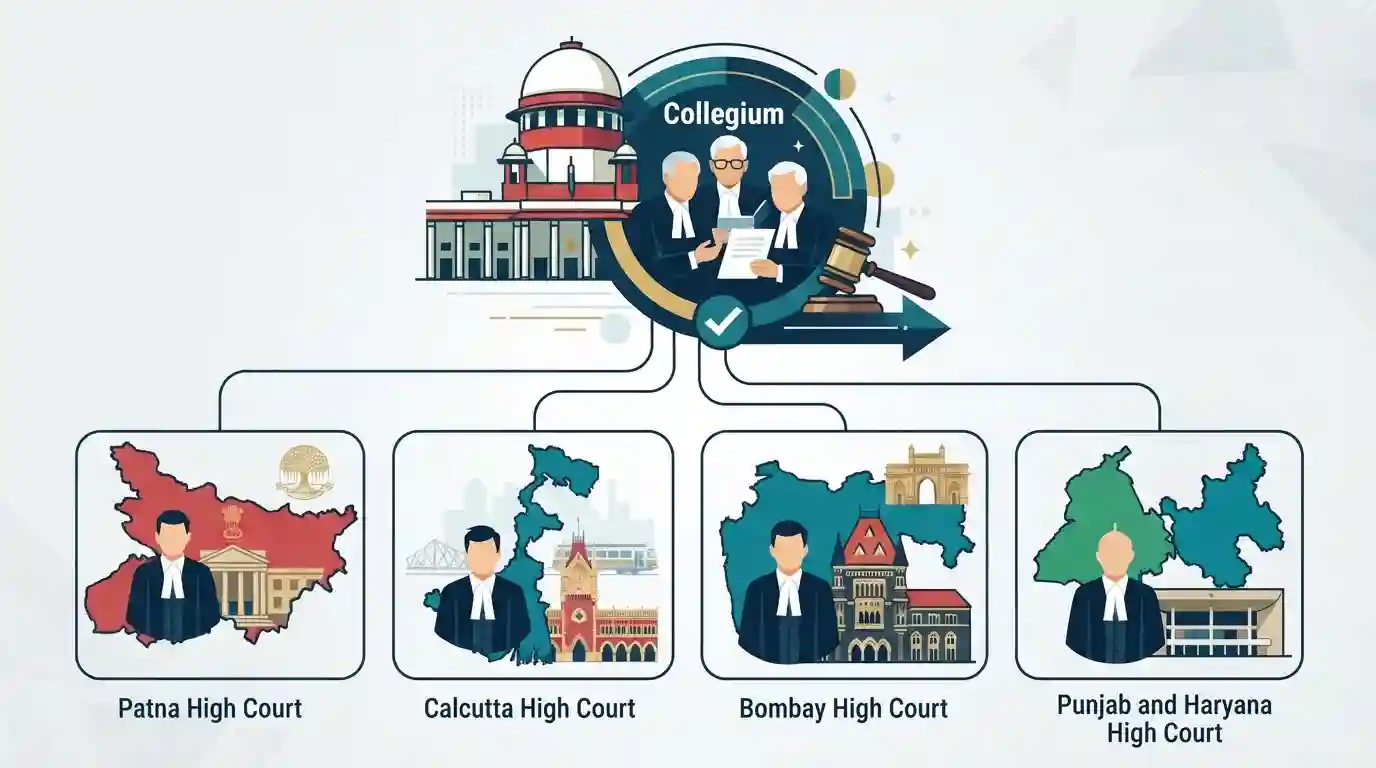
The Supreme Court Collegium, led by Chief Justice of India Surya Kant, has recommended the appointment of new Chief Justices for four High Courts. Notably, Justice V. Kameswar Rao has been recommended to head the Patna High Court, a development of direct relevance to Bihar. Additionally, Justices Ravindra V. Ghuge, Mahesh Chandra Tripathi, and Ashwani Kumar Mishra have been recommended for the High Courts of Calcutta, Bombay, and Punjab and Haryana, respectively.
Key Points
- The Supreme Court Collegium, headed by CJI Surya Kant, recommended the elevation of four judges as Chief Justices of different High Courts.
- Justice V. Kameswar Rao has been recommended for appointment as the Chief Justice of the Patna High Court.
- Justice Ravindra V. Ghuge has been recommended for the Calcutta High Court.
- Justice Mahesh Chandra Tripathi and Justice Ashwani Kumar Mishra have been recommended for the Bombay and Punjab and Haryana High Courts, respectively.
- The recommendations underscore the continued operational role of the Supreme Court Collegium in judicial appointments and transfers across constitutional courts.
Important Terms
Supreme Court Collegium

A mechanism involving the Chief Justice of India and senior judges that recommends the appointment and transfer of higher judiciary judges, evolved through judicial pronouncements rather than the Constitution.
UPSC context
Essential for GS Paper II (Polity). Tests understanding of judicial appointments, judicial independence, and executive-judiciary relations.
Patna High Court
The High Court of Bihar, established in 1916. It plays a pivotal role in the state's judicial administration and is a key constitutional institution for Bihar-specific legal matters.
UPSC context
Relevant for GS Paper II (Polity and Governance) and state-specific Public Service Commission exams (BPSC).
Calcutta High Court
Established in 1862, it is the oldest High Court in India, with territorial jurisdiction over West Bengal and the Andaman and Nicobar Islands.
UPSC context
Important for GS Paper II (Polity) concerning the history of the Indian judiciary, constitutional development, and High Court jurisdictions.
Bombay High Court
One of India's oldest High Courts, established in 1862. It has appellate jurisdiction over Maharashtra, Goa, Daman and Diu, and Dadra and Nagar Haveli.
UPSC context
Key for GS Paper II (Polity) regarding the structure of the judiciary and territorial jurisdictions extending to Union Territories.
Punjab and Haryana High Court
The common High Court for the states of Punjab and Haryana, and the Union Territory of Chandigarh, located in Chandigarh.
UPSC context
Relevant for GS Paper II (Polity) as an example of a common High Court for multiple states and a Union Territory.
Prelims Trap
The number of judges in a High Court is determined by the Parliament, just like the Supreme Court.
Article 216 states the President determines the number of judges in a High Court based on workload, whereas Parliament explicitly holds this power for the Supreme Court.
Static Concepts Connected
How does the SC Collegium composition differ for Supreme Court versus High Court appointments?
- SC Appointments: It comprises the Chief Justice of India and the four senior-most judges of the Supreme Court.
- HC Appointments: It comprises the Chief Justice of India and the two senior-most judges of the Supreme Court.
- Judicial Evolution: The system is not in the Constitution; it evolved from judicial interpretations of 'consultation' in the Three Judges Cases (1981, 1993, 1998).
What are the core constitutional provisions for the appointment and oath of High Court Judges?
- Article 217: Appointed by the President by warrant under his hand and seal after consulting the CJI and the State Governor.
- Article 219: Before taking office, a High Court Judge must make and subscribe an oath or affirmation before the Governor of the state, not the President.
- Article 218: A High Court Judge resigns by writing to the President and is removed in the same manner as a Supreme Court Judge.
Cross-Topic Patterns
MoP delays and judicial vacancies
Delays in notifying Collegium recommendations frequently spark debates around the Memorandum of Procedure (MoP) and the Executive's de facto pocket-veto power over judicial appointments.
Collegium opacity vs NJAC debate
The Collegium's continued opacity is heavily scrutinized against the backdrop of the struck-down 99th Amendment (NJAC), highlighting the ongoing tussle over judicial independence versus executive participation.

Expect a 2026 Prelims question contrasting the exact roles of the President and Governor in High Court appointments, transfers, and oaths.
Linked PYQs · 3
Linked PYQs · 3
- 2023BPSC_PRELIMSGS1
Consider the following statements about the collegium system: 1. The Supreme Court collegium is a five-member body, which is headed by the incumbent Chief Justice of India (CJI) and comprises four other seniormost Judges of the Court at that time. 2. The Parliament by law has evolved the collegium system. 3. The Judges of the Supreme Court and High Courts are appointed only through the collegium system. 4. The collegium system was introduced in the year 1993 by Justice P. N. Bhagwati in the landmark First Judges Case.
- 2023BPSC_PRELIMSGS1
The authority to determine the number of Judges in a High Court rests with which of the following entities?
- 2019BPSC_PRELIMSGS1
Who was the Chief Justice of the Patna High Court who administered the oath of office to Mr. Fagu Chauhan as the Governor of Bihar in July 2019?
