Collegium recommends retired judges to clear high court backlog
Source:Indian Express ↗
Why It Matters
Understanding the appointment of ad-hoc judges under Article 224A is crucial for the UPSC Polity syllabus, as it highlights both a specific constitutional mechanism and the broader, systemic issue of judicial pendency and vacancies in Indian High Courts.
Summary
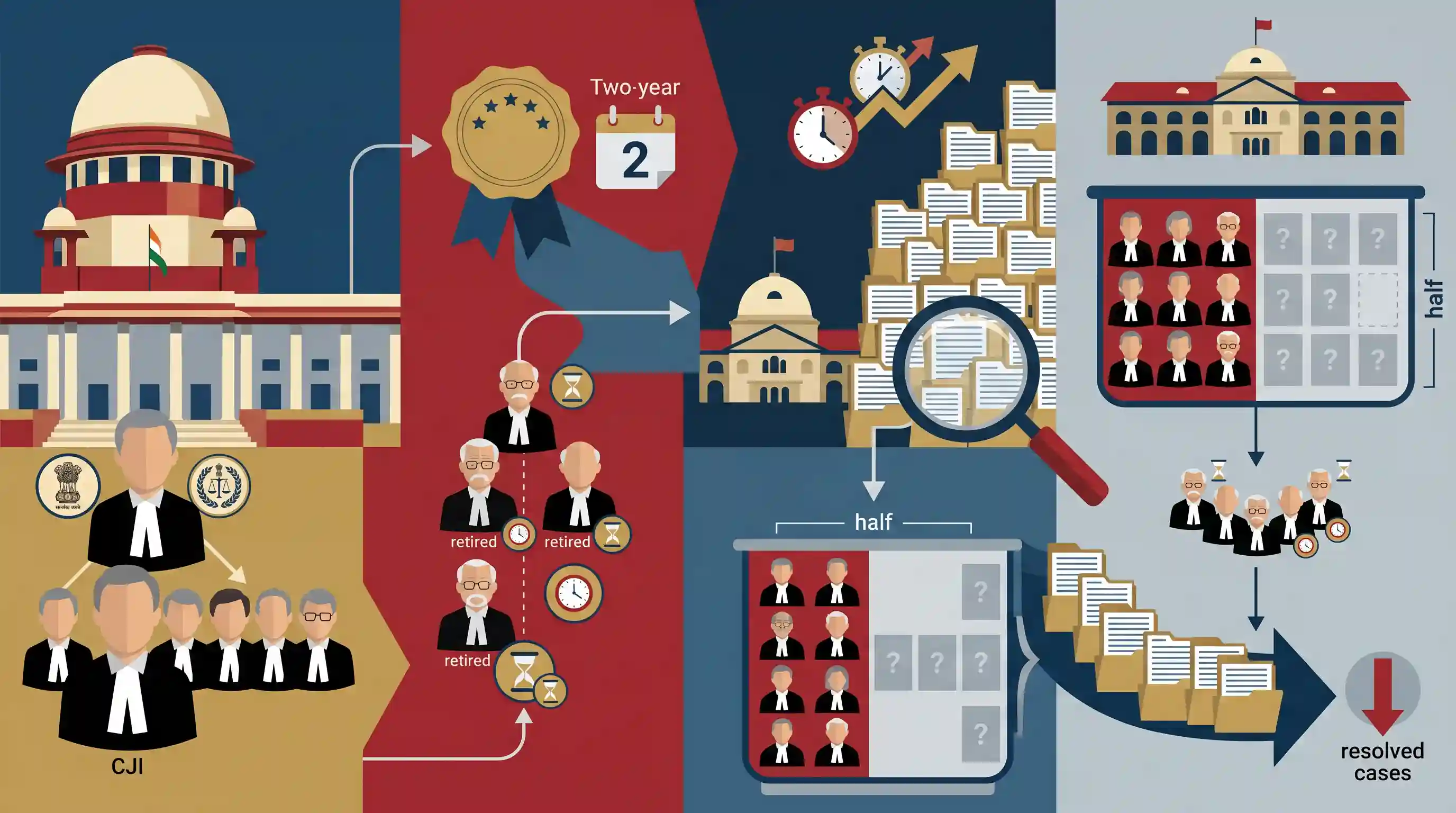
The Supreme Court Collegium, led by Chief Justice of India D Y Chandrachud, has approved the appointment of five retired judges as ad-hoc judges to the Allahabad High Court for a two-year term. This decision invokes Article 224A of the Constitution, a provision designed to help manage severe judicial backlogs. The Allahabad High Court currently faces a massive pendency of cases, exacerbated by the fact that nearly half of its sanctioned judicial strength of 160 judges remains vacant. This move underscores the ongoing challenges of judicial vacancies in India and the mechanisms available to the judiciary to mitigate them.
Key Points
- The Supreme Court Collegium has cleared the appointment of five former judges as ad-hoc judges for the Allahabad High Court to address case pendency.
- The appointments were made under Article 224A of the Constitution, which allows the Chief Justice of a High Court, with the President's prior consent, to appoint retired judges.
- The Allahabad High Court is currently operating with significant vacancies, having nearly half of its sanctioned strength of 160 judges vacant.
- The collegium, headed by Chief Justice of India D Y Chandrachud, recommended these judges for a tenure of two years to specifically tackle the backlog of cases.
Important Terms
Article 224A of the Indian Constitution

A constitutional provision allowing the Chief Justice of a High Court, with the President's and retired judge's consent, to appoint retired judges as ad-hoc judges to manage backlogs.
UPSC context
GS Paper II (Judiciary); tests knowledge of extraordinary constitutional provisions for addressing judicial delays and vacancies.
Supreme Court Collegium
A system of senior judges (CJI and four senior-most judges) that recommends judicial appointments and transfers, evolved through the 'Three Judges Cases' rather than the Constitution.
UPSC context
GS Paper II (Judiciary); fundamental to understanding judicial independence, appointment procedures, and the separation of powers.
Ad-hoc Judges
Temporary judges appointed to a court for a specific duration or purpose, such as clearing chronic backlogs; under Article 224A, these are retired High Court judges.
UPSC context
GS Paper II (Judiciary); relevant for questions on temporary judicial measures and mechanisms to optimize judicial manpower.
Judicial Pendency
The state of being unresolved or 'hanging' for a long period; in the Indian judiciary, it refers to the massive backlog of over 5 crore cases.
UPSC context
GS Paper II (Social Justice/Polity); tests understanding of systemic hurdles to the Right to Speedy Trial under Article 21.
Allahabad High Court
The High Court of Uttar Pradesh; it is the largest in India by sanctioned strength (160) and faces the highest volume of pending cases.
UPSC context
GS Paper II/Mains; serves as a critical case study for discussing regional judicial vacancies and pendency issues.
Prelims Trap
Ad-hoc judges of High Courts are appointed directly by the President and are deemed permanent judges.
Under Article 224A, they are appointed by the Chief Justice of the High Court (with the President's prior consent) and are explicitly NOT deemed to be regular judges of that Court.
Static Concepts Connected
What are the constitutional conditions for appointing ad-hoc judges to High Courts?
- Appointing Authority: The Chief Justice of a High Court requests a retired High Court judge to sit and act as a judge of that Court.
- Dual Consent: The appointment mandatorily requires both the prior consent of the President and the personal consent of the retired judge.
- Legal Status: They enjoy all jurisdiction, powers, and privileges of a judge but are explicitly not deemed to be regular judges of that High Court.
How do Additional Judges differ from Ad-hoc Judges in High Courts?
- Purpose & Article: Additional judges (Art 224) are appointed for temporary business increases. Ad-hoc judges (Art 224A) are retired judges recalled to clear massive case pendency.
- Appointment Method: Additional judges are appointed directly by the President. Ad-hoc judges are appointed by the HC Chief Justice (with Presidential consent).
- Age Constraints: Additional judges cannot hold office beyond 62 years of age. Ad-hoc judges are already retired, thus operating beyond this standard age limit.
Cross-Topic Patterns
Judicial Pendency & Contract Enforcement
High judicial vacancy rates directly impact India's Ease of Doing Business, specifically the 'enforcing contracts' parameter often highlighted in the Economic Survey as a structural bottleneck to investment.
Expanding scope of the Collegium
The Lok Prahari (2021) judgment mandated Collegium approval for Article 224A appointments, demonstrating the Supreme Court's expanding administrative footprint over mechanisms originally designed as executive-High Court prerogatives.

Expect a multi-statement prelims question contrasting Articles 224 (Additional) and 224A (Ad-hoc) judges on appointing authority & status.
Linked PYQs · 3
Linked PYQs · 3
- 2025MainsGS2
Discuss the evolution of collegium system in India. Critically examine the advantages and disadvantages of the system of appointment of the Judges of the Supreme Court of India and that of the USA.
- 2017MainsGS2
Critically examine the Supreme Court's judgement on 'National Judicial Appointments Commission Act, 2014' with reference to appointment of judges of higher judiciary in India.
- 2021PrelimsGS1
With reference to Indian judiciary, consider the following statements : 1. Any retired judge of the Supreme Court of India can be called back to sit and act as a Supreme Court judge by the Chief Justice of India with prior permission of the President of India. 2. A High Court in India has the power to review its own judgement as the Supreme Court does. Which of the statements given above is/are correct?
