Judicial Federalism Protects High Court Collegium Appointment Autonomy
Source:The Hindu ↗
Why It Matters
The article provides crucial insights into the functional dynamics and federal relationship within the higher judiciary's appointment process (the Collegium system). Understanding the operational boundaries between the Supreme Court and High Courts is essential for answering GS2 Polity questions on judicial independence, federalism, and the structural challenges (like vacancies) facing the Indian justice system.
Summary
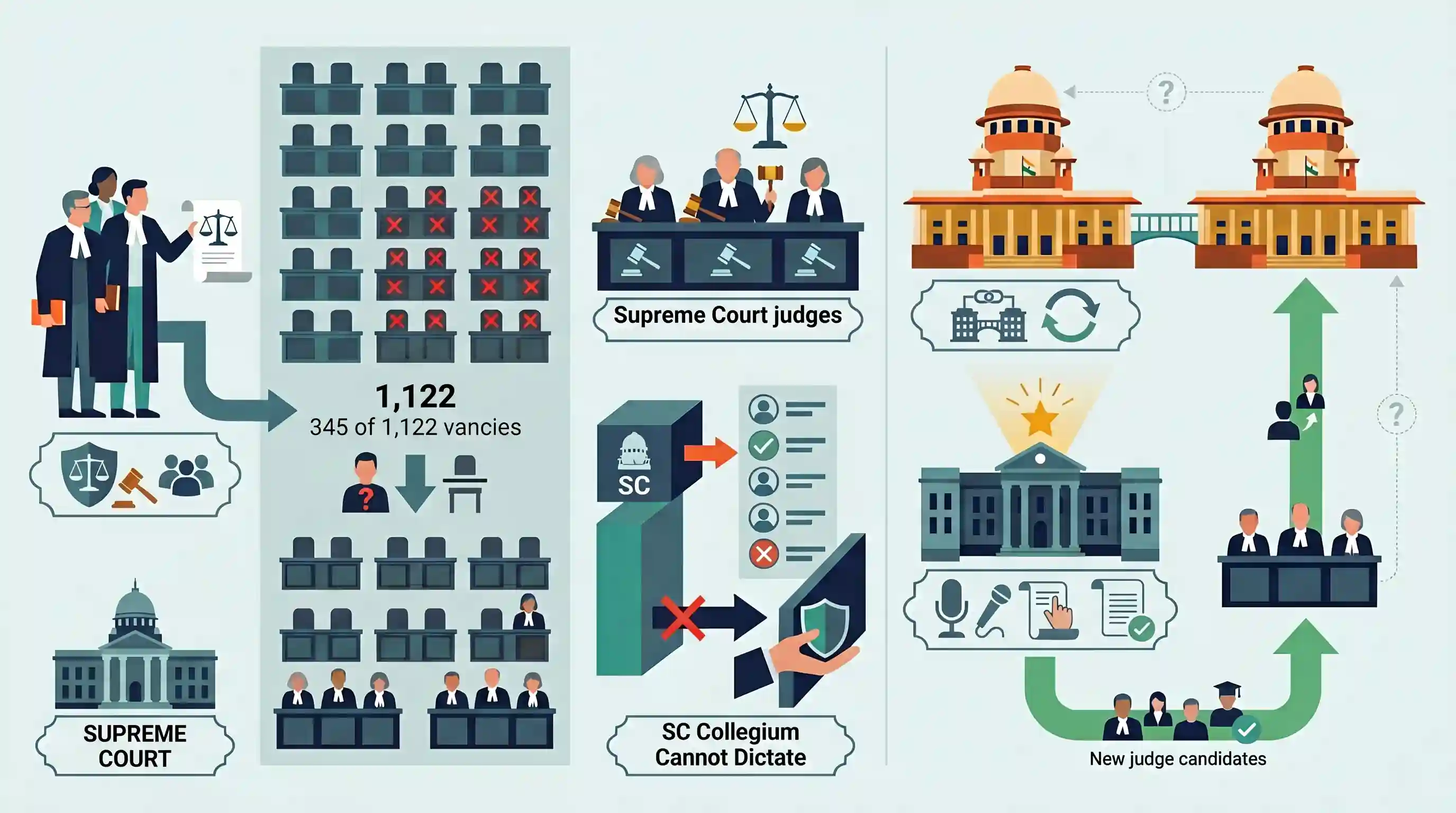
Justice B.R. Gavai clarified that the Supreme Court Collegium cannot "dictate" names to High Court Collegiums for judicial appointments, emphasizing the federal structure of the Indian judiciary. He noted that High Courts are independent constitutional courts, not subordinate to the Supreme Court. Consequently, the High Court Collegium retains the primary responsibility ("first call") to recommend candidates for High Court judgeships. The Supreme Court Collegium can only request High Court Collegiums to consider specific names, with formal processing beginning only after the High Court's approval. This observation was made in response to a plea by the Supreme Court Bar Association (SCBA) to consider Supreme Court lawyers for High Court judge appointments. The proceedings also highlighted the severe issue of judicial vacancies across High Courts, with 345 unfilled positions out of 1,122 sanctioned posts.
Key Points
- The Supreme Court Collegium cannot impose or dictate candidates for judgeships to High Court Collegiums.
- The High Court Collegium has the initial authority ('first call') to recommend candidates for High Court judge appointments.
- The Supreme Court and High Courts share a federal relationship; High Courts are independent constitutional courts and are not 'subordinate' to the Supreme Court.
- The Supreme Court Collegium can only request High Court Collegiums to consider specific names, and the formal process proceeds only after the High Court makes a recommendation.
- The Supreme Court Bar Association (SCBA) had requested expanding the candidate pool for High Court judges to include lawyers practicing in the Supreme Court.
- There are significant judicial vacancies across India's High Courts (345 vacancies out of a sanctioned strength of 1,122 judges).
Important Terms
Supreme Court Collegium

A five-member body comprising the Chief Justice of India and four senior-most judges, responsible for recommending appointments and transfers of judges to the Supreme Court.
UPSC context
GS Paper II: Appointment to various Constitutional posts, powers, functions and responsibilities of various Constitutional Bodies. Tests understanding of judicial independence.
High Court Collegium
A body comprising the Chief Justice of the respective High Court and two (sometimes four) senior-most judges, which initiates recommendations for judicial appointments to that court.
UPSC context
GS Paper II: Structure, organization, and functioning of the Judiciary. Focuses on the decentralised nature of judicial appointments.
Three Judges Cases
A series of three Supreme Court judgments (1981, 1993, 1998) that interpreted 'consultation' as 'concurrence', establishing the judiciary-led Collegium system for judicial appointments.
UPSC context
GS Paper II: Landmark judgments and their impact on the Constitution. Essential for questions on judicial primacy and appointments.
Federal Structure of Judiciary
The constitutional arrangement where High Courts are independent institutions within their states, not administratively subordinate to the Supreme Court, despite the unified appellate hierarchy.
UPSC context
GS Paper II: Federalism and separation of powers. Tests the balance of power between the Union and State-level judicial entities.
Supreme Court Bar Association (SCBA)
A voluntary bar association representing lawyers practicing in the Supreme Court of India, which often intervenes in matters of judicial policy and administration.
UPSC context
GS Paper II: Role of pressure groups and formal associations in the Indian polity. Relevant for debates on judicial reforms.
Prelims Trap
High Courts are subordinate to the Supreme Court, and the SC Collegium initiates the appointment of High Court judges.
India has an integrated appellate judiciary, but High Courts are independent constitutional bodies. Furthermore, the HC Collegium (not SC) exclusively initiates HC judge appointments.
Static Concepts Connected
What is the structure and mandate of the High Court Collegium?
- Composition: It comprises the Chief Justice of the respective High Court and its two senior-most judges.
- Initiation Power: It holds the exclusive 'first call' to initiate proposals for appointing High Court judges under the established Memorandum of Procedure (MoP).
- Evolution: The system evolved through the Three Judges Cases (1981, 1993, 1998) to ensure judicial independence under Article 217.
How does the Constitution define the relationship between the Supreme Court and High Courts?
- Appellate Hierarchy: India has an integrated judicial system where the SC is the highest court of appeal, but it does not exercise administrative or constitutional subordination over HCs.
- Superintendence: Under Article 227, High Courts have supervisory jurisdiction over subordinate courts. The Supreme Court lacks this direct supervisory administrative power over High Courts.
Cross-Topic Patterns
Judicial Federalism in GS-2 Mains
The assertion that High Courts are independent, not subordinate, feeds directly into Mains GS-2 debates on whether India's judiciary is purely integrated or possesses distinct federal characteristics.
MoP Delays and Judicial Vacancies
With roughly 30% vacancies in High Courts, the administrative friction between the Executive and Judiciary over the unfinalized Memorandum of Procedure (MoP) remains a chronic governance and pendency hurdle.

Expect a 2026 Prelims statement question testing initiation powers of SC vs HC Collegiums and the constitutional status of High Courts.
Linked PYQs · 2
Linked PYQs · 2
- 2025MainsGS2
Discuss the evolution of collegium system in India. Critically examine the advantages and disadvantages of the system of appointment of the Judges of the Supreme Court of India and that of the USA.
- 2017MainsGS2
Critically examine the Supreme Court's judgement on 'National Judicial Appointments Commission Act, 2014' with reference to appointment of judges of higher judiciary in India.
