Supreme Court Disposes of IPS Officer Plea on Postpartum Training
Source:The Hindu ↗
Why It Matters
This case brings to the forefront the challenges faced by female officers in the civil and police services regarding maternal welfare versus career progression. It highlights the persistence of archaic, gender-insensitive administrative rules (such as the 1993 MHA policy) and serves as an important study in service jurisprudence, constitutional gender justice, and the jurisdictional relationship between CAT, High Courts, and the Supreme Court.
Summary
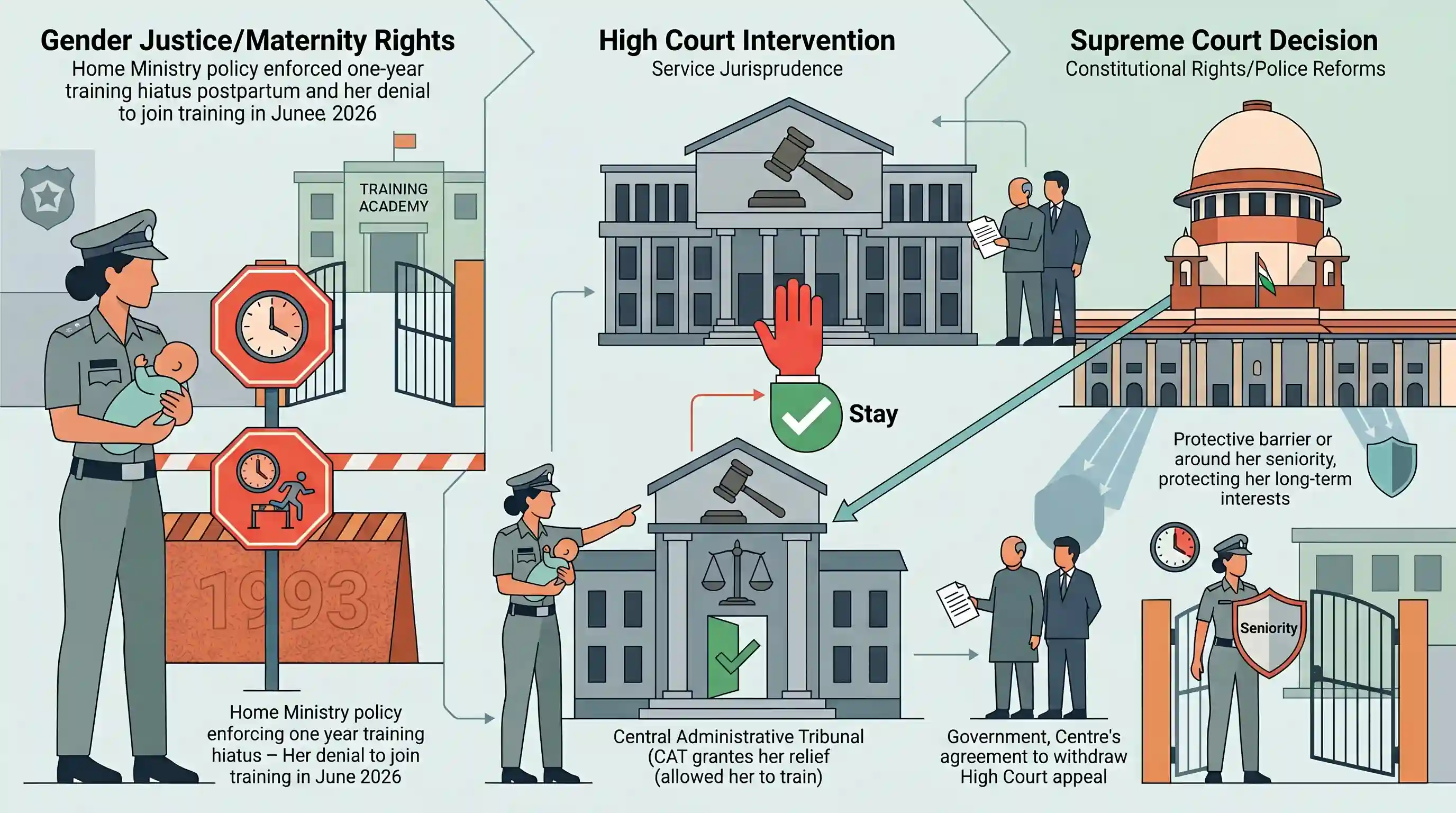
The Supreme Court of India disposed of a petition by IPS officer Urvashi Sengar challenging a 33-year-old Union Home Ministry policy (Office Memorandum of August 23, 1993) that enforces a mandatory one-year postpartum hiatus from training for new mothers. After Sengar's request to join a 9-week training session starting June 2026 was denied, she successfully sought relief from the Central Administrative Tribunal (CAT). However, the Delhi High Court stayed CAT's order. While the Supreme Court declined to let Sengar join the current training as one-third of the sessions had already concluded, it protected her interests by directing CAT to decide her case independently of the High Court's stay. The Centre also agreed to withdraw its High Court appeal and protect her seniority in service.
Key Points
- The Supreme Court disposed of a petition by IPS officer Urvashi Sengar challenging a 1993 Union Home Ministry policy that mandates a one-year postpartum training hiatus for new mothers.
- Ms. Sengar gave birth in September 2025 and volunteered to join a nine-week police training starting in June 2026, which the department denied based on the 1993 Office Memorandum (OM).
- Though the Central Administrative Tribunal (CAT) initially permitted Sengar to join training, the Delhi High Court stayed CAT's interim order following a challenge by the Union government.
- The Supreme Court declined to allow Sengar to join the current training session immediately, noting that missing three out of the nine weeks of classes would be detrimental to her learning.
- To protect the officer's interests, the Supreme Court directed the CAT to decide the pending case on its merits without being prejudiced by any subsequent stay orders of the Delhi High Court.
- The Union government undertook to withdraw its petition in the High Court and committed to protecting Ms. Sengar's seniority in service.
- The case emphasizes the need for administrative modernization and gender-sensitive policies to accommodate maternal duties without jeopardizing the career progression and seniority of female civil servants.
Important Terms
Central Administrative Tribunal

A quasi-judicial body established under Article 323A of the Constitution to resolve disputes and complaints regarding the recruitment and service conditions of public servants.
UPSC context
GS Paper II (Polity/Governance): Quasi-judicial bodies; tests knowledge of administrative adjudication and civil service dispute resolution.
Ministry of Home Affairs
The nodal Union ministry responsible for internal security, police administration, and serving as the cadre-controlling authority for the Indian Police Service.
UPSC context
GS Paper II & III: Executive structures and internal security; tests understanding of cadre management and police administration.
MHA Office Memorandum (OM) of August 23, 1993
A Union Home Ministry policy requiring pregnant IPS probationers to discontinue training immediately and resume it only one year after childbirth.
UPSC context
GS Paper II (Social Justice/Gender): Policies impacting women in civil services; tests understanding of substantive gender justice.
Supreme Court of India
The highest judicial forum and final court of appeal under the Indian Constitution, possessing original, appellate, and advisory jurisdictions.
UPSC context
GS Paper II (Polity): Judiciary; tests knowledge of apex court powers, constitutional remedies, and judicial review.
Delhi High Court
The high court exercising civil, criminal, and constitutional jurisdiction over the NCT of Delhi, including supervisory jurisdiction over local administrative tribunals.
UPSC context
GS Paper II (Polity): High Courts; tests understanding of judicial hierarchy and appellate relations with administrative tribunals.
Prelims Trap
All India Services (IAS, IPS, IFoS) training and maternity guidelines are uniformly regulated by the Department of Personnel and Training.
IPS training and cadre management are governed by the Ministry of Home Affairs (MHA), whereas IAS falls under the Department of Personnel and Training (DoPT). Their training rules on maternity differ significantly.
Static Concepts Connected
What is the constitutional basis and jurisdiction of the Central Administrative Tribunal (CAT)?
- Constitutional Origin: Established under Article 323A (inserted by the 42nd Amendment, 1976) to adjudicate disputes regarding recruitment and service conditions of public servants.
- Jurisdictional Scope: Covers All India Services, Central Civil Services, civil posts under the Union, and civilian defense employees. Excludes military personnel and parliamentary staff.
- Judicial Review: Subject to the writ jurisdiction of the respective High Court under Article 226/227 before a Division Bench (L. Chandra Kumar case).
How do the Directive Principles of State Policy (DPSP) support maternity and labor welfare?
- Article 42: Directs the State to secure just and humane conditions of work and for maternity relief, acting as the constitutional anchor for the Maternity Benefit Act.
- Article 15(3): Empowers the State to make special, affirmative provisions for women, overriding formal equality to ensure substantive, real-world gender justice.
Cross-Topic Patterns
CAT orders and High Court judicial review
Illustrates the complex jurisdictional interplay under the L. Chandra Kumar doctrine, where Tribunal rulings must pass through High Court scrutiny before reaching the Supreme Court.
Substantive equality vs protective paternalism
Connects Article 16 (employment equality) with Article 15(3) (special provisions). It shows how rigid state paternalism can inadvertently transform protective rules into career-limiting barriers.

Expect questions testing Article 15(3) and 42 where paternalistic protective policies are challenged for restricting women's career growth.
Linked PYQs · 3
Linked PYQs · 3
- 2023MainsGS2
Explain the constitutional perspectives of Gender Justice with the help of relevant Constitutional Provisions and case laws.
- 2019MainsGS2
“The Central Administrative Tribunal which was established for redressal of grievances and complaints by or against central government employees, nowadays is exercising its powers as an independent judicial authority.” Explain.
- 2024MainsGS1
Distinguish between gender equality, gender equity and women's empowerment. Why is it important to take gender concerns into account in programme design and implementation?
