Kukrail Night Safari project clearance by Supreme Court of India
Source:whalesbook ↗
Why It Matters
The Kukrail Night Safari is a significant ex-situ conservation and tourism project in Uttar Pradesh, making it highly relevant for UP-specific current affairs and geography questions in UPPSC Prelims. Furthermore, the Supreme Court's intervention regarding SEIAA and SEAC highlights crucial issues in environmental governance and the enforcement of Environmental Impact Assessments (EIA).
Summary
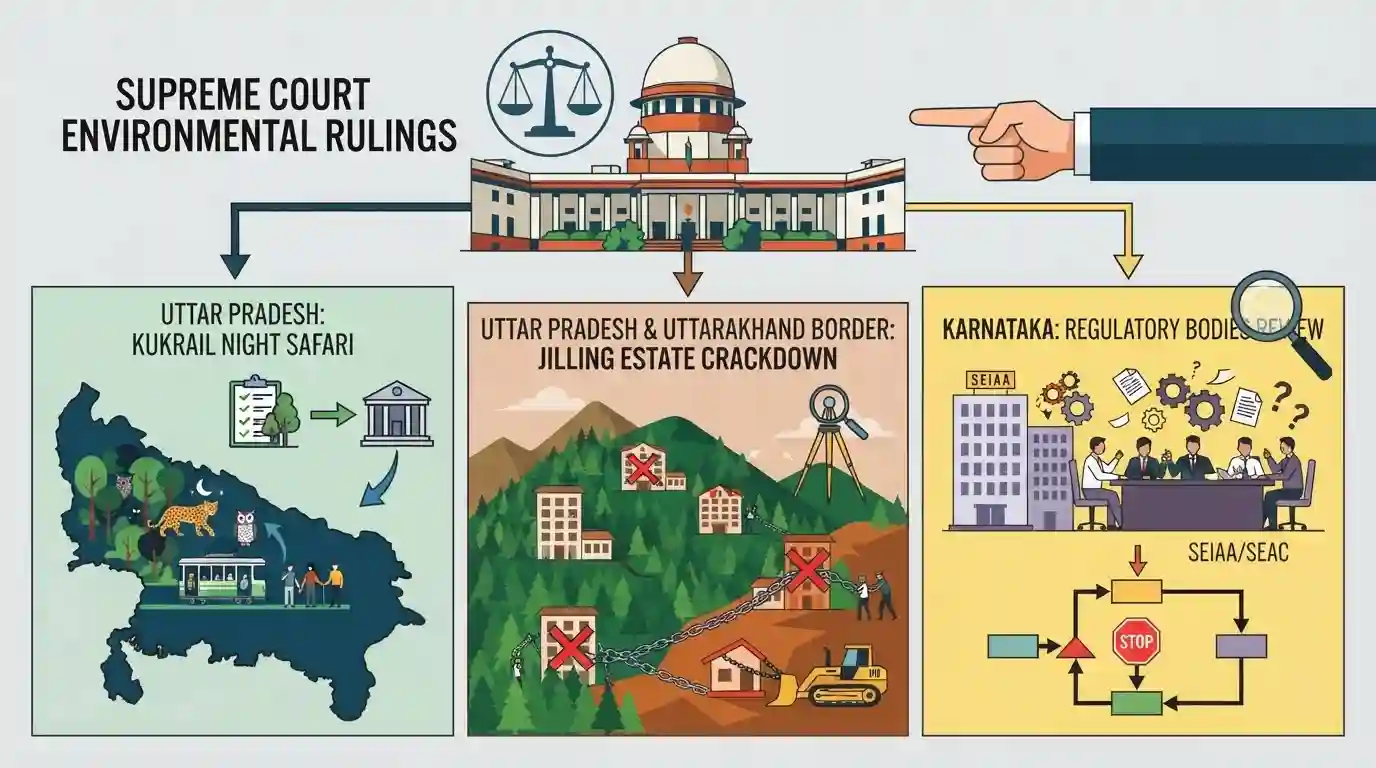
The Supreme Court of India has approved the Uttar Pradesh government's Kukrail Night Safari project in Lucknow while taking strict action in other environmental matters. The Court ordered a survey to crack down on illegal hotels in Uttarakhand's ecologically sensitive Jilling Estate and sharply criticized the composition and functioning of Karnataka's environmental regulatory bodies (SEIAA and SEAC).
Key Points
- The Supreme Court cleared the development of the Kukrail Night Safari project in Lucknow, Uttar Pradesh, which had previously secured approvals from the Central Zoo Authority and the Central Empowered Committee (CEC).
- The Court ordered the Uttarakhand government to survey and identify illegally constructed hotels lacking proper clearances in the ecologically sensitive Jilling Estate within the Bhimtal-Mukteshwar region.
- The bench strongly criticized the functioning and composition of Karnataka’s State Environment Impact Assessment Authority (SEIAA) and State Expert Appraisal Committee (SEAC), expressing concerns over the appointment of private members instead of impartial environmental experts.
- The rulings emphasize the need for stringent environmental governance and adherence to ecological regulations, balancing infrastructural projects like the UP Safari with strict enforcement against illegal commercial developments in fragile zones.
Important Terms
Kukrail Night Safari Project

India’s first urban night safari and day zoo project, spanning 855 acres in Lucknow's Kukrail Reserve Forest. It aims to showcase nocturnal wildlife using moonlight-mimicking technology while promoting eco-tourism, breeding, and conservation.
UPSC context
GS-3 (Environment/Biodiversity). Highlights eco-tourism and ex-situ conservation initiatives alongside the strict regulatory compliances required for sensitive forest diversions.
Central Empowered Committee (CEC)
A committee initially constituted by the Supreme Court in 2002 to monitor compliance with its environmental orders. It acts as an expert watchdog for issues involving deforestation, wildlife conservation, and illegal mining.
UPSC context
GS-3 (Environment) and GS-2 (Governance). Tests knowledge of environmental governance, judicial activism, and institutional mechanisms protecting India's forests.
State Environment Impact Assessment Authority (SEIAA)
A state-level regulatory body constituted under the EIA Notification, 2006. It is responsible for evaluating, monitoring, and granting environmental clearances for "Category B" infrastructure and developmental projects within a given state.
UPSC context
GS-3 (Environmental Impact Assessment). Crucial for questions on decentralized environmental governance, sustainable development, and regulatory bottlenecks.
State Expert Appraisal Committee (SEAC)
A state-level advisory committee of experts under the EIA Notification, 2006. It screens, scopes, and appraises Category B projects, providing mandatory scientific recommendations to the SEIAA for granting or rejecting environmental clearances.
UPSC context
GS-3 (EIA process). Important for understanding the scientific and technical appraisal stages of environmental governance at the state level.
Central Zoo Authority (CZA)
A statutory body under the Ministry of Environment, Forest and Climate Change, established under the Wildlife (Protection) Act, 1972. It regulates the establishment, functioning, and management of zoos across India to ensure animal welfare.
UPSC context
GS-3 (Conservation). Relevant to topics on ex-situ conservation, wildlife laws, and statutory bodies governing biodiversity.
Prelims Trap
The Central Empowered Committee (CEC) is an ad hoc watchdog appointed by the Supreme Court.
Since September 2023, the MoEFCC transitioned the CEC into a permanent statutory body. Its members are now solely appointed by the Central government, removing independent/NGO representation.
Static Concepts Connected
How are projects classified for appraisal under the EIA Notification 2006?
- Category A projects: These require mandatory clearance at the national level by the MoEFCC, based on recommendations from the central Expert Appraisal Committee (EAC).
- Category B projects: These are appraised at the state level by the State Environment Impact Assessment Authority (SEIAA) based on the State Expert Appraisal Committee (SEAC) recommendations.
What is the statutory framework of the Central Zoo Authority (CZA)?
- Origin: Established in 1992, it is a statutory autonomous body functioning under the Ministry of Environment, Forest and Climate Change.
- Governing Act: It was created under an amendment to the Wildlife (Protection) Act, 1972 (not the Environment Protection Act).
- Mandate: It regulates zoos across India and approves the exchange or transfer of endangered animals listed under Schedules I and II of the WPA.
Cross-Topic Patterns
EIA dilution & state investment push
Supreme Court scrutiny of Karnataka's SEIAA and Uttarakhand's single-window mechanisms highlights an emerging trend: states attempting to dilute national EIA 2006 mandates to fast-track private investments in ecologically fragile zones.
Judiciary to Executive: The CEC shift
The transition of the Central Empowered Committee from a Supreme Court-appointed watchdog (Godavarman case) to a MoEFCC-controlled body reflects the ongoing tug-of-war between judicial oversight and executive control in environmental governance.

Expect a 2026 Prelims question contrasting the Central Empowered Committee's new MoEFCC-appointed structure with its SC-watchdog origins.
Linked PYQs · 3
Linked PYQs · 3
- 2020UPPSC_PRELIMSGS1
In which of the following places the Bio-technology Park is located in Uttar Pradesh ?
- 2023UPPSC_PRELIMSGS1
In National Parks, Genetic diversity is maintained by -
- 2023UPPSC_PRELIMSGS1
Chandraprabha Wildlife Sanctuary is situated in which district of Uttar Pradesh?
