Supreme Court clears Kukrail night safari project in Lucknow
Source:The Hindu ↗
Why It Matters
UP-specific geography, environmental initiatives, and state-specific biodiversity parks (like Kukrail and the Lucknow Zoo relocation) are highly prioritized in UPPSC PCS Prelims. Furthermore, the administrative framework of ex-situ conservation (CZA under the Wildlife Protection Act, 1972) and environmental regulatory bodies (CEC) are standard syllabus areas.
Summary
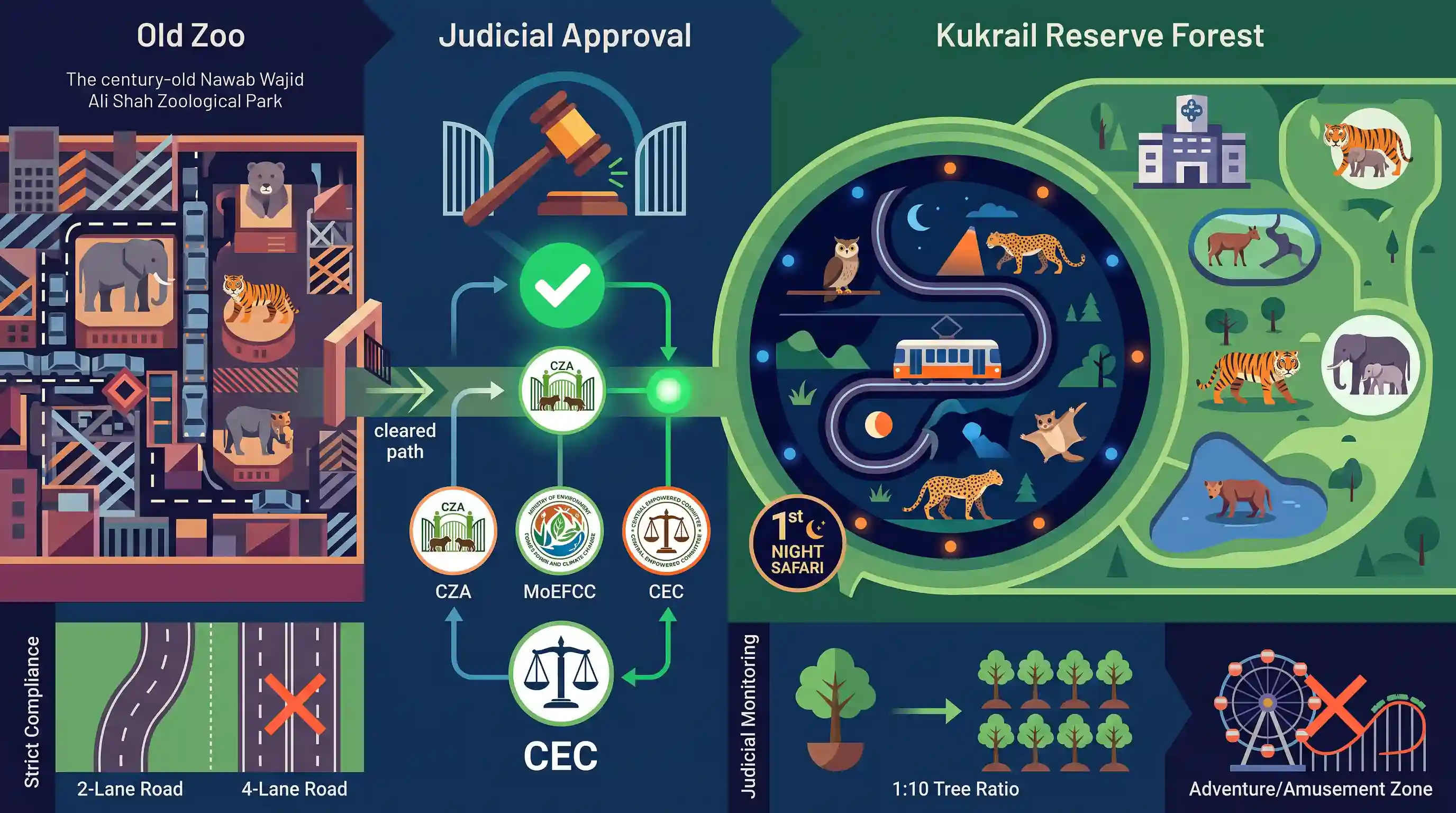
The Supreme Court has cleared the path for Uttar Pradesh's ambitious Kukrail Night Safari and Zoological Park project in Lucknow. Spread across 850 acres within the Kukrail Reserve Forest, this will be India's first night safari. The project involves relocating the century-old Nawab Wajid Ali Shah Zoological Park from congested city limits to facilitate modernization and better breeding environments. The project received necessary clearances from the Central Zoo Authority (CZA), MoEFCC, and the Central Empowered Committee (CEC), under strict judicial monitoring to ensure ecological compliance and minimal tree-felling.
Key Points
- The Supreme Court of India greenlighted the Kukrail Night Safari and Zoological Park project, located within the 2,000-hectare Kukrail Reserve Forest near Lucknow, Uttar Pradesh.
- The project, spread over 850 acres, is billed as India's first-of-its-kind night safari and the third or fourth such project globally.
- The project includes relocating Lucknow's century-old Nawab Wajid Ali Shah Zoological Park (formerly Lucknow Zoological Garden, established in 1921) because its current city location has no scope for expansion and is surrounded by high-traffic, congested areas hostile to animal breeding.
- A Supreme Court order from February 2024 mandates prior leave/permission from the Apex Court to establish zoos and night safaris within reserve forests.
- The project has obtained clearances from the Central Zoo Authority (CZA), the Union Environment Ministry (MoEFCC), and the Central Empowered Committee (CEC). The Supreme Court directed the CEC to continuously monitor the site and submit status reports.
- To minimize environmental impact, 71% (over 610 acres) of the project area will be maintained as green cover, focusing on eco-restoration by replacing invasive flora with native species.
Important Terms
Central Zoo Authority (CZA)

A statutory body under the Wildlife (Protection) Act, 1972, responsible for regulating, recognizing, and monitoring zoos in India, ensuring they meet prescribed standards of housing, veterinary care, and animal welfare.
UPSC context
GS Paper III: Environment & Ecology; tests institutional frameworks for ex-situ biodiversity conservation and environmental governance.
Central Empowered Committee (CEC)
An expert watchdog committee originally set up by the Supreme Court of India in 2002 to monitor compliance with judicial orders related to forest conservation, wildlife protection, and environmental issues.
UPSC context
GS Paper III: Environmental Governance; tests judicial environmentalism, watchdog bodies, and enforcement mechanisms for forest protection in India.
Nawab Wajid Ali Shah Zoological Park
A century-old zoo located in Lucknow, Uttar Pradesh, also known as the Lucknow Zoo; it is being relocated to the Kukrail Reserve Forest to establish India's first urban night safari.
UPSC context
GS Paper I & III: UP Geography and ex-situ conservation; tests awareness of key biodiversity sites and species relocation projects.
Wildlife (Protection) Act, 1972
A landmark Indian legislation providing a legal framework for protecting wild animals, birds, and plants, managing their habitats, and regulating trade in wildlife products to ensure ecological security.
UPSC context
GS Paper III: Environmental Legislation; tests understanding of wildlife protection schedules, protected area categories, and statutory conservation authorities.
Forest (Conservation) Act, 1980
A central Act enacted to restrict rapid deforestation in India by regulating the diversion of forest lands for non-forestry purposes, requiring prior approval from the Central Government.
UPSC context
GS Paper III: Environmental Governance; tests knowledge of regulatory approval processes for infrastructure development in forest zones and conservation policies.
Environment (Protection) Act, 1986
An umbrella legislation enacted in the wake of the Bhopal gas tragedy to empower the Central Government to protect, improve, and coordinate environmental pollution control activities across India.
UPSC context
GS Paper III: Environmental Pollution & Acts; tests key legal frameworks, national pollution standards, and emergency response environmental mechanisms.
Prelims Trap
The Central Empowered Committee (CEC) is an ad-hoc judicial body functioning under the administrative control of the Supreme Court of India.
In September 2023, the MoEFCC notified the CEC as a permanent, statutory body under the Environment (Protection) Act, 1986, changing its status from an ad-hoc body.
Static Concepts Connected
What are the regulatory powers and composition of the Central Zoo Authority (CZA)?
- Statutory Basis: Established in 1992 under Section 38A of the Wildlife (Protection) Act, 1972, to regulate Indian zoos.
- Leadership: Chaired by the Union Minister of Environment, Forest and Climate Change, ensuring high-level executive oversight.
- Core Function: Prescribes minimum standards for animal housing, grants recognition to zoos, and coordinates captive-breeding programs.
What is the historical significance of Nawab Wajid Ali Shah's reign in Awadh?
- Political Annexation: Deposed in 1856 by Lord Dalhousie under the pretext of 'maladministration' rather than Doctrine of Lapse, triggering the 1857 Revolt.
- Cultural Patronage: Nurtured the Lucknow Gharana of Kathak dance and composed Thumris under the pen name 'Akhtarpiya'.
Cross-Topic Patterns
CEC transition & environmental governance
Connects judicial activism (T.N. Godavarman case) to executive rulemaking under the Environment Protection Act, reflecting evolving separation of powers.
Ex-situ conservation & urban forestry
Integrates wildlife relocation with urban heat-island mitigation, highlighting how reserve forests act as crucial urban carbon sinks and biodiversity nodes.

Statutory evolution of Supreme Court-appointed bodies like the CEC under the EPA, 1986 is highly likely to feature in Prelims 2026.
Linked PYQs · 4
Linked PYQs · 4
- 2023UPPSC_PRELIMSGS1
Chandraprabha Wildlife Sanctuary is situated in which district of Uttar Pradesh?
- 2025UPPSC_PRELIMSGS1
Which of the following Ramsar wetland site is/are NOT situated in Uttar Pradesh? 1. Sarsai Nawar Jheel 2. Samaspur Bird Sanctuary 3. Rudrasagar Lake 4. Sultanpur National Park Select the correct answer from the code given below:
- 2015UPPSC_PRELIMSGS1
The Wildlife Protection Act was passed in the year
- 2023UPPSC_PRELIMSGS1
In National Parks, Genetic diversity is maintained by -
