BNSS Police Custody Scope and Judicial Interpretation Standards
Source:The Hindu ↗
ఇది ఎందుకు ముఖ్యం
As India transitions to the newly overhauled criminal laws (BNSS), judicial interpretations regarding police custody and personal liberty carry immense weight for civil rights, police powers, and institutional accountability.
సారాంశం
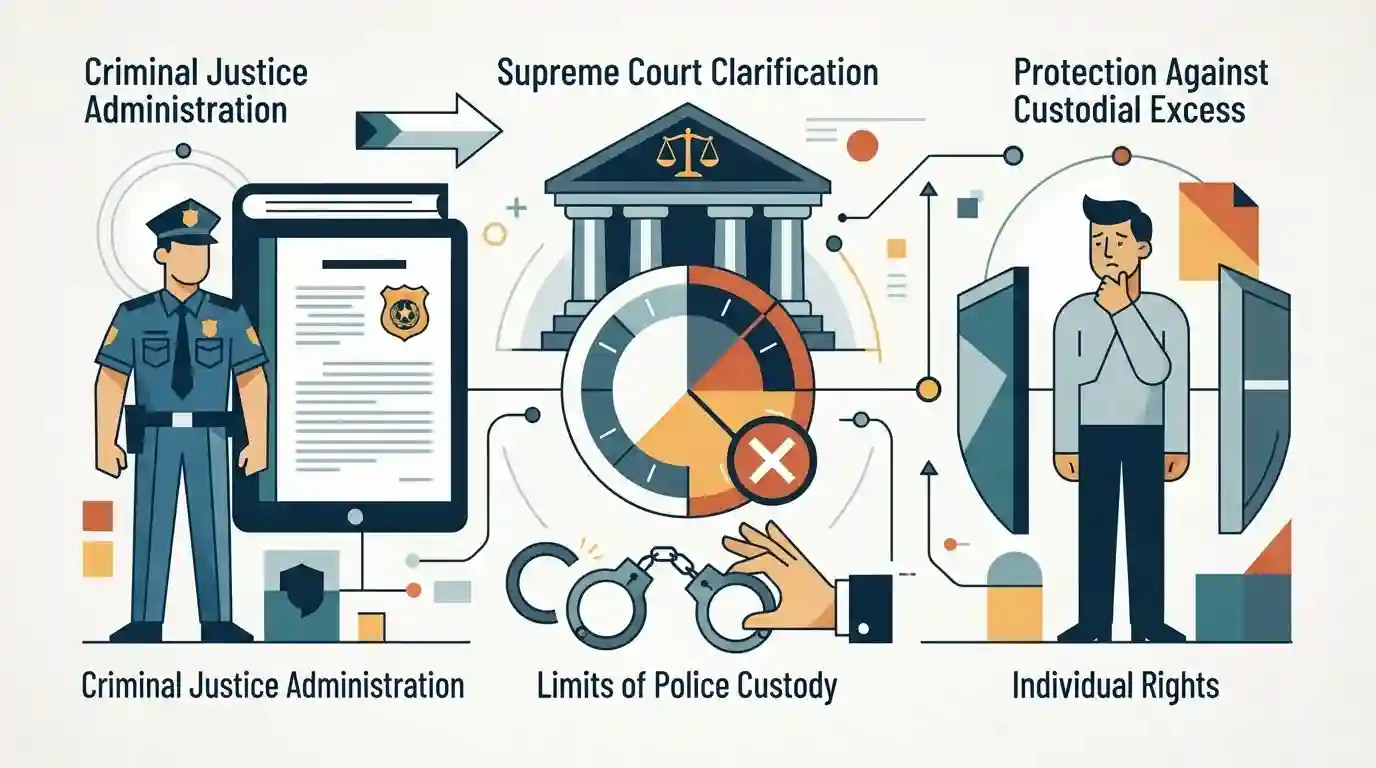
The Supreme Court has delivered an important clarification regarding the scope, duration, and limits of police custody under the Bharatiya Nagarik Suraksha Sanhita (BNSS), highlighting the balance between criminal justice administration and protection against custodial excess.
ముఖ్య అంశాలు
- The Supreme Court clarified the legal scope and parameters of police custody under the newly enacted Bharatiya Nagarik Suraksha Sanhita (BNSS), replacing the colonial-era CrPC.
- The interpretation addresses crucial safeguards regarding individual liberty, interrogation rights, and the prevention of custodial abuse or arbitrary detentions.
- The ruling balances effective criminal investigation by law enforcement agencies with the fundamental rights guaranteed under Article 21 of the Constitution.
ముఖ్యమైన పదాలు
Bharatiya Nagarik Suraksha Sanhita (BNSS)

The new criminal procedural code enacted to replace the colonial-era Code of Criminal Procedure (CrPC), governing arrest, investigation, and trial procedures in India.
UPSC context
GS Paper II (Polity and Governance - Criminal Justice System Reforms). Tests understanding of new criminal laws and procedural changes.
Code of Criminal Procedure (CrPC)
The colonial-era statute enacted in 1973 that governed criminal procedure in India until it was replaced by the Bharatiya Nagarik Suraksha Sanhita in 2023.
UPSC context
GS Paper II (Polity and Governance). Tests knowledge of historical criminal jurisprudence and legislative changes in India.
Supreme Court
The apex judicial body of India responsible for interpreting the Constitution and statutory laws, ensuring fundamental rights, and delivering landmark judgments on criminal jurisprudence.
UPSC context
GS Paper II (Indian Judiciary and Constitutional Governance). Tests the role of the apex court in balancing individual liberties with state investigative powers.
ప్రిలిమ్స్ ఉచ్చు
Police custody under the BNSS can now be extended beyond the total 15-day aggregate cap if split across multiple spells.
Under the old CrPC, police custody had to be availed strictly within the first 15 days of arrest. Under BNSS Section 187, police custody can be split into multiple spells within the first 40 or 60 days, though the 15-day aggregate cap remains.
అనుసంధానమైన స్థిర భావనలు
What is the maximum duration and legal framework for police custody versus judicial custody in India?
- Duration Cap: Police Custody: Maximum 15 days total allowed under BNSS Section 187 (can be split across the first 40/60 days), unlike the old CrPC where it had to be within the first 15 days.
- Judicial Limit: Judicial Custody: Can extend up to 60 or 90 days depending on the gravity of the offence and punishment prescribed under the penal statute.
- Article 21 Safeguard: Constitutional Link: Police custody requires production before a judicial magistrate within 24 hours of arrest, anchoring the fundamental right under Article 21.
అంతర-అంశ నమూనాలు
Criminal Law Reforms + Article 21 Rights
The transition from colonial penal codes (CrPC, IPC, Evidence Act) to indigenous codes (BNSS, BNS, BSA) tests systemic capacity, digital record-keeping, and judicial interpretation of expanded police powers.

BNSS Section 187 splitting of police custody vs CrPC 15-day rule is prime material for a direct statement-based prelims question.
అనుసంధాన PYQలు · 2
అనుసంధాన PYQలు · 2
- 2021PrelimsGS1
With reference to India, consider the following statements : 1. Judicial custody means an accused is in the custody of the concerned magistrate and such accused is locked up in police station, not in jail. 2. During judicial custody, the police officer in charge of the case is not allowed to interrogate the suspect without the approval of the court. Which of the statements given above is/are correct?
- 2026PrelimsGS1
Which of the following statements about a Zero First Information Report (Zero FIR) under the Bharatiya Nagarik Suraksha Sanhita (BNSS), 2023 is/are correct ? 1. A Zero FIR can be lodged at a police station, even though the place of commission of a cognizable/non-cognizable offence is outside the territorial jurisdiction of that police station. 2. The Officer-in-Charge of the police station where a Zero FIR has been lodged may, with the permission of the competent authority, initiate a preliminary enquiry. 3. Under Zero FIR, it is obligatory for the informant to furnish information electronically. Select the answer using the code given below :
