Supreme Court Slams Probe Agencies Over Indiabulls Case
Source:Indian Express ↗
ఇది ఎందుకు ముఖ్యం
This article illustrates the crucial role of judicial oversight in pushing investigative agencies to maintain accountability and pace in high-profile corporate fraud cases. It highlights issues such as white-collar crime investigation challenges, transnational flight of economic offenders, and systemic lapses in coordination between premier investigative organs like the CBI, SFIO, and State/UT Police EOWs.
సారాంశం
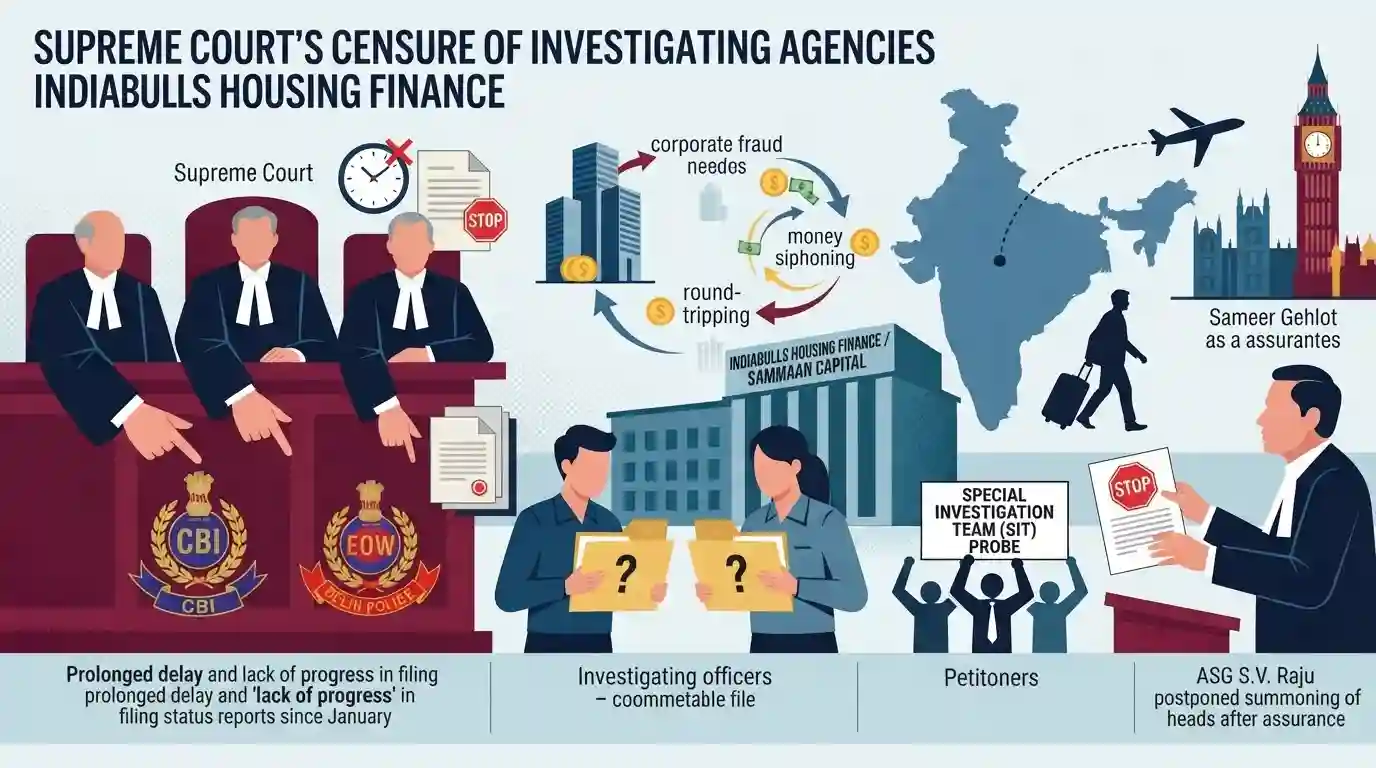
The Supreme Court of India censured the Central Bureau of Investigation (CBI) and the Delhi Police Economic Offences Wing (EOW) over the prolonged delay and lack of progress in investigating corporate fraud, money siphoning, and round-tripping allegations against the promoters of Indiabulls Housing Finance Limited (IHFL, now Sammaan Capital Limited). A three-judge bench led by Chief Justice Surya Kant reprimanded the agencies for failing to file a status report since January. The petitioners have demanded a Special Investigation Team (SIT) probe, highlighting that a key accused, Sameer Gehlot, has left India for London. The apex court postponed summoning the heads of the agencies after receiving assurances from ASG S.V. Raju that a status report would be filed.
ముఖ్య అంశాలు
- The Supreme Court of India sharply criticized the Central Bureau of Investigation (CBI) and the Delhi Police Economic Offences Wing (EOW) for a lack of progress in probing promoters of Indiabulls Housing Finance Limited (now Sammaan Capital Limited).
- The three-judge bench led by Chief Justice of India Surya Kant termed the agencies' silence and failure to file a status report since January as 'shocking' and indicative of negligence.
- The allegations against the promoters involve serious economic offences, including corporate fund siphoning, round-tripping of funds, and violations of the Companies Act, 2013.
- The petitioner's advocate, Prashant Bhushan, sought the creation of a Special Investigation Team (SIT) to oversee the case, pointing out that one of the main accused, Sameer Gehlot, had relocated to London.
- The Additional Solicitor General, S.V. Raju, assured the bench that a status report would be filed, prompting the court to defer summoning the agency heads.
- The case underscores the challenges in multi-agency coordinate probes involving the CBI, EOW, and the Serious Fraud Investigation Office (SFIO) for financial crimes.
ముఖ్యమైన పదాలు
Central Bureau of Investigation (CBI)

India's premier investigating agency handling corruption, economic offences, and complex crimes. It is not a statutory body and derives its investigative powers from the Delhi Special Police Establishment (DSPE) Act, 1946.
UPSC context
GS Paper II: Governance, statutory/regulatory bodies. Tests police reforms, federal-state friction, and functional autonomy of central agencies.
Serious Fraud Investigation Office (SFIO)
A statutory, multi-disciplinary organization under the Ministry of Corporate Affairs, established to detect, investigate, and prosecute complex corporate frauds and white-collar crimes.
UPSC context
GS Paper II & III: Corporate governance and statutory bodies. Tests regulatory frameworks governing economic offences and complex corporate fraud.
Companies Act, 2013
The primary legislative framework governing corporate incorporation, management, compliance, and dissolution in India, strengthening corporate governance, accountability, and investor protection.
UPSC context
GS Paper II & III: Economic development and corporate governance. Tests understanding of statutory corporate regulation and ease of doing business.
Economic Offences Wing (EOW) of Delhi Police
A specialized wing of the Delhi Police Crime Branch dedicated to investigating complex white-collar crimes, financial frauds, bank scams, and large-scale embezzlements.
UPSC context
GS Paper III: Internal security and money laundering. Tests enforcement mechanisms dealing with specialized financial crimes and regulatory compliance.
Supreme Court of India
The apex constitutional court and the final court of appeal in India, acting as the guardian of the Constitution and the ultimate arbiter of law.
UPSC context
GS Paper II: Structure, organization, and functioning of the Judiciary. Tests judicial activism, oversight of probe agencies, and PIL mechanisms.
Ministry of Corporate Affairs
A Ministry of the Government of India responsible for administering the Companies Act, 2013, and other legislations regulating the corporate sector.
UPSC context
GS Paper II: Government ministries and departments. Tests role of executive ministries in corporate compliance and ease of doing business.
ప్రిలిమ్స్ ఉచ్చు
The CBI requires state government consent under Section 6 of the DSPE Act even for investigations ordered by the Supreme Court.
The Supreme Court and High Courts can order the CBI to conduct investigations anywhere in India without needing the consent of the state government.
అనుసంధానమైన స్థిర భావనలు
What is the statutory status and mandate of the Serious Fraud Investigation Office (SFIO)?
- Statutory Status: Established under Section 211 of the Companies Act, 2013, operating under the Ministry of Corporate Affairs.
- Multi-disciplinary Mandate: Comprises experts in forensic auditing, corporate law, taxation, and IT to investigate complex, multi-disciplinary corporate frauds.
- No Suo Motu Powers: Cannot initiate investigations on its own (suo motu); requires case referral from the Central Government or via company resolution.
How does jurisdictional consent affect CBI investigations under the DSPE Act, 1946?
- Consent Mandate: Section 6 requires the CBI to obtain state government consent to exercise police powers within a state's territory.
- General vs. Specific: General consent allows seamless investigation; its withdrawal requires the CBI to seek case-specific permission for new registrations.
- Judicial Exception: Consent is legally redundant if the investigation is directed by the Supreme Court or High Courts.
అంతర-అంశ నమూనాలు
Corporate Governance vs. Economic Security
Round-tripping of funds via shell companies bypasses regulatory checks, linking corporate governance failures directly to India's broader external financial security and money laundering vulnerabilities.
Judicial Activism and Executive Accountability
The Supreme Court's threat to summon agency heads showcases judicial oversight filling operational gaps left by executive sluggishness in high-profile economic offences.

Expect a multi-statement Prelims question comparing the statutory powers of SFIO under Companies Act, 2013, with the CBI's consent regime.
అనుసంధాన PYQలు · 2
అనుసంధాన PYQలు · 2
- 2021MainsGS2
The jurisdiction of the Central Bureau of Investigation (CBI) regarding lodging an FIR and conducting probe within a particular State is being questioned by various States. However, the power of the States to withhold consent to the CBI is not absolute. Explain with special reference to the federal character of India.
- 2021MainsGS3
Discuss how emerging technologies and globalisation contribute to money laundering. Elaborate measures to tackle the problem of money laundering both at national and international levels.
