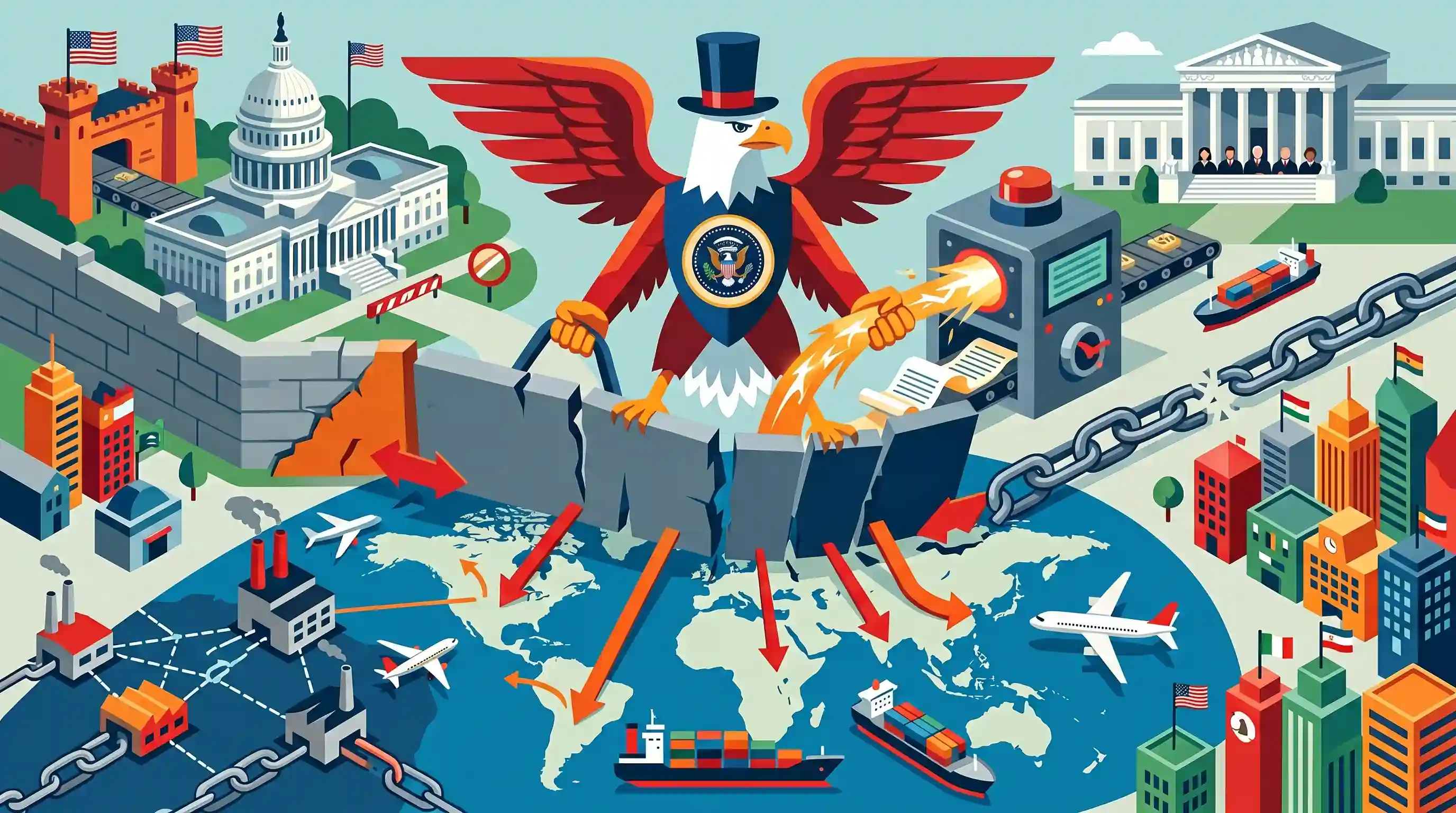
US Executive Tariff Powers and Judicial Review Limitations
Source:Indian Express ↗
Why It Matters
Understanding the legal and political mechanisms behind major powers' shift toward protectionism is crucial for analyzing the current global economic order and its impact on India's macroeconomic stability and trade strategies.
Summary
The article examines the legal and political dynamics surrounding US President Donald Trump’s proposed global tariffs. It highlights that the US Supreme Court is unlikely to fully block these tariffs, as the executive branch possesses broad, historically delegated statutory powers (such as the IEEPA and various Trade Acts) to regulate foreign commerce and address trade deficits. This reliance on executive authority to bypass traditional legislative hurdles underscores a profound shift in US economic policy toward aggressive protectionism and unilateral trade actions, with significant implications for global supply chains, international trade relations, and the rules-based multilateral trading system.
Key Points
- The US Supreme Court's involvement cannot entirely stop President Trump from implementing his planned global tariffs due to the extensive statutory powers delegated by Congress.
- Even if courts strike down his use of the 1977 International Emergency Economic Powers Act (IEEPA), the administration has multiple other legal avenues, such as Section 122 of the Trade Act of 1974 or Section 232 of the Trade Expansion Act of 1962.
- The reliance on sweeping executive authority to regulate trade highlights a shift towards aggressive protectionism and the use of economic statecraft as a tool for national security and foreign policy.
- These tariff measures signal ongoing challenges to global multilateral trade norms, contributing to an environment of sovereign nationalism over free trade.
Important Terms
International Emergency Economic Powers Act (IEEPA)

A 1977 US law authorizing the President to regulate international commerce during declared national emergencies, primarily used for sanctions and asset freezes.
UPSC context
GS Paper II (International Relations); tests understanding of executive-legislative balance and tools of economic statecraft.
Trade Act of 1974
US legislation providing frameworks for trade negotiations and enforcement, including Section 301 for unfair trade practices and Section 122 for balance-of-payments deficits.
UPSC context
GS Paper III (Economy); relevant for analyzing US-India trade disputes and retaliatory trade measures.
Trade Expansion Act of 1962
A law allowing the President to restrict imports (via Section 232) if they are deemed a threat to national security, traditionally used for steel and aluminum.
UPSC context
GS Paper II (Effect of policies of developed countries); tests knowledge of national security justifications for protectionism.
Tariff Act of 1930
Also known as Smoot-Hawley, this 1930 act established US tariff schedules and includes Section 338 for retaliating against discriminatory trade practices.
UPSC context
GS Paper I (World History) and GS Paper III; compares historical protectionism with modern trade wars.
US Supreme Court (Trade Jurisdiction)
The US judicial body that recently limited executive power by ruling that broad tariff-imposing authority resides with Congress under the Major Questions Doctrine.
UPSC context
GS Paper II (Comparison of Constitutional schemes); examines judicial checks on executive economic overreach.
Protectionism
An economic policy of restricting imports through tariffs, quotas, or regulations to protect domestic industries from foreign competition.
UPSC context
GS Paper III (Liberalization); a core concept regarding the crisis in the WTO-led multilateral trading system.
Prelims Trap
"Unilateral national security tariffs are strictly prohibited and automatically invalidated by WTO rules."
The WTO’s GATT Article XXI contains a "security exception" that nations increasingly invoke to legally defend unilateral protectionist tariffs, making it a contested grey area.
Static Concepts Connected
What are the primary trade remedy measures permitted under WTO rules?
- Anti-dumping duties: Tariffs applied to imported goods sold below their domestic market price, causing injury to local industries.
- Countervailing duties: Levies imposed to neutralize the unfair advantage of subsidies given by the exporting country's government.
- Safeguard measures: Temporary restrictions applied in response to a sudden, unforeseen surge in imports threatening domestic producers.
What is the GATT Article XXI "Security Exception"?
- National Security basis: Allows WTO members to legally breach trade commitments if they deem it necessary to protect essential security interests.
- Executive weaponization: Increasingly invoked by nations to justify unilateral protectionist tariffs, thereby bypassing traditional multilateral dispute resolution mechanisms.
Cross-Topic Patterns
Trade wars & India's Export Schemes
Aggressive US tariffs threaten India's export targets, increasing reliance on WTO-compliant incentives like RoDTEP and pushing India to accelerate bilateral FTAs to secure market access.
Global supply chain friend-shoring
Unilateral trade barriers accelerate the shift from pure globalization to 'friend-shoring,' where nations limit supply chain dependencies to geopolitical allies through frameworks like IPEF.

Expect a GS2/GS3 question linking unilateral 'national security' tariffs to the paralysis of the WTO Dispute Settlement Mechanism in 2026.
Linked PYQs · 3
Linked PYQs · 3
- 2025MainsGS3
What are the challenges before the Indian economy when the world is moving away from free trade and multilateralism to protectionism and bilateralism? How can these challenges be met?
- 2018MainsGS3
How would the recent phenomena of protectionism and currency manipulations in world trade affect macroeconomic stability of India?
- 2025MainsGS2
"With the waning of globalization, post-Cold War world is becoming a site of sovereign nationalism.” Elucidate.
