Supreme Court Cancels Panel Meeting on Simultaneous Polls
Source:Indian Express ↗
কেন এটি গুরুত্বপূর্ণ
The news highlights crucial questions regarding institutional comity, separation of powers, and the practical challenges surrounding electoral reforms like simultaneous elections in India's constitutional framework.
সারসংক্ষেপ
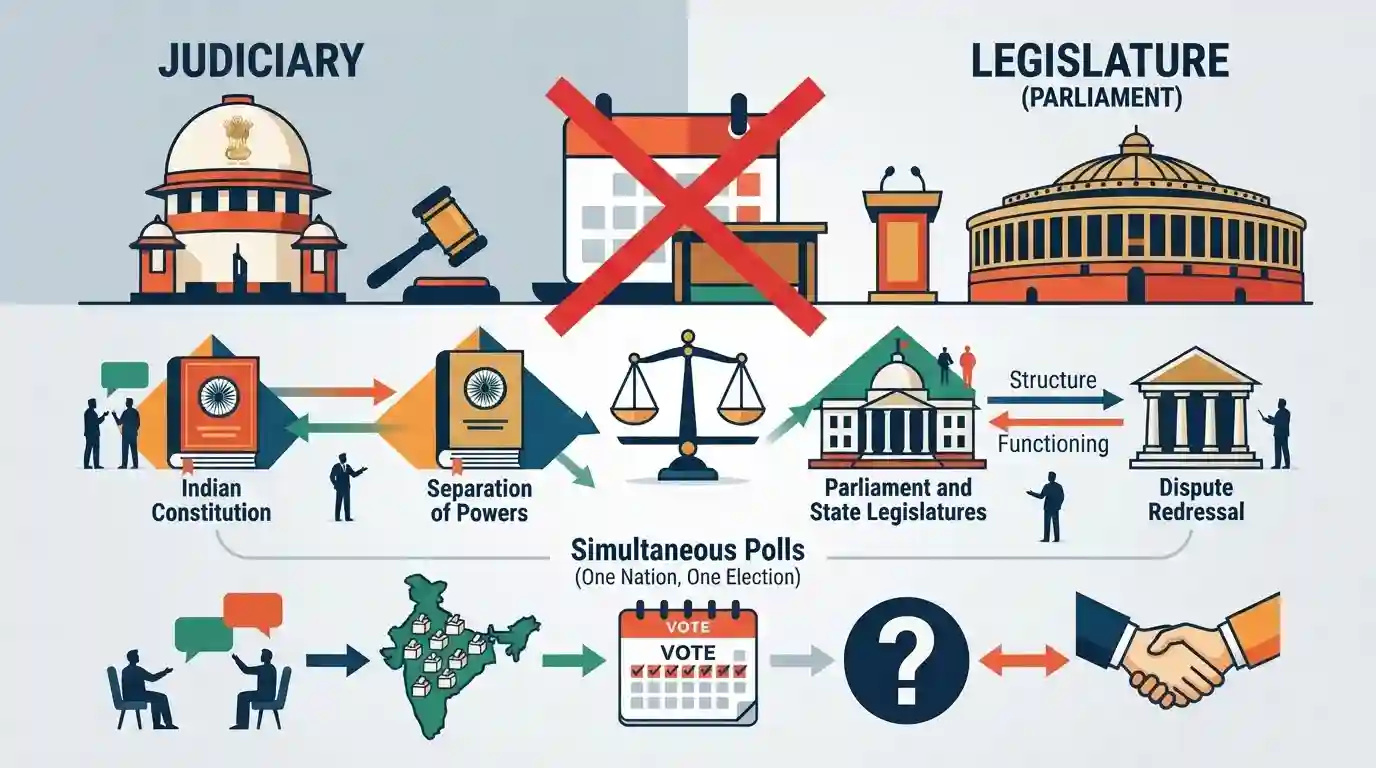
The Supreme Court has cancelled its scheduled meeting with a parliamentary panel that was set to discuss the implementation of simultaneous polls ('One Nation, One Election'). This development touches upon important institutional dynamics, the separation of powers between the judiciary and the legislature, and ongoing debates over electoral reforms in India.
মূল বিষয়
- The Supreme Court cancelled a scheduled meeting with the Parliamentary Standing Committee on Personnel, Public Grievances, Law and Justice regarding the issue of simultaneous polls.
- The cancellation highlights the delicate institutional boundaries and the doctrine of separation of powers between the judiciary and the legislature.
- Simultaneous elections ('One Nation, One Election') remain a major policy debate concerning constitutional amendments, federalism, and electoral reforms in India.
গুরুত্বপূর্ণ শব্দ
Simultaneous Elections

A proposed electoral reform in India aiming to synchronize Lok Sabha and State Legislative Assembly elections simultaneously to reduce costs, policy paralysis, and governance disruption.
UPSC context
GS Paper II (Indian Polity): Tests understanding of electoral reforms, federal structure, and governance issues.
Supreme Court
The apex judicial body of India with original, appellate, and writ jurisdiction, serving as the ultimate guardian and interpreter of the Indian Constitution.
UPSC context
GS Paper II (Indian Polity): Focuses on the structure, powers, and role of the judiciary in maintaining the separation of powers.
সংযুক্ত স্থির ধারণা
How does the Indian concept of 'Separation of Powers' differ from the American model?
- Checks & Balances: Unlike the US model of strict separation, India follows functional overlapping and a system of checks and balances.
- Directive Principles: Article 50 directs the state to separate the judiciary from the executive in public services.
- Institutional Comity: No organ can usurp the core constitutional domain of another, maintaining institutional comity.
আন্তঃবিষয় প্যাটার্ন
Simultaneous Polls + Basic Structure Doctrine
Proposals for 'One Nation, One Election' require amending multiple articles including 83 and 172, testing the interplay between Article 368 amendment powers and the Basic Structure doctrine.

Separation of powers and institutional comity questions will likely be framed around judiciary-legislature interactions.
সংযুক্ত PYQ · 2
সংযুক্ত PYQ · 2
- 2024MainsGS2
Examine the need for electoral reforms as suggested by various committees with particular reference to "one nation one election" principle.
- 2019MainsGS2
Do you think that Constitution of India does not accept principle of strict separation of powers rather it is based on the principle of 'checks and balance'? Explain.
