Judiciary Legislature Relations on Simultaneous Elections
Source:Indian Express ↗
কেন এটি গুরুত্বপূর্ণ
It brings to the fore critical questions on the institutional boundaries between the judiciary and legislature, as well as the ongoing national debate surrounding electoral reforms like simultaneous polls.
সারসংক্ষেপ
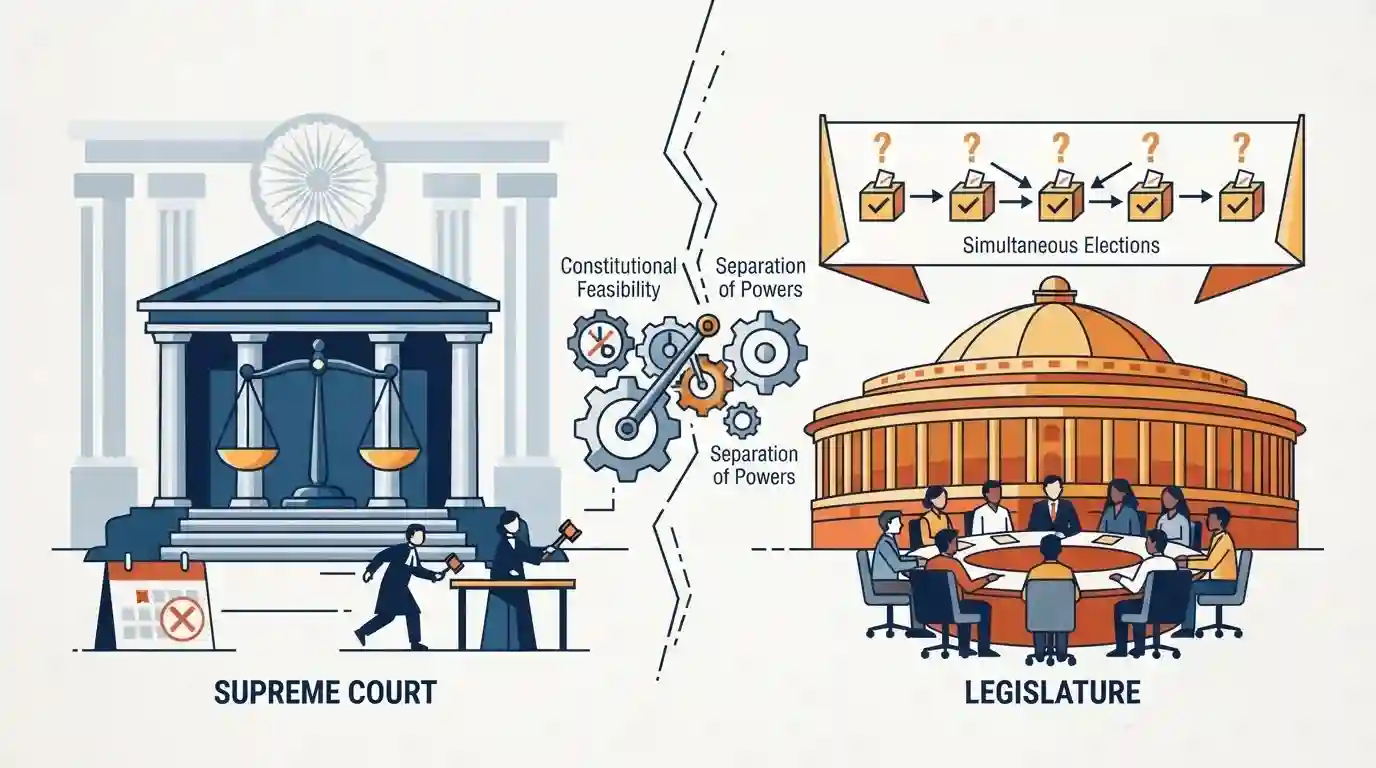
The Supreme Court cancelled its scheduled meeting with a parliamentary panel examining simultaneous polls ('One Nation, One Election'). This development draws focus to the delicate institutional interface between the judiciary and the legislature, raising questions around separation of powers and the constitutional feasibility of simultaneous elections in India.
মূল বিষয়
- The Supreme Court cancelled a scheduled meeting with a parliamentary panel examining the issue of simultaneous elections.
- The cancellation highlights institutional boundaries and questions regarding the separation of powers between the judiciary and the legislature.
- Simultaneous polls ('One Nation, One Election') remain a major subject of debate involving constitutional, federal, and administrative implications.
গুরুত্বপূর্ণ শব্দ
Simultaneous Polls

An electoral reform proposal seeking to synchronize elections to the Lok Sabha and all State Legislative Assemblies across India to reduce costs, administrative burden, and policy paralysis caused by frequent poll cycles.
UPSC context
Relevant for GS Paper II (Polity - Electoral Reforms, Federalism, Separation of Powers). Tests understanding of institutional coordination and governance efficiency.
Joint Committee on Simultaneous Polls
A joint parliamentary panel comprising members from both Houses of Parliament tasked with examining legislative amendments related to the synchronisation of elections across the country.
UPSC context
Relevant for GS Paper II (Parliamentary Committees, Legislative Process). Tests knowledge of committee functions and legislative scrutiny.
Separation of Powers
The constitutional doctrine that divides the powers of government into distinct executive, legislative, and judicial branches to prevent abuse of power through checks and balances.
UPSC context
Relevant for GS Paper II (Basic Structure, Organs of State). Essential for analyzing institutional friction between the judiciary and legislature.
সংযুক্ত স্থির ধারণা
What are the constitutional provisions and amendments required for implementing simultaneous elections in India?
- Term Alteration: Article 83 and Article 172 govern the duration of Parliament and State Legislatures, requiring constitutional amendments to curtail or extend terms.
- President's Rule: Article 356 provisions on President's Rule need safeguards to prevent mid-term assembly dissolutions from breaking synchronized election cycles.
- Kovind Panel: Kovind Committee recommended a two-step approach: first synchronizing Lok Sabha and state assembly polls, and second synchronizing local bodies within 100 days.
আন্তঃবিষয় প্যাটার্ন
Electoral Reforms + Federalism + Basic Structure
Proposals to synchronize election cycles intersect with Article 356 misuse, federal autonomy, and the basic structure doctrine on democratic continuity.
Separation of Powers + Parliamentary Privileges
Judicial engagement with parliamentary panels touches upon legislative privilege, immunity, and institutional comity under Articles 105 and 121.

Simultaneous polls constitutional mechanics, Kovind panel recommendations, and separation of powers are ripe for a multi-statement Prelims Q.
সংযুক্ত PYQ · 3
সংযুক্ত PYQ · 3
- 2024MainsGS2
Examine the need for electoral reforms as suggested by various committees with particular reference to "one nation one election" principle.
- 2017MainsGS2
Simultaneous election to the Lok Sabha and the State Assemblies will limit the amount of time and money spent in electioneering but it will reduce the government's accountability to the people." Discuss.
- 2020MainsGS2
Judicial Legislation is antithetical to the doctrine of separation of powers as envisaged in the Indian Constitution. In this context justify the filing of large number of public interest petitions praying for issuing guidelines to executive authorities.
