Supreme Court Ruling on Bail in Dowry Death Cases
Source:Indian Express ↗
Why It Matters
This judgment is significant for UPSC aspirants as it demonstrates the Supreme Court's strict stance on gender justice and bail jurisprudence. It also provides a crucial contemporary example of the application of the newly enacted Bharatiya Sakshya Adhiniyam, 2023, which is highly relevant for GS2 (Polity & Governance) and GS1 (Social Issues - Women's Empowerment).
Summary
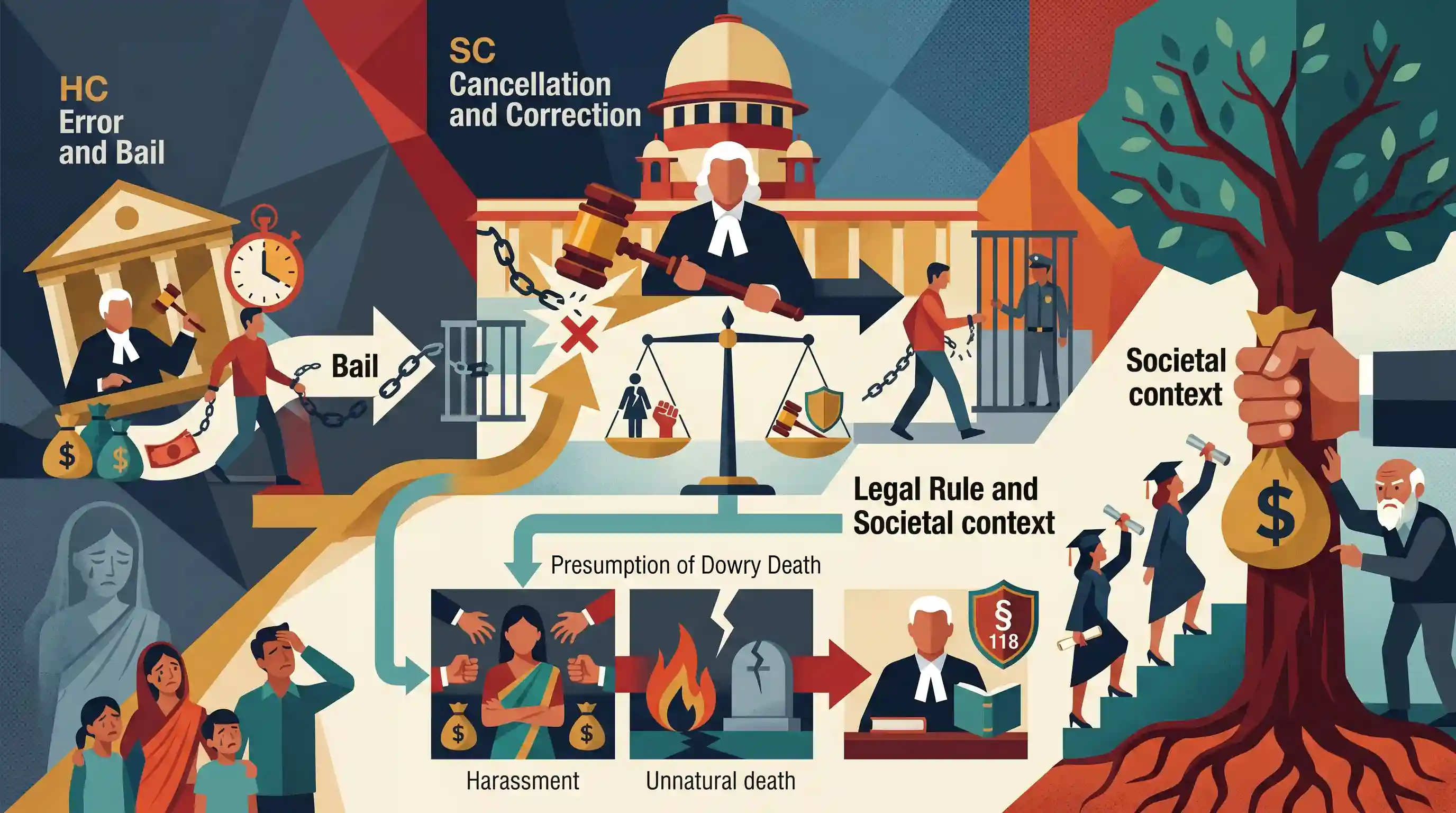
The Supreme Court of India cancelled the bail of a man accused in a dowry death case, strongly criticizing the Allahabad High Court for granting bail merely due to an alleged delay in filing the FIR. The apex court emphasized that judicial orders must not convey that serious crimes against women are being treated lightly. Highlighting Section 118 of the new Bharatiya Sakshya Adhiniyam, 2023, the Court reiterated the legal presumption of dowry death when a woman faces harassment for dowry shortly before an unnatural death. The judgment also reflected on the broader societal issue, noting with concern that dowry demands and patriarchal mindsets remain deeply entrenched despite women's increasing educational advancements.
Key Points
- The Supreme Court cancelled bail in a dowry death case, criticizing the lower court for granting it based solely on an alleged delay in lodging the FIR.
- The Court asserted that judicial orders must not suggest that courts are taking serious crimes against women lightly.
- The judgment cited Section 118 of the Bharatiya Sakshya Adhiniyam, 2023, which mandates the presumption of dowry death if cruelty or harassment for dowry occurred soon before an unnatural death.
- The ruling noted a troubling paradox: the persistence of dowry demands and patriarchal attitudes despite increasing educational opportunities for women, particularly in states like Uttar Pradesh.
Important Terms
Bharatiya Sakshya Adhiniyam, 2023

The legislative act that replaced the Indian Evidence Act, 1872, governing the admissibility and weight of evidence in Indian courts, including new provisions for electronic and digital records.
UPSC context
GS II (Judiciary & Reforms); tests knowledge of the modernization of India's criminal justice system.
Section 118, BSA
A statutory provision mandating that courts presume an accused caused a 'dowry death' if proof exists of harassment for dowry shortly before the woman’s unnatural death within seven years of marriage.
UPSC context
GS II (Judiciary/Social Justice); tests understanding of the 'reverse burden of proof' in crimes against women.
Bail Jurisprudence
The set of legal principles and guidelines governing the grant of bail, balancing an accused's right to personal liberty (Article 21) against the gravity of the offense and public interest.
UPSC context
GS II (Constitution & Judiciary); tests the application of judicial discretion and fundamental rights in criminal law.
Dowry Death
The unnatural death of a woman within seven years of her marriage, preceded by harassment or cruelty by her husband or in-laws in connection with demands for property or money.
UPSC context
GS I (Indian Society); GS II (Social Justice); tests awareness of systemic violence and legislative protections for women.
Gender Justice
A constitutional and judicial framework ensuring that the legal system effectively addresses gender inequality and protects women from systemic violence and patriarchal biases.
UPSC context
GS II (Governance & Constitution); tests knowledge of judicial activism and constitutional mandates for equality (Articles 14, 15, 21).
Bharatiya Nyaya Sanhita, 2023
The substantive criminal code of India that replaced the Indian Penal Code (IPC), consolidating and defining offenses and punishments, including specific provisions for crimes against women.
UPSC context
GS II (Judiciary & Statutory Bodies); tests knowledge of the transition from colonial-era laws to a modern penal framework.
Prelims Trap
Under the BSA 2023, courts "may presume" dowry death, leaving it to judicial discretion.
The law mandates a 'shall presume' standard for dowry deaths. This creates a mandatory presumption and a reverse burden of proof on the accused, entirely removing judicial discretion.
Static Concepts Connected
What is 'Reverse Burden of Proof' in the Indian criminal justice system?
- General Principle: Normally, the fundamental principle of criminal law is that the prosecution must prove the accused's guilt beyond a reasonable doubt.
- The Exception: Certain laws (Dowry, POCSO, UAPA, NDPS) shift the burden to the accused to prove their innocence once foundational facts are established by the prosecution.
- Evidentiary Standard: This is triggered by mandatory 'shall presume' clauses in evidence laws (like Section 118 of BSA 2023), legally compelling the court to presume guilt initially.
What are the legal requisites for classifying an incident as a 'Dowry Death'?
- Specific Timeframe: The death of the woman must be caused by burns, bodily injury, or occur under unnatural circumstances within seven years of her marriage.
- Prior Cruelty: It must be established that "soon before her death," the woman was subjected to cruelty or harassment by her husband or in-laws for dowry.
- Statutory Provision: Governed by Section 80 of the BNS 2023 (formerly Section 304B IPC), the offense carries a strict minimum sentence of seven years, extendable to life imprisonment.
Cross-Topic Patterns
Education vs. structural patriarchy
The SC highlighted a classic GS1/GS2 paradox: rising female literacy and education have not proportionately reduced dowry demands, proving that socio-economic development alone doesn't dismantle entrenched patriarchal mindsets.
FIR delays in bail jurisprudence
The ruling adds to ongoing bail reform debates (GS2), clarifying that procedural lapses like FIR delays cannot serve as standalone grounds for granting bail in heinous, structurally-driven crimes against women.

Expect a 2026 Prelims statement contrasting 'may presume' vs 'shall presume' under the BSA regarding reverse burden in crimes against women.
Linked PYQs · 3
Linked PYQs · 3
- 2023MainsGS1
Explain why suicide among young women is increasing in Indian society.
- 2014MainsGS1
How does patriarchy impact the position of a middle class working woman in India?
- 2023MainsGS2
Explain the constitutional perspectives of Gender Justice with the help of relevant Constitutional Provisions and case laws.
