Parliamentary Competence and Regulation of Online Gaming
Source:The Hindu ↗
Why It Matters
The issue represents a contemporary application of constitutional federalism (Seventh Schedule disputes) to modern digital challenges, highlighting the tension between the fundamental right to trade and the state's duty to regulate internal security threats like money laundering.
Summary
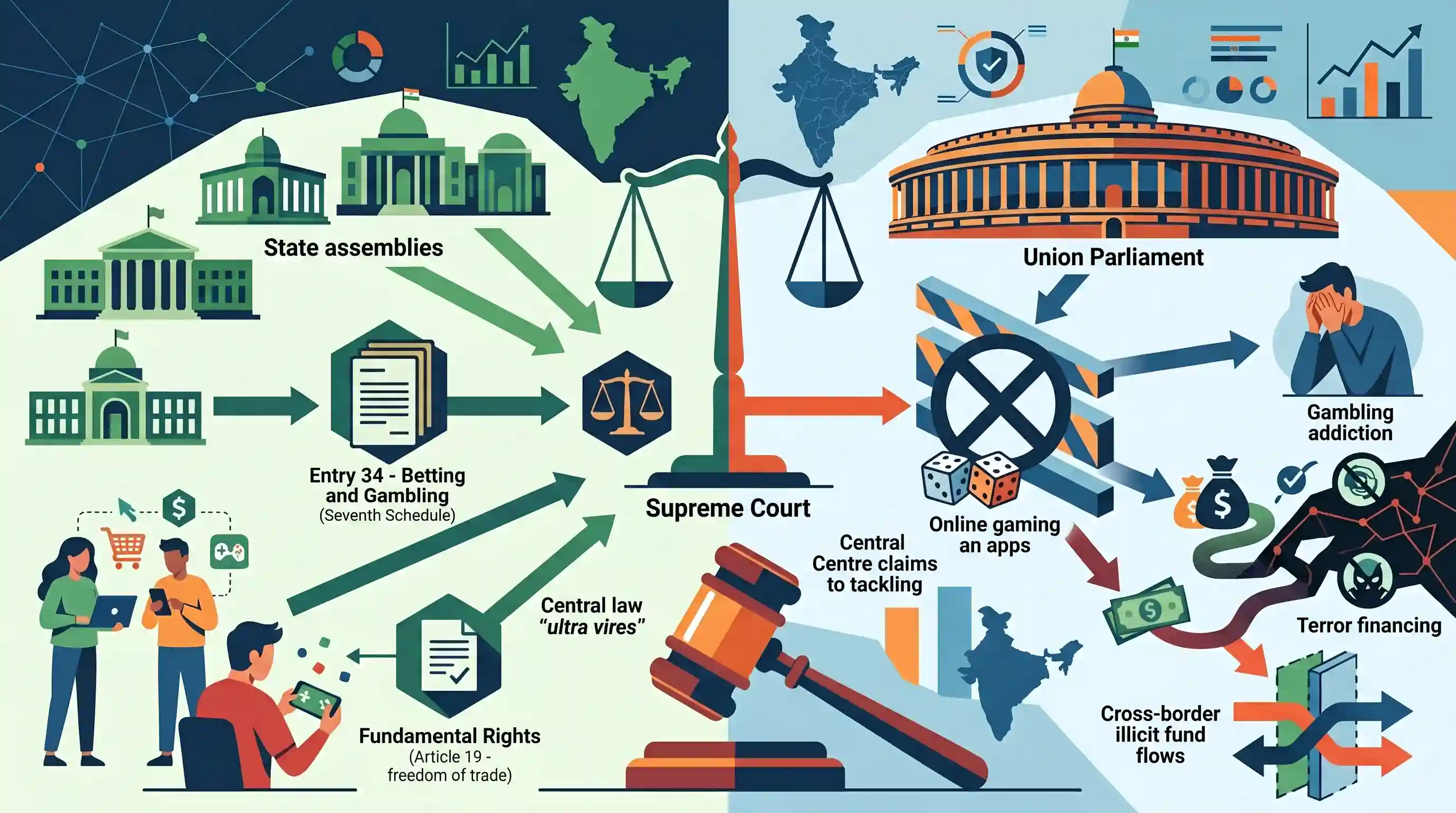
The Supreme Court is hearing petitions challenging Parliament's legislative competence to enact the Promotion and Regulation of Online Gaming Act, 2025, which enforces a comprehensive ban on real-money games. Petitioners argue that 'betting and gambling' are exclusively State subjects under Entry 34 of the State List in the Seventh Schedule, rendering the central law ultra vires, and claim the ban violates their fundamental right to trade. In defense, the Centre contends that the law is necessary to tackle severe socioeconomic and security threats, including widespread addiction, money laundering, terror financing, and cross-border illicit fund flows.
Key Points
- The Supreme Court is examining Parliament's legislative competence to enact the Promotion and Regulation of Online Gaming Act, 2025, which bans real-money games and related services.
- Petitioners argue that online gaming falls under 'betting and gambling'—a State subject under Entry 34 of the State List—rendering the central law unconstitutional.
- Gaming platforms assert that the blanket ban violates their right to carry on trade and profession, leading to severe job losses.
- The Centre justifies the law citing grave public interest concerns, including addiction, money laundering, terror funding, tax evasion, and massive financial losses to citizens.
Important Terms
Promotion and Regulation of Online Gaming Act, 2025

A central statute enacted to ban real-money games while regulating e-sports; it is currently contested for allegedly encroaching on State powers over betting and gambling.
UPSC context
GS II: Regulatory frameworks for emerging sectors and Center-State legislative disputes.
Seventh Schedule
A constitutional framework (Article 246) that distributes legislative subjects between the Union (List I), States (List II), and both (List III - Concurrent List).
UPSC context
GS II: Federal structure and the division of legislative powers.
Entry 34 (State List)
A specific item in the Seventh Schedule's State List that gives state legislatures exclusive authority to make laws concerning "betting and gambling."
UPSC context
GS II: Center-State relations and jurisdictional authority over online gaming.
Legislative Competence
The constitutional authority of a legislative body (Parliament or State Legislature) to enact laws on specific subjects based on the Seventh Schedule.
UPSC context
GS II: Judicial review and constitutional interpretation of legislative powers.
Ultra Vires
A legal doctrine meaning "beyond the powers"; it refers to acts or laws that exceed the authority granted to a legislature or body by the Constitution.
UPSC context
GS II: Principles of judicial review and the validity of statutes.
Article 19(1)(g)
A fundamental right guaranteeing Indian citizens the freedom to practice any profession or carry on any occupation, trade, or business, subject to reasonable restrictions.
UPSC context
GS II: Fundamental Rights and the "game of skill vs. chance" debate.
Prelims Trap
Online gaming, betting, and gambling are Concurrent List subjects, allowing Parliament to enact nationwide bans.
Betting and gambling (Entry 34) are exclusively State List subjects. The Centre relies on its Information Technology powers (Entry 31, Union List) to justify its legislative competence, sparking federal disputes.
Static Concepts Connected
How do courts resolve conflicts over legislative competence in the Seventh Schedule?
- Pith and Substance: Determines the true nature and character of a law to check which list it belongs to, validating it even if it incidentally encroaches on another list.
- Article 246 supremacy: Establishes the absolute predominance of the Union List over the State and Concurrent lists in cases of irreconcilable constitutional overlap.
How does Article 19(1)(g) treat games of skill versus games of chance?
- Predominance Test: Courts recognize games where skill predominates over chance as a legitimate business activity fully protected under the fundamental right to trade and profession.
- Res Extra Commercium: Pure games of chance (gambling) are deemed inherently pernicious and are excluded from the constitutional protection of free trade and commerce.
Cross-Topic Patterns
PMLA's expanding sweep over tech
Integrating real-money gaming into the PMLA framework mirrors recent moves bringing virtual digital assets (crypto) and CA/CS professionals under stringent anti-money laundering reporting requirements.
Borderless tech vs. traditional federalism
Online gaming joins data protection, AI regulation, and OTT platforms as frontier areas where internet borderlessness fundamentally strains traditional State List jurisdictional boundaries.

A multi-statement question testing 'Pith and Substance' via Entry 34 (State) vs. Entry 31 (Union) overlaps is highly probable.
Linked PYQs · 4
Linked PYQs · 4
- 2024MainsGS2
What changes has the Union Government recently introduced in the domain of Centre-State relations ? Suggest measures to be adopted to build the trust between the Centre and the States and for strengthening federalism.
- 2021MainsGS3
Discuss how emerging technologies and globalisation contribute to money laundering. Elaborate measures to tackle the problem of money laundering both at national and international levels.
- 2020MainsGS3
Discuss different types of cyber crimes and measures required to be taken to fight the menace.
- 2022MainsGS3
Discuss the types of organised crimes. Describe the linkages between terrorists and organised crime that exist at the national and transnational levels.
