Supreme Court Upholds MHA Advisory on National Song Vande Mataram
Source:The Hindu ↗
Why It Matters
This issue touches upon the delicate balance between civic duties (Article 51A) and fundamental individual freedoms (conscience and speech), which is a recurring theme in UPSC Polity and Governance sections.
Summary
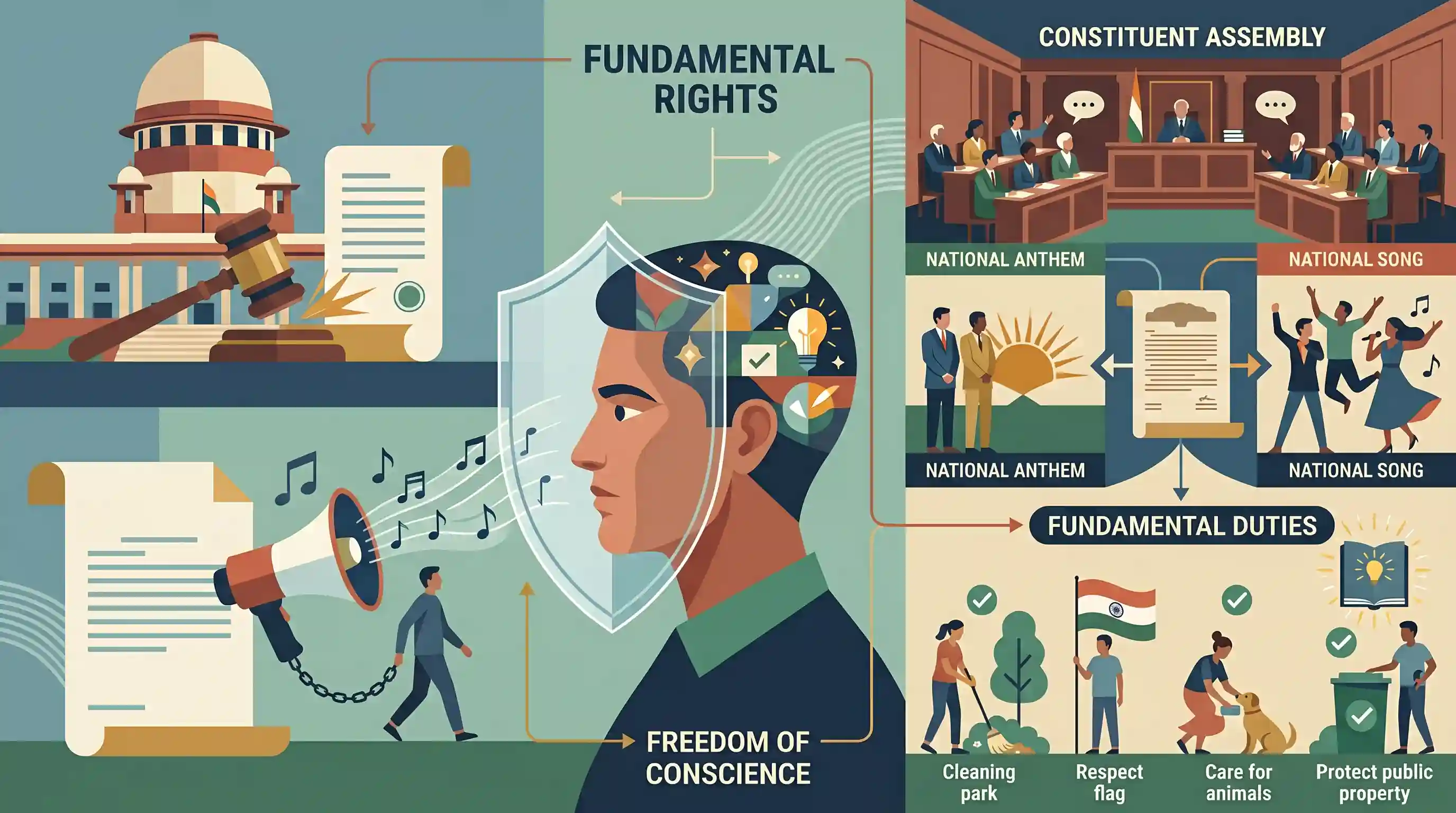
The Supreme Court dismissed a plea challenging a Ministry of Home Affairs advisory on playing the National Song 'Vande Mataram' at public events. The court ruled the circular is an advisory without penal consequences and does not infringe upon individual conscience. The hearing spotlighted constitutional debates surrounding enforced patriotism, the historical distinction between the National Anthem and the National Song established by the Constituent Assembly, and the scope of fundamental duties under Article 51A.
Key Points
- The Supreme Court dismissed a petition challenging an MHA advisory on playing 'Vande Mataram' at public and ceremonial events.
- The petitioner argued the advisory compels a demonstration of loyalty that violates individual conscience and diminishes the National Anthem's status.
- The court clarified that the circular is merely an advisory, uses the word "may," and carries no penal consequences for non-compliance.
- The debate underscored the constitutional distinction between the National Anthem and the National Song, noting that Article 51A specifically mentions the duty to respect the National Anthem but not the National Song.
Important Terms
Article 51A

Part IV-A of the Constitution containing 11 core moral and civic obligations for citizens, including respecting the National Anthem (51A(a)) and cherishing the freedom struggle (51A(b)).
UPSC context
GS Paper II: Constitution. Tests the understanding of non-justiciable moral obligations vs. enforceable fundamental rights.
42nd Constitutional Amendment
A landmark 1976 amendment, known as the 'Mini-Constitution,' which added 'Fundamental Duties' (Part IV-A) and inserted the words 'Socialist' and 'Secular' into the Preamble.
UPSC context
GS Paper II: Polity. Essential for understanding the evolution of the Indian Constitution and centralized executive power.
National Song vs National Anthem
While the National Anthem (Jana Gana Mana) has explicit legal protection under the PINH Act, the National Song (Vande Mataram) holds symbolic reverence without penal consequences for non-singing.
UPSC context
Prelims/GS II: Polity. Tests factual accuracy regarding national symbols and the legal distinction between symbolic honour and statutory mandates.
Freedom of Conscience (Article 25)
A fundamental right under Article 25 ensuring an individual's absolute inner freedom to hold religious or moral convictions without state-mandated expression or coercion.
UPSC context
GS Paper II: Fundamental Rights. Tests the balance between state-enforced patriotism and personal religious or ethical liberty.
Constituent Assembly
The sovereign assembly that drafted India's Constitution and formally adopted the National Anthem on January 24, 1950, while according equal respect to the National Song.
UPSC context
GS I & II: Modern History/Polity. Tests the historical intent behind national symbols and the foundational debates of the Republic.
Prevention of Insults to National Honour Act, 1971
A 1971 law that penalizes intentional disrespect to the Constitution, National Flag, and National Anthem, but notably does not provide for the National Song.
UPSC context
GS Paper II: Governance/Laws. Crucial for understanding the scope of penal enforcement regarding national symbols and judicial interpretations of patriotism.
Prelims Trap
"Article 51A imposes a fundamental duty on citizens to respect the National Flag, National Anthem, and National Song."
False. Article 51A(a) explicitly mentions the National Anthem but omits the National Song. Neither the Constitution nor the 1971 Act formally protects the National Song.
Static Concepts Connected
How does the legal status of the National Anthem differ from the National Song?
- Article 51A(a): Explicitly mandates respect for the National Anthem and the National Flag, but it does not mention the National Song.
- Statutory Protection: The Prevention of Insults to National Honour Act, 1971 penalizes disrupting the National Anthem, but it contains no specific penal provisions for the National Song.
- Historical Status: Dr. Rajendra Prasad issued a declaration in 1950 granting equal status to 'Vande Mataram', though no formal resolution was passed by the Constituent Assembly.
When does Freedom of Conscience protect citizens from singing the National Anthem?
- Bijoe Emmanuel (1986): The SC ruled that forcing students with sincere religious objections to sing the Anthem violates Freedom of Religion (Art 25) and Speech (Art 19(1)(a)).
- No Singing Compulsion: Standing respectfully when the Anthem is played fulfills the legal and civic obligation; actually singing it is not legally compulsory.
Cross-Topic Patterns
Executive Advisories vs Statutory Law
The SC reinforces that executive advisories without statutory backing cannot impose penal consequences. Curtailing fundamental rights requires a valid law enacted by the legislature, not mere MHA circulars.
Art 25 vs Compelled Expression
Debates around enforcing 'Vande Mataram' directly connect to the 'Bijoe Emmanuel' jurisprudence, balancing the state's push for constitutional morality against individual freedom of religion and expression.

Expect a tricky 2026 Prelims statement swapping National Anthem and National Song regarding their explicit mention in Article 51A.
Linked PYQs · 5
Linked PYQs · 5
- 2015PrelimsGS1
"To uphold and protect the Sovereignty, Unity and Integrity of India" is a provision made in the
- 2020PrelimsGS1
Other than the Fundamental Rights, which of the following parts of the Constitution of India reflect/reflects the principles and provisions of the Universal Declaration of Human Rights (1948)? 1. Preamble 2. Directive Principles of State Policy 3. Fundamental Duties Select the correct answer using the code given below:
- 2017PrelimsGS1
The mind of the makers of the Constitution of India is reflected in which of the following?
- 2017PrelimsGS1
Which of the following statements is/are true of the Fundamental Duties of an Indian citizen? 1. A legislative process has been provided to enforce these duties. 2. They are correlative to legal duties. Select the correct answer using the code given below:
- 2017MainsGS2
Examine the scope of Fundamental Rights in the light of the latest judgement of the Supreme Court on Right to Privacy.
