Supreme Court Upholds JSW Acquisition Under IBC Framework
Source:The Hindu ↗
Why It Matters
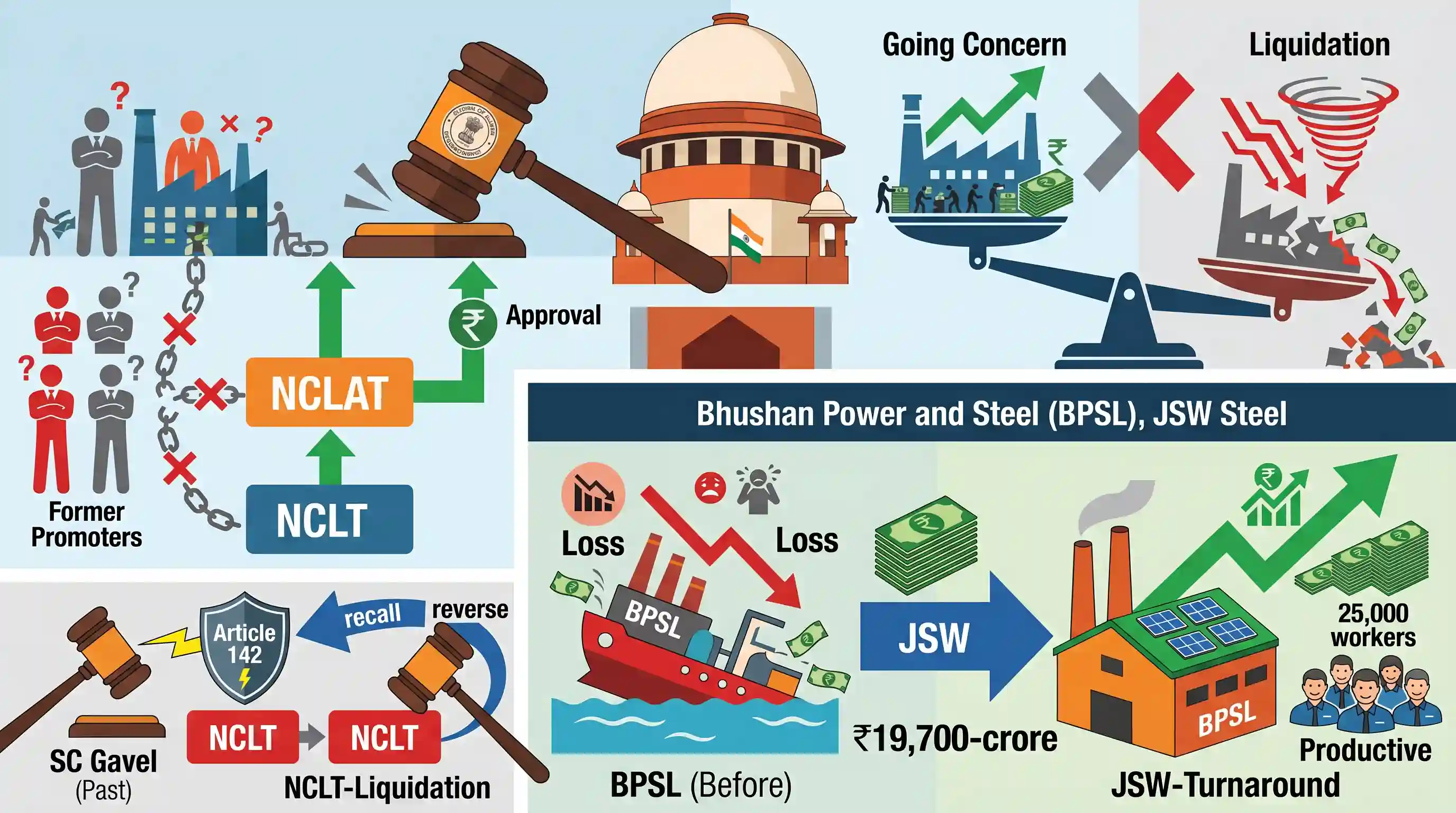
The ruling is a landmark interpretation of the Insolvency and Bankruptcy Code (IBC), reaffirming that corporate resolution and revival take precedence over liquidation. It underlines the finality of resolution plans once approved by the NCLT/NCLAT and curtails frivolous or belated litigation by former promoters. It also highlights the Supreme Court's exercise and subsequent recall of its extraordinary powers under Article 142, offering a crucial case study for GS2 (Polity - Judicial Powers) and GS3 (Economy - IBC and corporate turnaround).
Summary
The Supreme Court has upheld the National Company Law Appellate Tribunal's (NCLAT) approval of JSW Steel's ₹19,700-crore resolution plan for Bhushan Power and Steel (BPSL). In a judgment authored by Chief Justice B.R. Gavai, the Court emphasized that the primary purpose of the Insolvency and Bankruptcy Code (IBC) is to ensure the continuity of corporate debtors as going concerns rather than pursuing liquidation. Dismissing challenges from former promoters and creditors, the Court noted that JSW Steel successfully transformed BPSL from a loss-making entity into a profitable one. This ruling reverses the Court's previous May order, where it had invoked Article 142 of the Constitution to direct the NCLT to initiate liquidation proceedings.
Key Points
- The Supreme Court upheld the NCLAT's approval of JSW Steel's ₹19,700-crore resolution plan for Bhushan Power and Steel (BPSL), reversing its earlier May order that had directed liquidation.
- Authored by CJI B.R. Gavai, the judgment highlighted that JSW successfully transformed the loss-making BPSL into a profitable entity, thereby achieving the core objective of the Insolvency and Bankruptcy Code (IBC).
- The SC dismissed objections from former promoters and operational creditors, cautioning that entertaining belated claims would 'open a Pandora's box' and undermine the finality of IBC resolution plans.
- Earlier, the SC had invoked its extraordinary powers under Article 142 of the Constitution to order the NCLT to initiate liquidation proceedings, before recalling the order in July.
- The judgment clarified the ongoing role of the Committee of Creditors (CoC), stating it exists until a resolution plan is fully implemented or the corporate debtor is liquidated.
Important Terms
Insolvency and Bankruptcy Code (IBC)

A 2016 law providing a time-bound, unified framework for resolving insolvency and bankruptcy of companies, partnerships, and individuals to maximize asset value.
UPSC context
GS Paper III: Economy; tests understanding of stressed asset resolution and ease of doing business.
Article 142 of the Constitution
A constitutional provision granting the Supreme Court plenary power to pass any decree or order necessary for doing 'complete justice' in any pending matter.
UPSC context
GS Paper II: Indian Polity; relevant for judicial activism, separation of powers, and extraordinary judicial remedies.
National Company Law Tribunal (NCLT)
A quasi-judicial body established under the Companies Act (2013) that serves as the adjudicating authority for corporate insolvency resolution and company law matters.
UPSC context
GS Paper II: Statutory/Regulatory Bodies; tests knowledge of specialized tribunals and corporate governance.
National Company Law Appellate Tribunal (NCLAT)
A specialized tribunal that hears appeals against orders passed by the NCLT under the Companies Act and the Insolvency and Bankruptcy Code.
UPSC context
GS Paper II: Statutory/Regulatory Bodies; important for the hierarchy of judicial review in corporate law.
Committee of Creditors (CoC)
A decision-making body in the insolvency process, primarily comprising financial creditors, which evaluates and votes on resolution plans to revive or liquidate a debtor.
UPSC context
GS Paper III: Economy; tests the 'creditor-in-control' model and financial restructuring processes.
Corporate Insolvency Resolution Process (CIRP)
A time-bound recovery mechanism under the IBC for insolvent companies, aimed at debt restructuring rather than immediate liquidation to ensure business continuity.
UPSC context
GS Paper III: Economy; focuses on the procedural aspects of resolving non-performing assets (NPAs).
Commercial Wisdom
A legal doctrine emphasizing that the financial decisions and business judgments of the Committee of Creditors are generally beyond judicial review unless they violate the law.
UPSC context
GS Paper III: Economy/Law; tests the limits of judicial intervention in economic decisions of creditors.
Prelims Trap
The Committee of Creditors (CoC) automatically dissolves the moment a resolution plan is approved by the NCLT.
The CoC continues to exist until the resolution plan is fully implemented or the corporate debtor is liquidated, ensuring ongoing oversight during transition.
Static Concepts Connected
What is the institutional framework for corporate insolvency under the IBC?
- Adjudicating Authority: The National Company Law Tribunal (NCLT) handles corporate insolvency, while the Debt Recovery Tribunal (DRT) handles individual and partnership insolvency.
- Appellate Authority: The National Company Law Appellate Tribunal (NCLAT) hears appeals against NCLT orders. Further appeals lie only with the Supreme Court on questions of law.
- IBBI: The Insolvency and Bankruptcy Board of India (IBBI) serves as the apex regulator overseeing insolvency professionals, agencies, and information utilities.
What extraordinary powers does Article 142 grant to the Supreme Court?
- Complete Justice: It empowers the Supreme Court to pass any decree or order necessary for doing 'complete justice' in any cause or matter pending before it.
- Pan-India Enforceability: Orders passed under Article 142 are enforceable throughout the entire territory of India.
- Statutory Limitation: While expansive, the Court generally holds that Article 142 cannot be used to supplant or entirely ignore substantive statutory law.
Cross-Topic Patterns
IBC's Clean Slate & NPA Resolution
The SC's refusal to entertain belated claims reinforces the 'Clean Slate' doctrine, which is vital for twin-balance sheet resolution and attracting bidders for stressed assets.
Article 142 vs Statutory Economic Frameworks
The SC recalling its own Article 142 liquidation order highlights the tension between extraordinary judicial decrees and structured economic legislations aimed at corporate revival.

A multi-statement question on the IBC is highly probable in 2026, testing the Clean Slate doctrine, CoC lifespan, and NCLT hierarchy.
Linked PYQs · 1
Linked PYQs · 1
- 2018MainsGS2
How far do you agree with the view that tribunals curtail the jurisdiction of ordinary courts? In view of the above, discuss the constitutional validity and competency of the tribunals in India.
