Supreme Court Directs Bar Council to Probe AI Risks and Fake Judgments
Source:Indian Express ↗
Why It Matters
This issue highlights the critical systemic and ethical risks of adopting unregulated AI in sensitive sectors like the judiciary. It underscores the urgent need for domain-specific 'sovereign LLMs', clear regulatory guidelines, and strict professional accountability to prevent AI 'hallucinations' from undermining the justice system.
Summary
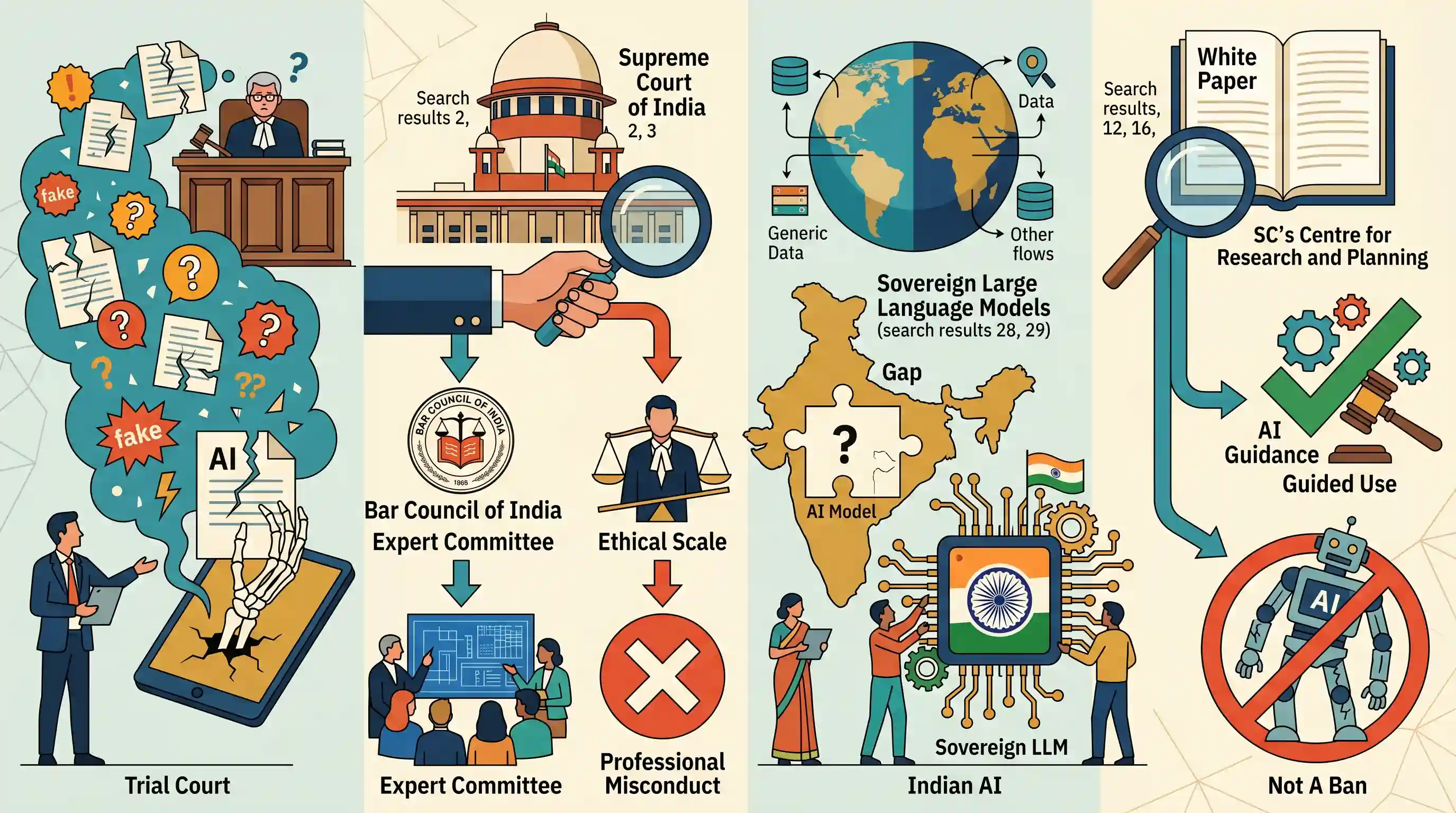
The Supreme Court of India has asked the Bar Council of India to form an expert committee to examine the risks of artificial intelligence (AI) in legal proceedings. This follows an incident where a trial court relied on non-existent, AI-generated judgments—a phenomenon known as AI 'hallucination'. The apex court asserted that citing fake AI judgments amounts to professional misconduct rather than a simple error. Emphasizing the need for accountability, the Court also raised concerns over the lack of 'sovereign large language models' (LLMs) for India. A white paper on AI use in the judiciary has already been prepared by the SC's Centre for Research and Planning to guide future regulations without outright banning the technology.
Key Points
- The Supreme Court directed the Bar Council of India to establish an expert committee to study the risks of AI in court proceedings.
- The directive was prompted by a trial court relying on non-existent, AI-generated fake judgments (AI 'hallucinations').
- The SC ruled that relying on fake AI judgments constitutes 'misconduct' carrying legal consequences, rather than a mere judicial error.
- The Court highlighted concerns regarding the absence of 'sovereign large language models (LLMs)' and the inherent risks of open-source algorithms.
- The SC clarified its intention is not to ban AI in the judiciary but to formulate guidelines and ensure professional accountability.
Important Terms
AI Hallucination

The phenomenon where artificial intelligence generates factually incorrect or non-existent information, such as fictitious legal citations, that appears plausible.
UPSC context
GS Paper III (Science & Technology/AI Ethics); tests understanding of risks in Generative AI and automated systems.
Bar Council of India (BCI)
A statutory body established under the Advocates Act, 1961, that regulates the legal profession and education in India.
UPSC context
GS Paper II (Statutory Bodies); tests knowledge of regulatory frameworks for professional ethics and legal conduct.
Centre for Research and Planning (CRP)
The Supreme Court's in-house think tank that focuses on judicial reforms, data collection, and drafting policy papers for the judiciary.
UPSC context
GS Paper II (Judiciary); relevant for questions on institutional reforms and e-governance in the justice system.
India AI Governance Guidelines 2025
A 2025 framework by MeitY setting principles like trust and accountability to balance AI innovation with risk mitigation in India.
UPSC context
GS Paper II (Governance) & GS III (Technology); tests awareness of national policies on emerging tech.
Sovereign Large Language Models (LLMs)
State-controlled or domestically developed AI models designed to ensure data privacy, cultural relevance, and national security in sensitive sectors.
UPSC context
GS Paper III (Internal Security/Technology); concerns data sovereignty and reducing reliance on foreign tech infrastructure.
Professional Misconduct
Behaviors by legal professionals that breach ethical codes; the SC ruled that citing fake AI judgments falls under this category.
UPSC context
GS Paper IV (Ethics); tests the application of ethical standards in the face of technological challenges.
Prelims Trap
The Supreme Court has banned the use of Generative AI in legal proceedings.
The SC explicitly clarified it does not intend to ban AI, but rather seeks to formulate guidelines and ensure human-verified accountability.
Static Concepts Connected
What distinguishes a 'Sovereign Large Language Model (LLM)'?
- Domestic Training Data: Trained exclusively on national datasets, reflecting local cultural, legal, and linguistic contexts to reduce systemic bias.
- Strategic Autonomy: Mitigates risks of data colonialism and reliance on foreign open-source algorithms for sensitive state functions.
What are the key AI initiatives assisting the Indian Judiciary?
- SUVAS: Supreme Court Vidhik Anuvaad Software uses AI to translate judicial documents and judgments into regional vernacular languages.
- SUPACE: Supreme Court Portal for Assistance in Court Efficiency processes data to assist judges with legal research and case management.
Cross-Topic Patterns
AI Hallucinations + Statutory Misconduct
Links unregulated generative AI outputs directly to professional misconduct under the Advocates Act, merging technology ethics with statutory legal accountability.
Sovereign AI + Data Localization
The SC’s demand for 'Sovereign LLMs' echoes the Justice Srikrishna Committee's rationale for data localization, treating algorithmic autonomy as critical national infrastructure.

A multi-statement Prelims question pairing 'AI Hallucinations' with SC portals (SUVAS/SUPACE) is highly probable in 2026.
Linked PYQs · 4
Linked PYQs · 4
- 2023MainsGS3
Introduce the concept of Artificial Intelligence (AI). How does Al help clinical diagnosis? Do you perceive any threat to privacy of the individual in the use of Al in healthcare?
- 2024MainsGS4
The application of Artificial Intelligence as a dependable source of input for administrative rational decision-making is a debatable issue. Critically examine the statement from the ethical point of view.
- 2024MainsGS2
e-governance is not just about the routine application of digital technology in service delivery process. It is as much about multifarious interactions for ensuring transparency and accountability. In this context evaluate the role of the 'Interactive Service Model' of e-governance.
- 2021MainsGS4
Impact of digital technology as reliable source of input for rational decision making is a debatable issue. Critically evaluate with suitable example.
