Dharmasthala Case Gag Order and Judicial Hierarchy Standards
Source:The Hindu ↗
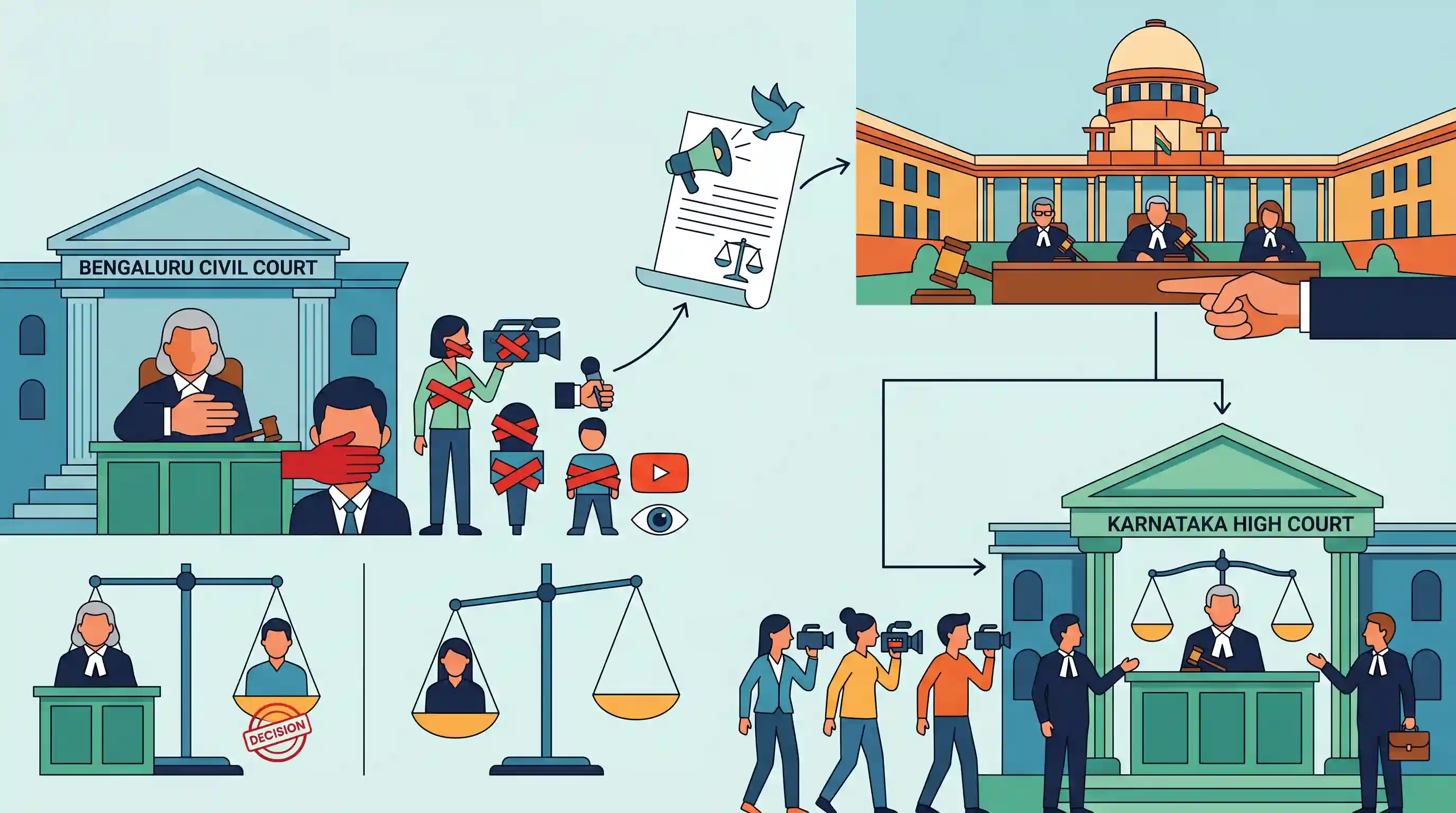
Why It Matters
This case exemplifies the tension between the media's fundamental right to free speech and individuals' right to reputation, while also highlighting the procedural protocols of judicial hierarchy (approaching High Courts before the Supreme Court) and the constitutional scrutiny of ex-parte gag orders.
Summary
The Supreme Court of India has directed the YouTube channel 'Third Eye' to approach the Karnataka High Court to challenge an ex-parte gag order issued by a Bengaluru civil court. The civil court's order restrained media outlets from publishing potentially defamatory material regarding the 'Dharmasthala burials' case and the temple's administration. The channel's petition argued that the sweeping, pre-publication censorship order violates the freedom of speech and expression guaranteed under Article 19(1)(a) of the Constitution. Additionally, it claimed that the ex-parte nature of the order, issued without a hearing, violates the principles of natural justice and due process under Article 21. The Supreme Court's refusal to hear the case directly underscores the procedural expectation that litigants exhaust remedies at the High Court level before approaching the apex court.
Key Points
- The Supreme Court declined to directly entertain a petition from a YouTube channel challenging a Bengaluru civil court's sweeping gag order, directing them to approach the Karnataka High Court first.
- The civil court had issued an ex-parte order restraining over 50 media outlets from publishing defamatory content related to the Dharmasthala burials case.
- The petitioners argued that the gag order violates the fundamental right to freedom of speech and the press under Article 19(1)(a).
- The petition also contended that the order was passed without notice or hearing, thereby breaching the principles of natural justice and due process under Article 21.
Important Terms
Article 19(1)(a)

Constitutional provision guaranteeing freedom of speech and expression. It encompasses press freedom and the right to information, subject to reasonable restrictions like public order or defamation.
UPSC context
GS II: Fundamental Rights. Essential for topics on media freedom, civil liberties, and constitutional checks on power.
Article 21
Guarantees that no person shall be deprived of life or personal liberty except by procedure established by law, incorporating the right to a fair trial and due process.
UPSC context
GS II: Polity. Core to judicial interpretation of 'due process' and protection against arbitrary judicial or state action.
Gag Order
A legal injunction restricting information or comments from being made public. Used to prevent pre-trial prejudice or protect a party's reputation from potentially defamatory content.
UPSC context
GS II: Media/Judiciary. Relevant for debates on 'prior restraint' versus freedom of the press.
Principles of Natural Justice
Procedural safeguards ensuring fairness, primarily comprising 'audi alteram partem' (the right to be heard) and the rule against bias (no one should judge their own cause).
UPSC context
GS II: Governance/Law. Tests understanding of judicial fairness and procedural requirements for authoritative decisions.
Exhaustion of Remedies
A judicial principle requiring litigants to pursue relief through available lower courts (like High Courts) before approaching the Supreme Court under its extraordinary jurisdiction.
UPSC context
GS II: Judicial Procedures. Explains the hierarchy between High Courts and the Supreme Court in writ jurisdiction.
Ex-parte Order
A judicial order granted for the benefit of one party without notice to or hearing from the opposing party, typically in urgent or emergency situations.
UPSC context
GS II: Judicial Process. Highlights the tension between urgent relief and the right to be heard.
Prelims Trap
The Supreme Court cannot refuse an Article 32 petition because moving the SC is itself a Fundamental Right.
Though Article 32 is a Fundamental Right, the Supreme Court frequently applies the exhaustion of alternative remedies rule, directing petitioners to High Courts.
Static Concepts Connected
How does writ jurisdiction under Article 32 differ from Article 226?
- Scope: The Supreme Court issues writs only for Fundamental Rights; High Courts can issue them for Fundamental Rights and other legal rights.
- Territorial reach: The Supreme Court's writ jurisdiction spans the entire country; a High Court is confined to its territorial limits unless the cause of action arises there.
- Discretion: While Article 32 is a Fundamental Right, the Supreme Court increasingly exercises discretion to require exhausting the Article 226 remedy first to prevent docket explosion.
What is 'Prior Restraint' in Indian constitutional law?
- Concept: It means preventing publication or speech before it happens, commonly referred to as pre-censorship.
- Constitutionality: It is generally considered violative of Article 19(1)(a) unless strictly justified under the enumerated reasonable restrictions in Article 19(2).
- Natural Justice: Issuing ex-parte gag orders without hearing the publisher violates 'audi alteram partem', a core facet of Natural Justice embedded in Article 21.
Cross-Topic Patterns
Defamation vs Free Speech
The tension between the right to reputation (protected under Article 21) and freedom of the press (Article 19) frequently requires strict judicial balancing in gag order cases.
Digital Media & IT Rules
A YouTube channel invoking press freedom ties into the broader syllabus theme of regulating digital news publishers and OTT platforms under the IT Rules.

Expect a comparative Prelims statement testing if the Supreme Court can refuse an Article 32 petition when an Article 226 remedy exists.
Linked PYQs · 2
Linked PYQs · 2
- 2014MainsGS2
What do you understand by the concept "freedom of speech and expression"? Does it cover hate speech also ? Why do the films in India stand on a slightly different plane from other forms of expression ? Discuss.
- 2024MainsGS2
Right to privacy is intrinsic to life and personal liberty and is inherently protected under Article 21 of the constitution. Explain. In this reference discuss the law relating to D.N.A. testing of child in the womb to establish its paternity.
