Supreme Court Suggests National Testing Body for Law Entrance
Source:The Hindu ↗
Why It Matters
This development highlights the critical gap in institutional capacity and regulatory frameworks governing higher education entrance exams in India. It also illustrates the ongoing role of the judiciary (via PILs and suo motu actions) in prompting the executive to establish robust, independent regulatory institutions to secure transparency, fairness, and accountability in public administration.
Summary
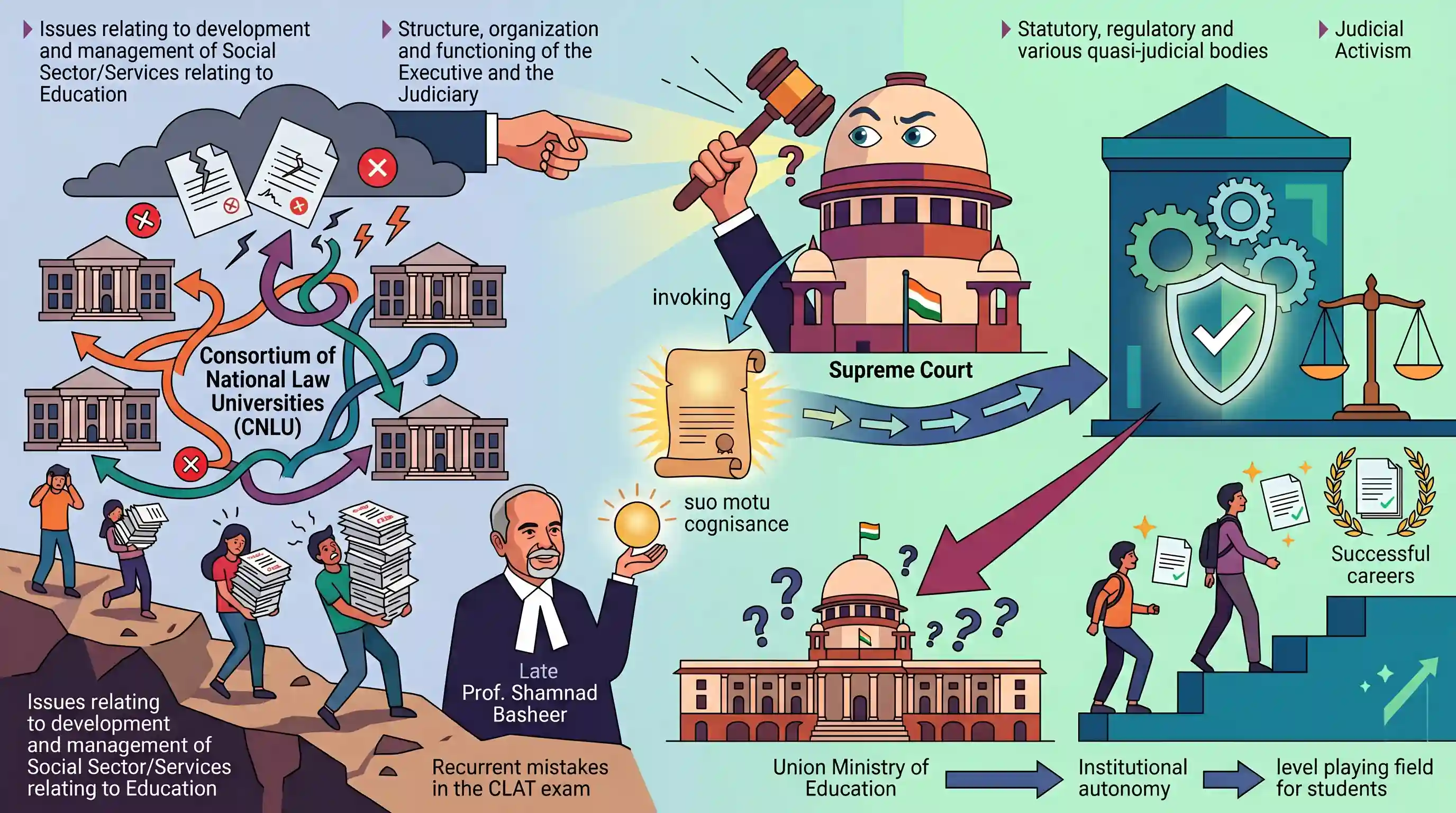
The Supreme Court expressed severe dissatisfaction with the Consortium of National Law Universities (CNLU) over recurrent errors in the CLAT 2025 exam. Citing systemic flaws stemming from the current rotational system where different universities conduct the exam each year, the Court questioned the Union Ministry of Education on why a permanent, independent testing mechanism—akin to the National Testing Agency (NTA) for NEET—cannot be established. Referencing its own 2018 judgment and taking suo motu cognisance of a prior PIL by the late Prof. Shamnad Basheer, the judiciary emphasized the urgent need for structural reform to ensure fairness, institutional autonomy, and a level playing field for students.
Key Points
- The Supreme Court strongly criticized the Consortium of National Law Universities (CNLU) for framing CLAT 2025 questions in a casual, error-riddled manner.
- CLAT is currently administered by member universities of the CNLU on a rotational basis, which the Court believes contributes to systemic inconsistencies.
- The Court questioned the Union Ministry of Education and CNLU on why a permanent testing mechanism, similar to the National Testing Agency (NTA) that conducts NEET, cannot be established.
- The Court invoked its 2018 judgment which had previously flagged issues like yearly rotation of exam-conducting duties and excessive fees.
- The SC took suo motu cognisance of a petition initially filed by the late Prof. Shamnad Basheer advocating for an independent and permanent testing body.
Important Terms
Consortium of National Law Universities (CNLU)

A group of National Law Universities (NLUs) formed in 2017 to manage the Common Law Admission Test (CLAT). It is a non-statutory body currently conducting the exam on a rotational basis.
UPSC context
GS Paper-II (Education, Regulatory Bodies). Relevant for reforms in educational governance and institutional autonomy in higher education.
National Testing Agency (NTA)
An autonomous body under the Ministry of Education established to conduct transparent, standardized entrance examinations like NEET and JEE for higher education institutions in India.
UPSC context
GS Paper-II (Social Sector/Education, Statutory/Regulatory Bodies). Tests understanding of specialized agencies aimed at improving examination standards.
Bar Council of India (BCI)
A statutory body established under the Advocates Act, 1961, to regulate legal practice and prescribe standards for legal education in India.
UPSC context
GS Paper-II (Statutory Bodies, Education). Important for understanding the regulation of professional education and legal standards.
Suo Motu Cognisance
A legal term meaning "on its own motion," where a court independently initiates legal proceedings on a matter of public importance without a formal petition.
UPSC context
GS Paper-II (Judiciary, Judicial Activism). Key concept for the Supreme Court’s proactive role in addressing systemic public grievances.
Public Interest Litigation (PIL)
A legal action initiated in a court for the enforcement of public interest or general welfare, allowing any citizen to seek judicial remedy for societal issues.
UPSC context
GS Paper-II (Judiciary). A fundamental tool for judicial activism and the protection of fundamental rights for marginalized sections.
Common Law Admission Test (CLAT)
The centralized national-level entrance exam for admissions to undergraduate and postgraduate programs at participating National Law Universities across India.
UPSC context
GS Paper-II (Education). Contextual for reforms in higher education, standardization of entrance tests, and student welfare.
Prelims Trap
"The National Testing Agency (NTA) is a statutory body established by an Act of Parliament."
NTA is not a statutory body. It is an autonomous testing organization established as a Society under the Indian Societies Registration Act, 1860, by the Ministry of Education.
Static Concepts Connected
What constitutional provisions enable Indian courts to take suo motu cognizance?
- Articles 32 & 226: Allows the Supreme Court and High Courts to initiate proceedings for fundamental rights enforcement without formal petitions, expanding access to justice.
- Epistolary Jurisdiction: Relaxation of traditional locus standi rules allows constitutional courts to act independently based on news reports, letters, or their own awareness.
- Articles 129 & 215: Courts can also initiate suo motu proceedings to punish individuals for contempt of court, ensuring the authority and dignity of the judiciary.
What is the structural mandate of the National Testing Agency (NTA)?
- Legal Status: It is registered as a Society under the Indian Societies Registration Act, 1860. It does not have statutory backing via a specific Act of Parliament.
- Nodal Ministry: Established by the Union Ministry of Education as an autonomous, self-sustained premier testing organization to conduct efficient and transparent higher education exams.
Cross-Topic Patterns
Judicial Activism vs Policy Making
SC directing the creation of a permanent exam body touches upon executive domain, making it a classic case study for Separation of Powers and Judicial Overreach in Mains GS2.
Centralized Testing & Exam Integrity
The push for centralized, error-free testing bodies aligns with the Public Examination Act 2024 aimed at curbing organized malpractices in exams conducted by central agencies like NTA.

Expect a 2026 prelims statement pairing NTA's non-statutory status (Society) with the penal provisions of the Public Examination Act 2024.
Linked PYQs · 3
Linked PYQs · 3
- 2024MainsGS2
What are the aims and objects of recently passed and enforced, The Public Examination (Prevention of Unfair Means) Act, 2024? Whether University/State Education Board examinations, too, are covered under the Act ?
- 2020MainsGS2
Judicial Legislation is antithetical to the doctrine of separation of powers as envisaged in the Indian Constitution. In this context justify the filing of large number of public interest petitions praying for issuing guidelines to executive authorities.
- 2015MainsGS2
For achieving the desired objectives, it is necessary to ensure that the regulatory institutions remain independent and autonomous. Discuss in the light of the experiences in recent past.
