Supreme Court compensation ruling on emergency medical care denial
Source:The Hindu ↗
ఇది ఎందుకు ముఖ్యం
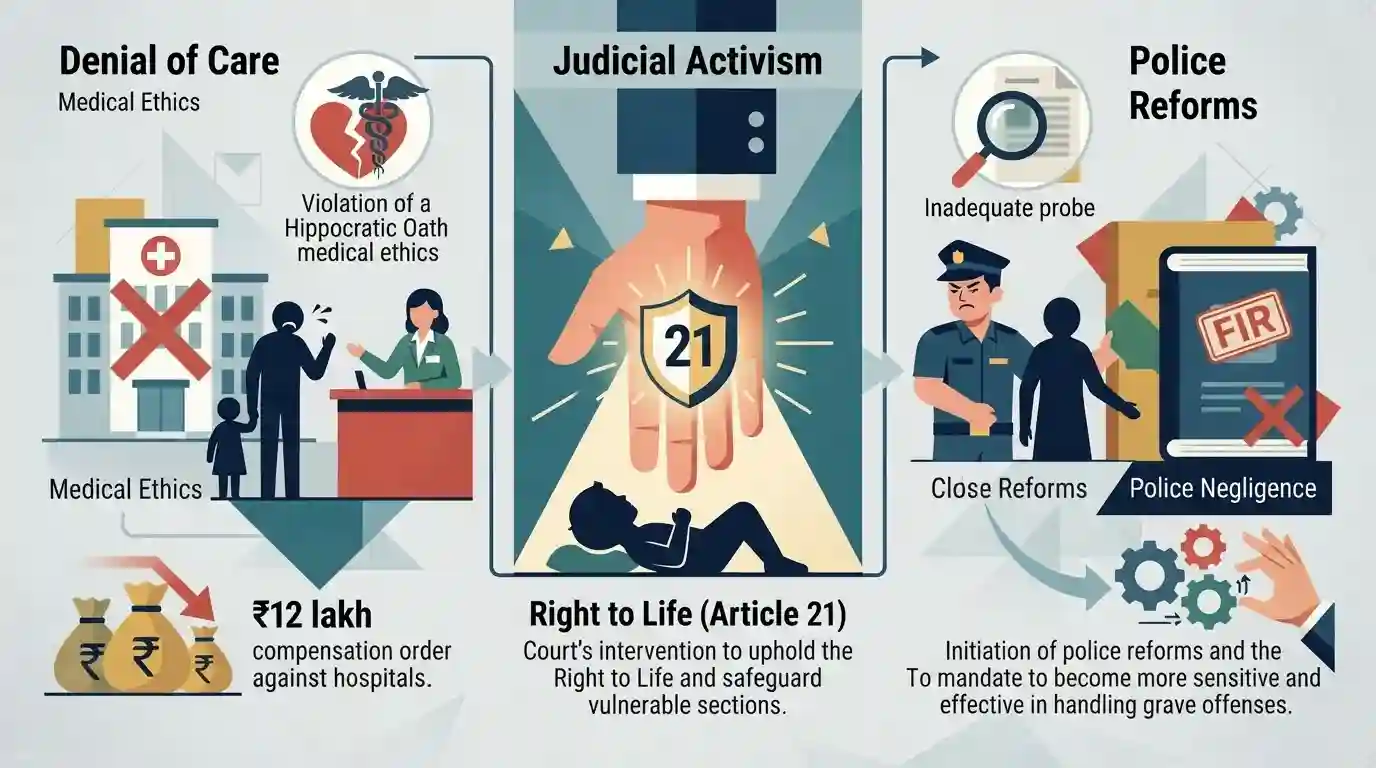
This judgment illustrates the expanding interpretation of Article 21 (Right to Life) encompassing emergency medical care. It provides a real-world example of judicial intervention (laying down guidelines for the executive and private entities) to address systemic apathy in police investigations and healthcare delivery, which is highly relevant for GS2 (Governance/Constitution) and GS4 (Empathy and Compassion in Public Service).
సారాంశం
The Supreme Court has ordered two Ghaziabad hospitals to pay ₹12 lakh in compensation to the family of a 4-year-old rape victim who died after being denied emergency medical treatment. The Court reprimanded the local police for their "insensitive approach" in registering the FIR and conducting the probe. Recognizing the denial of emergency care as a violation of the right to life under Article 21, the apex court stated it will lay down comprehensive guidelines for hospitals and law enforcement agencies to effectively deal with victims of grave offenses, thereby addressing both medical apathy and police negligence.
ముఖ్య అంశాలు
- The Supreme Court directed two Ghaziabad hospitals to pay ₹12 lakh to the father of a deceased four-year-old rape victim for refusing emergency treatment.
- The bench severely criticized the Ghaziabad police for their insensitive approach and mishandling of the FIR and investigation.
- Invoking the fundamental right to life, the Court announced it will formulate broad guidelines for hospitals and law enforcement agencies across the country on handling victims of grave offenses.
- The ruling underscores the constitutional obligation of hospitals to provide immediate emergency medical aid, overriding administrative or legal formalities.
ముఖ్యమైన పదాలు
Article 21

A Fundamental Right guaranteeing protection of life and personal liberty. The Supreme Court continually expands its scope, ruling that denying timely emergency medical treatment to victims of grave offenses directly violates this right to life.
UPSC context
GS Paper 2 (Constitution). Tests the expanded interpretation of fundamental rights, specifically the right to health and emergency care.
Supreme Court
India's apex judicial body. It frequently exercises judicial activism—as seen here by framing national guidelines for hospitals and police—to protect fundamental rights when institutional apathy causes harm.
UPSC context
GS Paper 2 (Judiciary). Evaluates the Court's proactive role in enforcing executive accountability and filling legislative vacuums via binding guidelines.
Ghaziabad police
The local law enforcement criticized by the Supreme Court for an "insensitive approach" and a 30-hour delay in registering an accurate FIR, exemplifying institutional negligence and highlighting the pressing need for nationwide police reforms.
UPSC context
GS Paper 2 (Governance) and GS Paper 4 (Ethics). Tests police accountability, empathy toward vulnerable sections, and procedural integrity.
Special Investigation Team (SIT)
A specialized, court-monitored committee formed to conduct an independent probe into complex or sensitive cases, particularly when local law enforcement is accused of severe negligence, bias, or cover-ups.
UPSC context
GS Paper 2 (Governance/Judiciary). Tests mechanisms for ensuring independent investigations and executive accountability in the criminal justice system.
Medical Ethics
The moral principles governing medical practice. The denial of critical, life-saving emergency care to a bleeding 4-year-old child by private hospitals represents a severe breach of these ethics and fundamental human rights.
UPSC context
GS Paper 4 (Ethics) and GS Paper 2 (Health). Tests the conflict between institutional profit/liability concerns and the duty of care.
ప్రిలిమ్స్ ఉచ్చు
The obligation to provide emergency medical aid under Article 21 applies exclusively to government hospitals.
The Supreme Court ruled in Parmanand Katara (1989) that all doctors and hospitals, whether public or private, bear this paramount constitutional obligation.
అనుసంధానమైన స్థిర భావనలు
How is the Right to Emergency Medical Care protected under Article 21?
- Parmanand Katara (1989): Established that all medical professionals must provide immediate aid in emergencies without waiting for police or legal formalities.
- Paschim Banga (1996): Ruled that failure of a government hospital to provide timely emergency treatment violates the patient's right to life.
Which core principles govern medical and administrative ethics in emergencies?
- Beneficence: Medical professionals must always act in the best interest of the patient, prioritizing life over institutional red-tape.
- Compassion & Empathy: A foundational public service value requiring law enforcement to handle vulnerable victims (like children) with utmost sensitivity.
అంతర-అంశ నమూనాలు
Judicial guidelines as interim laws
The SC's intent to frame nationwide hospital guidelines mirrors past activism (e.g., Vishaka guidelines), temporarily stepping into executive domains to address glaring legislative vacuums.
Police reforms beyond structural changes
While the Prakash Singh directives focus heavily on structural autonomy, this case highlights the glaring need for behavioral reforms and sensitization training for first responders.

Expect a GS2/GS4 question in 2026 linking Article 21 (Right to Emergency Care) with medical ethics and the limits of judicial activism.
అనుసంధాన PYQలు · 4
అనుసంధాన PYQలు · 4
- 2023MainsGS2
“The Constitution of India is a living instrument with capabilities of enormous dynamism. It is a constitution made for a progressive society.” Illustrate with special reference to the expanding horizons of the right to life and personal liberty.
- 2020MainsGS2
Judicial Legislation is antithetical to the doctrine of separation of powers as envisaged in the Indian Constitution. In this context justify the filing of large number of public interest petitions praying for issuing guidelines to executive authorities.
- 2024MainsGS2
Right to privacy is intrinsic to life and personal liberty and is inherently protected under Article 21 of the constitution. Explain. In this reference discuss the law relating to D.N.A. testing of child in the womb to establish its paternity.
- 2022MainsGS4
Apart from intellectual competency and moral qualities, empathy and compassion are some of the other vital attributes that facilitate the civil servants to be more competent in tackling the crucial issues or taking critical decisions. Explain with suitable illustrations.
