Supreme Court Proposes Raising Judicial Officers Retirement Age
Source:The Hindu ↗
ఇది ఎందుకు ముఖ్యం
The district judiciary handles the bulk of the country's litigation, yet its judges retire earlier (60) than High Court (62) and Supreme Court (65) judges. Harmonizing the retirement age is crucial for retaining experienced judicial minds, thereby helping to clear the severe backlog of over 5 crore pending cases. It also touches upon federalism and the separation of powers, as the administrative control over the subordinate judiciary is shared between State governments and High Courts.
సారాంశం
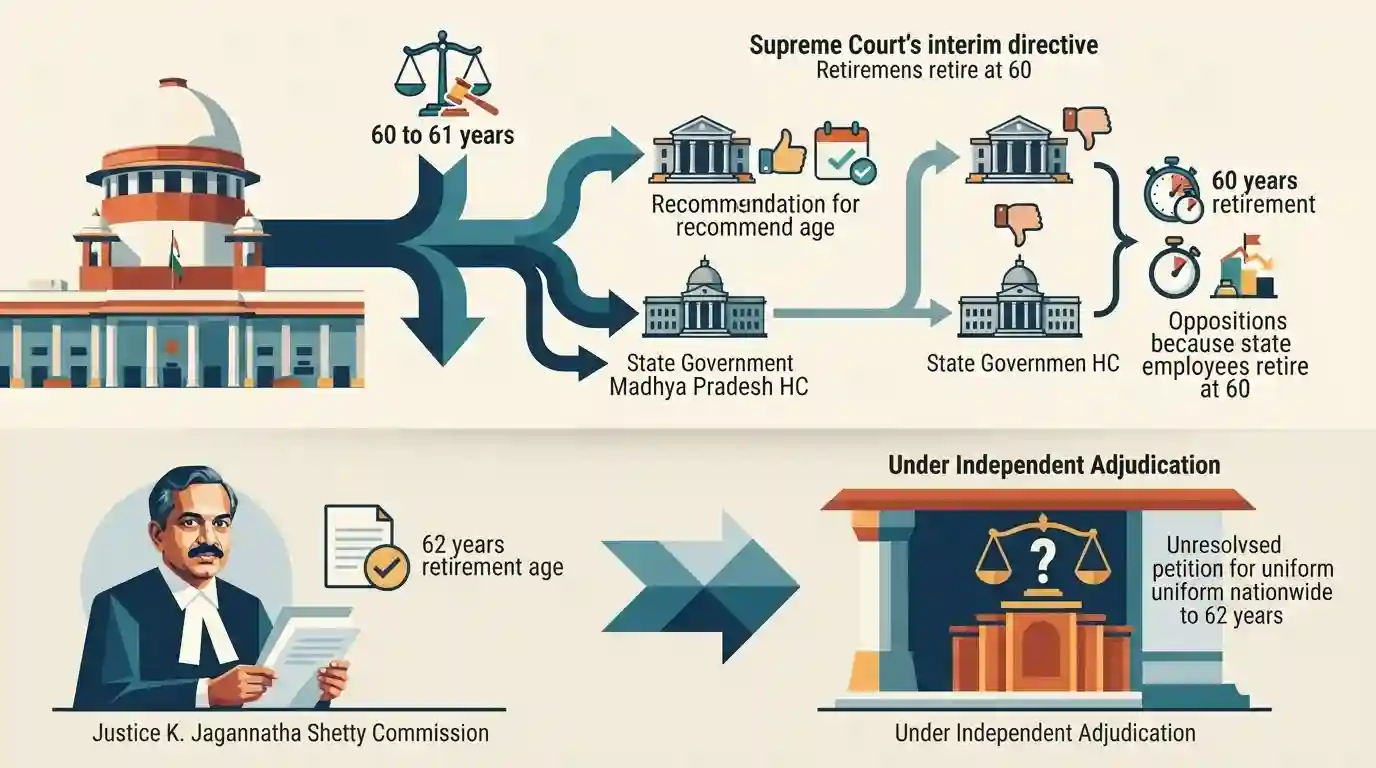
The Supreme Court of India has asked State governments and Union Territories to consider raising the retirement age of district judicial officers from 60 to 61 years as an interim arrangement. A Bench led by CJI Surya Kant ordered that this extension applies wherever there is concurrence between the State government and the jurisdictional High Court. The directive came while hearing a petition seeking a uniform nationwide enhancement of the retirement age for subordinate judiciary to 62 years. The Court noted divergent views among states—while the Madhya Pradesh High Court recommended the increase, the Punjab and Haryana High Court opposed it because state government employees there still retire at 60. The substantive question of a uniform retirement age of 62, previously recommended by the Justice K. Jagannatha Shetty Commission, remains under independent adjudication by the Supreme Court.
ముఖ్య అంశాలు
- The Supreme Court directed States and Union Territories to consider an interim measure to raise the retirement age of district judicial officers from 60 to 61 years.
- This age enhancement will be permitted in states where both the State government and the respective jurisdictional High Court reach a consensus.
- The directive was issued during the hearing of a petition demanding a uniform enhancement of the retirement age for the subordinate judiciary to 62 years across India.
- High Court judges currently retire at 62 and Supreme Court judges at 65, creating a disparity that affects the retention of experienced judges at the district level.
- The issue traces back to the Supreme Court's 2002 judgment, which had declined the Justice K. Jagannatha Shetty Commission's recommendation to uniformly raise the retirement age of district judges to 62.
ముఖ్యమైన పదాలు
Supreme Court of India

The apex judicial body in India, established under Article 124 of the Constitution. It acts as the final court of appeal, protector of fundamental rights, and ultimate interpreter of the Constitution.
UPSC context
GS Paper II: Structure, organization, and functioning of the judiciary; separation of powers; and judicial review.
Justice K. Jagannatha Shetty Commission
Officially the First National Judicial Pay Commission, constituted in 1996. It recommended uniform pay structures, improved service conditions, and raising the district judiciary's retirement age to 62 years.
UPSC context
GS Paper II: Subordinate judiciary reforms, pay commissions, and service conditions of district judges.
Madhya Pradesh High Court
The principal civil court of original jurisdiction in Madhya Pradesh, established under the States Reorganisation Act, 1956. It exercises administrative control over the state's subordinate judiciary.
UPSC context
GS Paper II: Federal structure, jurisdictional issues, and judicial administration at the state level.
Punjab and Haryana High Court
The common High Court for the states of Punjab and Haryana and the Union Territory of Chandigarh, exercising superintendence over their district judiciaries.
UPSC context
GS Paper II: State-level judiciary, joint high courts, and federal administrative challenges.
Telangana High Court
The High Court for the state of Telangana, which previously took progressive steps towards raising the superannuation age of its subordinate judicial officers.
UPSC context
GS Paper II: Comparative study of state judicial administrative policies and federal diversity.
ప్రిలిమ్స్ ఉచ్చు
The retirement age of subordinate court judges is constitutionally fixed and can only be increased via a parliamentary constitutional amendment.
Unlike HC/SC judges (whose retirement ages are constitutionally fixed), subordinate judges' retirement ages are governed by state rules framed under Article 309 in consultation with High Courts.
అనుసంధానమైన స్థిర భావనలు
What are the primary constitutional provisions governing the administration of subordinate courts in India?
- Article 233: The Governor appoints, posts, and promotes district judges in strict consultation with the state's jurisdictional High Court.
- Article 235: Vests the administrative control over subordinate courts (including postings, promotions, and discipline) entirely in the High Court to safeguard judicial independence.
- Article 234: Governs recruitment of persons other than district judges to the judicial service, requiring consultation with the State Public Service Commission and the High Court.
అంతర-అంశ నమూనాలు
Judicial administration vs state federal autonomy
Examines the friction between the Supreme Court's push for uniform judicial service conditions and the states' constitutional powers under Article 309 to regulate their own public services.
Lower court vacancy and Article 21
Connects judicial career-span extensions directly to reducing the massive backlog of lower-court cases, reinforcing the constitutional promise of speedy justice under Article 21.

Questions on the interplay of Articles 233-235 and the Governor's role in judicial service conditions are highly probable for Prelims 2026.
అనుసంధాన PYQలు · 3
అనుసంధాన PYQలు · 3
- 2023MainsGS2
“Constitutionally guaranteed judicial independence is a prerequisite of democracy.” Comment.
- 2025MainsGS2
Discuss the evolution of collegium system in India. Critically examine the advantages and disadvantages of the system of appointment of the Judges of the Supreme Court of India and that of the USA.
- 2017MainsGS2
Critically examine the Supreme Court's judgement on 'National Judicial Appointments Commission Act, 2014' with reference to appointment of judges of higher judiciary in India.
