Supreme Court Ruling on Civil Suits for Vaccine Compensation
Source:The Hindu ↗
Why It Matters
It illustrates the practical limitations of using writ jurisdiction (Article 32) for compensation claims, reinforcing the legal distinction between constitutional remedies and civil suits for damages (tort law). It also touches upon the ongoing discourse surrounding vaccine liability and Adverse Effects Following Immunisation (AEFI).
Summary
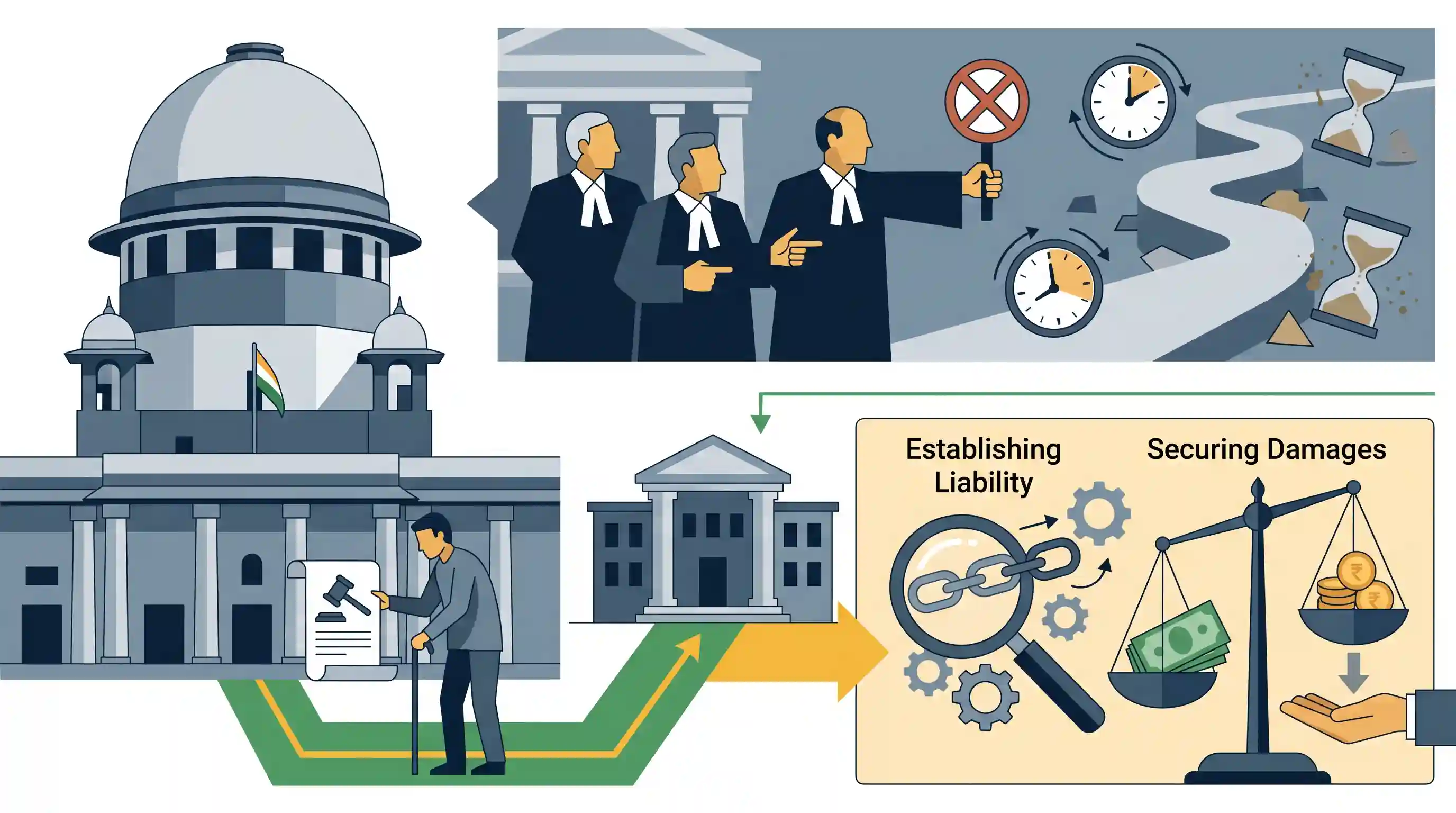
The Supreme Court has advised a petitioner claiming severe disability after a COVID-19 vaccination to file a civil suit for damages instead of a writ petition under Article 32. The court emphasized that civil suits are the appropriate avenue for establishing liability and securing monetary damages, noting the prolonged pendency that often plagues writ petitions. The petitioner had sought compensation and the establishment of guidelines for Adverse Effects Following Immunisation (AEFI) after receiving a dose of Covishield.
Key Points
- A petitioner approached the Supreme Court under Article 32 claiming 100% lower limb disability post his first dose of the Covishield vaccine.
- The petitioner sought damages, compensation for future medical expenses, and guidelines for Adverse Effects Following Immunisation (AEFI).
- The Supreme Court bench advised the petitioner to file a civil suit for damages rather than continuing with a writ petition under Article 32.
- The Court noted that writ petitions can remain pending for years without providing concrete relief, whereas a civil suit is the appropriate legal mechanism to establish manufacturer liability and claim damages based on evidence.
Important Terms
Article 32

A fundamental right in the Indian Constitution that empowers citizens to approach the Supreme Court directly for the enforcement of their other fundamental rights through various writs.
UPSC context
GS Paper II (Polity); essential for understanding constitutional remedies and the protector-of-rights role of the Supreme Court.
Adverse Events Following Immunization (AEFI)
Any untoward medical occurrence that follows immunization and which does not necessarily have a causal relationship with the vaccine, requiring systematic surveillance for public safety.
UPSC context
GS Paper II & III (Health/S&T); relevant for vaccine safety, public health governance, and regulatory accountability.
Writ Jurisdiction
The authority of the Supreme Court (Article 32) and High Courts (Article 226) to issue formal orders to protect legal and fundamental rights.
UPSC context
GS Paper II (Judiciary); tests knowledge of judicial powers and the distinction between public and private law remedies.
Covishield
A viral vector vaccine developed by Oxford-AstraZeneca and manufactured by the Serum Institute of India, utilizing a recombinant, replication-deficient chimpanzee adenovirus platform.
UPSC context
GS Paper III (S&T); important for understanding vaccine platforms and India's response to the COVID-19 pandemic.
Serum Institute of India (SII)
An Indian biotechnology and biopharmaceutical company based in Pune; the world's largest vaccine manufacturer by volume of doses produced and sold globally.
UPSC context
GS Paper III (Economy/S&T); highlights India's industrial role in global healthcare and pandemic preparedness.
Civil Suit for Damages
A legal proceeding in a civil court where an individual seeks monetary compensation (damages) for injury, loss, or a breach of legal duties.
UPSC context
GS Paper II (Governance/Law); distinguishes between standard legal recourse for personal injury and constitutional petitions for rights violations.
Prelims Trap
The Supreme Court cannot refuse an Article 32 petition as the right to constitutional remedies is absolute.
While Article 32 is a Fundamental Right, the Supreme Court can decline petitions involving complex disputed facts (like medical causation) that require evidence, cross-examination, and civil trials.
Static Concepts Connected
Why do courts refer complex damage claims to civil suits rather than writs?
- Disputed Facts: Writs are primarily decided on affidavits. Establishing medical causation requires evidentiary trials and cross-examination.
- Private Entities: Writs (like Mandamus) generally enforce public duties by the State. Civil torts establish liability and exact unliquidated damages against private actors like vaccine manufacturers.
- Unliquidated Damages: Calculating unquantified (unliquidated) monetary compensation requires a rigorous civil trial to assess damages, which falls outside standard writ jurisdiction.
What constitutes an Adverse Event Following Immunization (AEFI)?
- Definition: Any untoward medical occurrence post-vaccination. It does not necessarily have a proven causal relationship with the vaccine usage.
- Surveillance: Tracked by the National AEFI Committee to maintain vaccine safety, identify immunization errors, and preserve public trust in health drives.
- Classification: Events are classified as vaccine product-related, quality defect-related, immunization error-related, anxiety-related, or purely coincidental.
Cross-Topic Patterns
Constitutional Writs vs. Tort Law
The shift from Article 32 writs to civil torts highlights the boundary between enforcing constitutional public duties (State) and claiming unliquidated private compensation for product liability (Private entities).
Vaccine safety and AEFI protocols
Post-COVID public health infrastructure often intersects with judicial scrutiny. Vaccine safety protocols (AEFI) tie into broader discussions on the Epidemic Diseases Act and disaster management frameworks.

Expect a tricky 2026 prelims statement on the SC's power to refuse Article 32 petitions when complex, disputed questions of fact exist.
Linked PYQs · 3
Linked PYQs · 3
- 2024PrelimsGS1
A Writ of Prohibition is an order issued by the Supreme Court or High Courts to :
- 2014PrelimsGS1
The power of the Supreme Court of India to decide disputes between the Centre and the States falls under its
- 2017MainsGS2
Examine the scope of Fundamental Rights in the light of the latest judgement of the Supreme Court on Right to Privacy.
