Sonam Wangchuk Preventive Detention and National Security Act Review
Source:The Hindu ↗
Why It Matters
The issue intertwines constitutional provisions related to preventive detention (Article 22) and the National Security Act with the governance of tribal areas (Sixth Schedule) and Union Territories. It is highly relevant for GS Paper 2 in terms of balancing national security with fundamental rights, as well as addressing the regional aspirations of Ladakh post the J&K Reorganization Act.
Summary
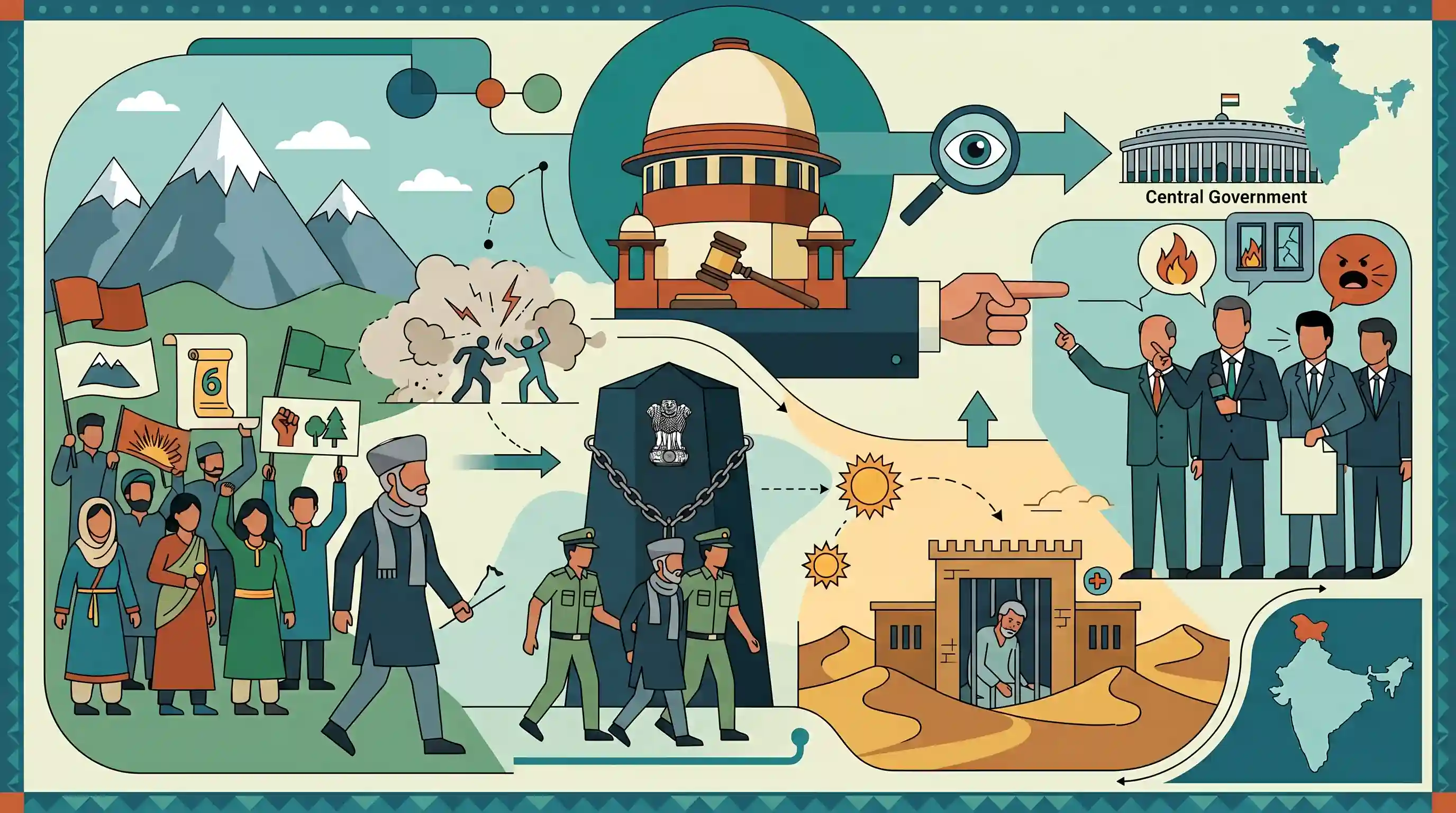
The Supreme Court of India has asked the Central Government to reconsider the continued detention of climate activist Sonam Wangchuk under the National Security Act (NSA) on health grounds. Wangchuk has been detained in Rajasthan's Jodhpur Central Jail since September 2025 following violent protests in Leh. The protests were centered around demands for Statehood and Sixth Schedule status for the Union Territory of Ladakh. While his wife filed a plea against the stringent NSA detention, the Centre defended its stance, arguing that Wangchuk's provocative speeches incited the violence.
Key Points
- The Supreme Court urged the Centre to reconsider the detention of climate activist Sonam Wangchuk under the National Security Act (NSA) citing his poor health.
- Wangchuk has been confined in Jodhpur Central Jail since September 2025.
- His detention followed protests demanding Statehood and Sixth Schedule status for the Union Territory of Ladakh.
- The Centre defended the detention, alleging that Wangchuk\'s provocative speeches instigated violence in Leh.
Important Terms
National Security Act (NSA), 1980

A 1980 law empowering the Centre or States to detain individuals without trial for up to 12 months to prevent actions prejudicial to national security or public order.
UPSC context
GS Paper II (Polity); tests understanding of executive preventive detention powers versus fundamental rights under Article 22.
Sixth Schedule
Constitutional provisions (Articles 244(2) and 275(1)) allowing autonomous administration of tribal areas through councils with legislative, judicial, and executive powers to protect tribal culture and land.
UPSC context
GS Paper II (Federalism); relevant to tribal governance and asymmetrical federalism demands in Ladakh.
Preventive Detention
Detention of an individual without trial or conviction to prevent future crimes, safeguarded by Article 22, which requires advisory board review for extensions beyond three months.
UPSC context
GS Paper II (Fundamental Rights); tests the balance between state security and individual liberty (Article 21).
Judicial Review
The power of the Supreme Court and High Courts to examine and invalidate legislative or executive actions that violate the Constitution or Fundamental Rights.
UPSC context
GS Paper II (Judiciary); a 'basic structure' element used to check executive overreach and safeguard the rule of law.
Habeas Corpus
A prerogative writ issued by courts to produce a detained person before them to determine the legality of their detention and order release if unlawful.
UPSC context
GS Paper II (Constitutional Remedies); the primary judicial tool for protecting personal liberty against arbitrary state action.
Statehood
The status of a Union Territory transitioning into a full constituent unit of the Indian Union, gaining its own elected legislature and executive powers.
UPSC context
GS Paper II (UT Administration); central to federalism debates regarding democratic representation in Ladakh and Jammu & Kashmir.
Prelims Trap
Preventive detention orders under the NSA are immune from judicial review if justified under national security.
Constitutional courts can always review preventive detention orders under Articles 32 and 226 to check for procedural lapses, mala fide intent, or humanitarian grounds (Art 21).
Static Concepts Connected
How does the Sixth Schedule differ from the Fifth Schedule for tribal administration?
- Geographic Scope: The Sixth Schedule applies exclusively to Assam, Meghalaya, Tripura, and Mizoram, while the Fifth applies to scheduled areas in other Indian states.
- Autonomy Level: Sixth Schedule establishes Autonomous District Councils (ADCs) with wider legislative/judicial powers, whereas the Fifth Schedule creates purely advisory Tribal Advisory Councils.
What safeguards does Article 22 provide against preventive detention laws like the NSA?
- Review Board: Detention cannot exceed three months unless an Advisory Board (comprising persons qualified to be High Court judges) reports sufficient cause for an extension.
- Communication: The detaining authority must communicate the grounds of detention to the individual as soon as possible, barring facts deemed against public interest.
- Right to Represent: The detenu must be afforded the earliest opportunity to make a representation against the detention order.
Cross-Topic Patterns
Sixth Schedule and ILP protective frameworks
Ladakh's demands overlap with Northeast India's use of Autonomous District Councils and Inner Line Permits to protect indigenous land, culture, and fragile demographics from external influx.
Himalayan Ecology vs UT Infrastructure
The climate angle of Wangchuk's protests links ecological fragility in high-altitude deserts to the friction of centralized administration in Union Territories lacking local legislative assemblies.

Expect a multi-statement Prelims question mixing Article 22 safeguards, NSA advisory board limits, and Sixth Schedule ADC powers in 2026.
Linked PYQs · 3
Linked PYQs · 3
- 2023PrelimsGS1
Consider the following statements: 1. According to the Constitution of India, the Central Government has a duty to protect States from internal disturbances. 2. The Constitution of India exempts the States from providing legal counsel to a person being held for preventive detention. 3. According to the Prevention of Terrorism Act, 2002, confession of the accused before the police cannot be used as evidence. How many of the above statements are correct?
- 2025MainsGS2
Discuss the nature of Jammu and Kashmir Legislative Assembly after the Jammu and Kashmir Reorganization Act, 2019. Briefly describe the powers and functions of the Assembly of the Union Territory of Jammu and Kashmir.
- 2023MainsGS2
“Constitutionally guaranteed judicial independence is a prerequisite of democracy.” Comment.
