Supreme Court Raises Legal Questions on Minors Social Media Access
Source:The Hindu ↗
Why It Matters
It bridges civil contract law, data protection frameworks (DPDP Act), and child welfare, forcing a re-evaluation of big tech's accountability in onboarding minor users.
Summary
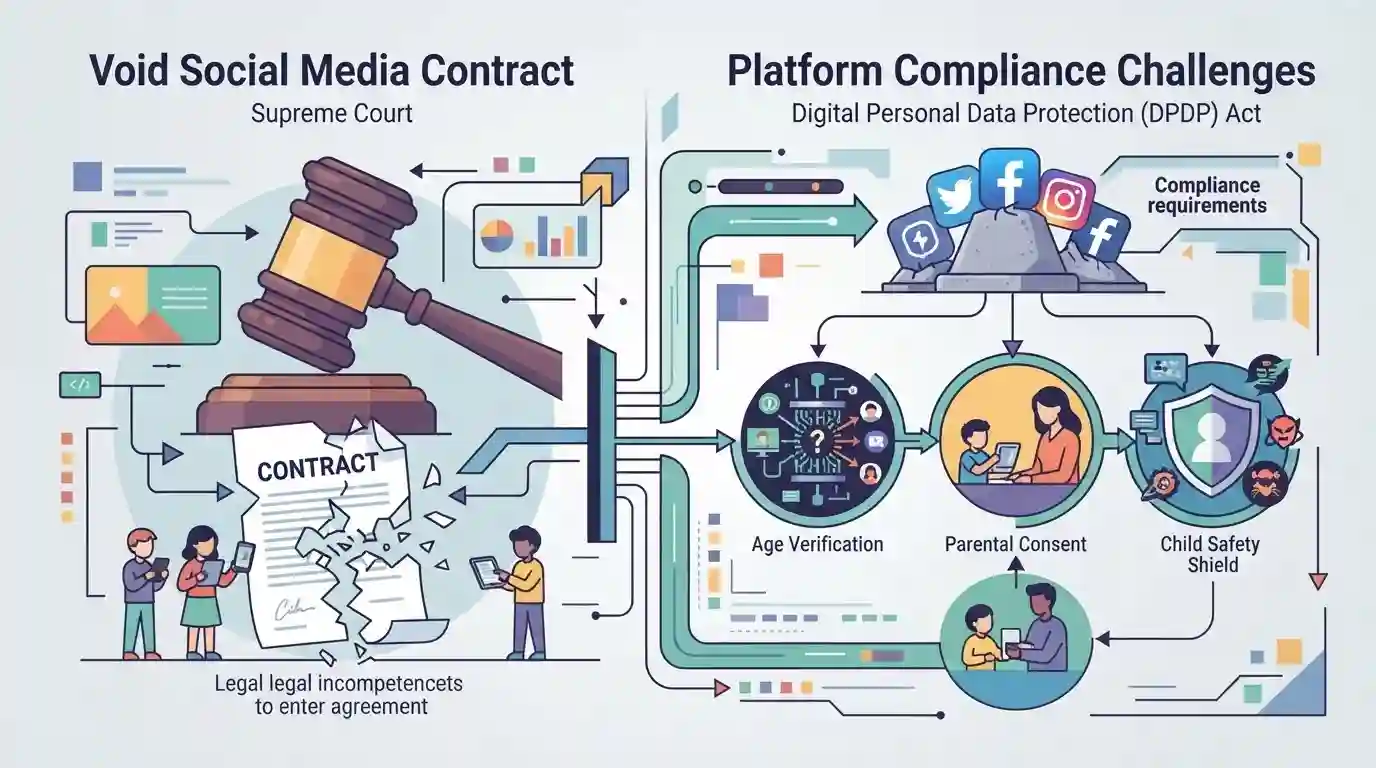
The Supreme Court of India raised critical legal questions regarding minors holding social media accounts, observing that the underlying terms of service contracts are legally void since minors are incompetent to contract under Indian law. The observation underscores major compliance challenges for technology platforms regarding age verification, consent, and child protection under frameworks like the DPDP Act.
Key Points
- The Supreme Court questioned how children can legally hold social media accounts given that the underlying Terms of Service/User Agreements constitute contracts, which are void ab initio when entered into by minors.
- Highlighted the legal inconsistency between the contractual incompetence of minors under contract law and their routine onboarding onto digital platforms.
- Raises significant issues regarding children's data privacy, online safety, parental consent, and the enforcement mechanisms under the Digital Personal Data Protection (DPDP) Act, 2023.
- Pushes focus toward structural liability for tech platforms regarding age verification and safeguarding minors online.
Important Terms
Digital Personal Data Protection (DPDP) Act, 2023

India's primary legislation governing data privacy, which mandates verifiable parental consent for processing personal data of children below 18 years and prohibits tracking or profiling them.
UPSC context
UPSC GS Paper-2/GS Paper-3 (Governance & Cyber Security/Data Protection). Tests knowledge of legal frameworks regulating digital rights, tech compliance, and minor safety.
Indian Contract Act, 1872
The foundational statute governing contracts in India, which mandates under Section 11 that minors lack capacity to contract, rendering such agreements void ab initio.
UPSC context
UPSC GS Paper-2 (Indian Polity & Governance / Judiciary / Civil Law). Tests core legal principles regarding contractual capacity and minor protection.
Static Concepts Connected
What is the legal status of an agreement made by a minor under the Indian Contract Act, 1872?
- Void Ab Initio: Under Section 11, minors lack contractual capacity; agreements made by minors are void ab initio (void from the very beginning).
- Judicial Precedent: As established by the landmark Privy Council case Mohori Bibee v. Dharmodas Ghose (1903), a minor's contract is entirely void.
- No Ratification: Minors cannot be asked to ratify an agreement upon attaining majority, as there is no prior valid contract to ratify.
Cross-Topic Patterns
Contract Law vs. Digital Data Protection Statutes
Minors cannot enter valid contracts under the Contract Act, yet the DPDP Act provides conditional access via parental consent, creating a statutory interplay that the judiciary must reconcile.

Expect a mains question on balancing minor online access rights with strict DPDP Act parental consent and contract law invalidity.
Linked PYQs · 3
Linked PYQs · 3
- 2025MainsGS2
The National Commission for Protection of Child Rights has to address the challenges faced by children in the digital era. Examine the existing policies and suggest measures the Commission can initiate to tackle the issue.
- 2024MainsGS3
Describe the context and salient features of the Digital Personal Data Protection Act, 2023.
- 2024MainsGS3
Social media and encrypting messaging services pose a serious security challenge. What measures have been adopted at various levels to address the security implications of social media? Also suggest any other remedies to address the problem.
