Supreme Court Seeks Himachal Government Report on Landslides
Source:The Hindu ↗
Why It Matters
The article highlights the ongoing conflict between rapid infrastructure development (highways, hydro projects) and ecological fragility in the Himalayan region. It emphasizes the importance of disaster preparedness, sustainable development, ecological zoning, and the active role of the judiciary in ensuring environmental accountability.
Summary
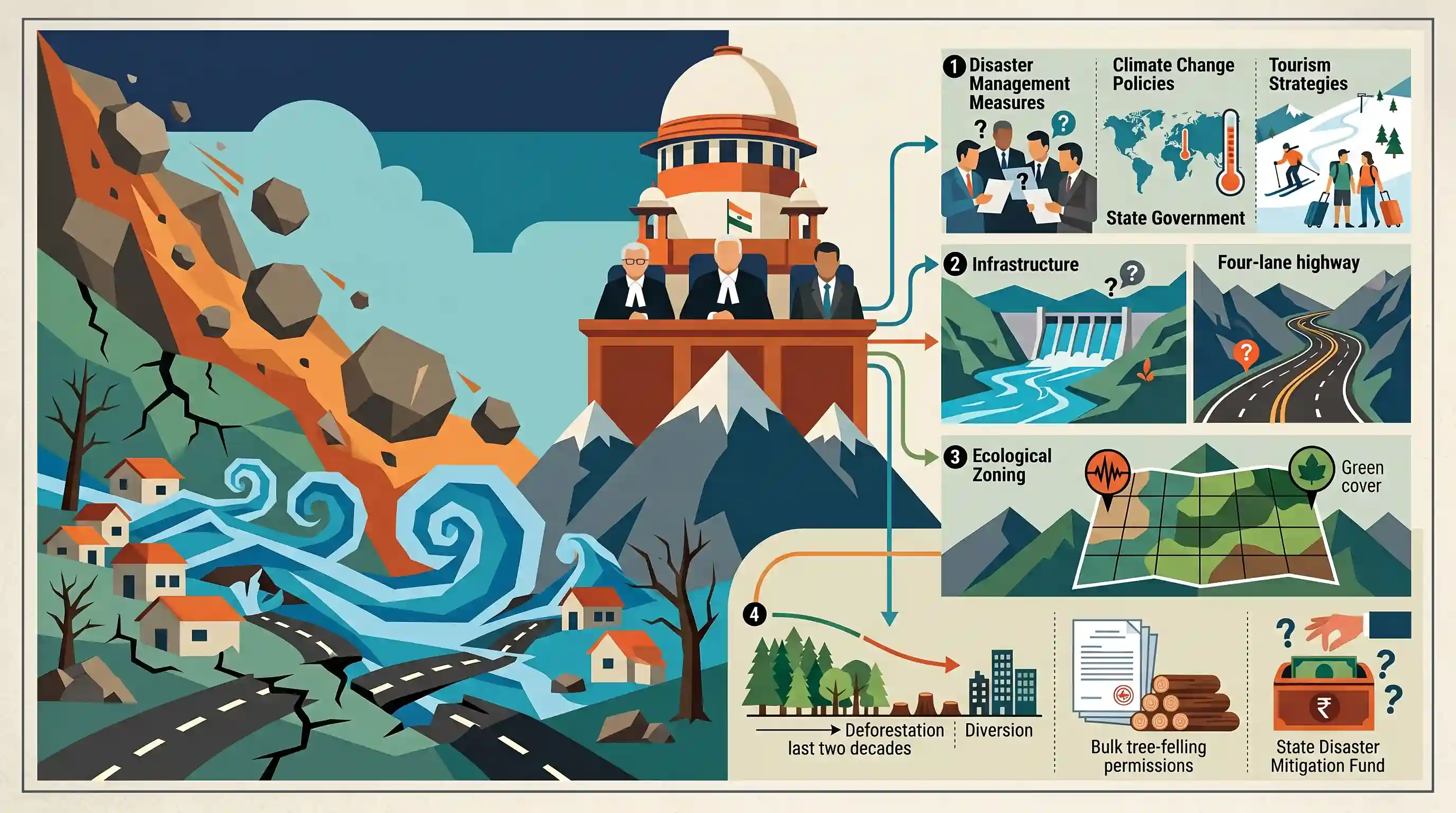
The Supreme Court has taken suo motu cognizance of the ecological imbalance in Himachal Pradesh, following a series of devastating landslides and flash floods. A Bench led by Justice Vikram Nath has directed the State government to clarify its disaster management measures, climate change policies, and tourism strategies. The court raised critical questions framed by amicus curiae K. Parameshwar regarding infrastructure projects like mega hydroelectric plants and four-lane highways, as well as ecological zoning based on seismic activity and green cover. Furthermore, the State must provide detailed data on deforestation, forest area diversion over the last two decades, bulk tree-felling permissions, and the utilization of the State Disaster Mitigation Fund.
Key Points
- The Supreme Court has initiated a suo motu case, attributing recent devastating landslides and flash floods in Himachal Pradesh to human activities rather than nature alone.
- The State government has been directed to detail its disaster management plans, climate change strategies, and the utilization of the State Disaster Mitigation Fund over the last 20 years.
- The court sought specific data on the expansion of mega hydroelectric projects, four-lane highways, and the diversion of forest areas for non-forest use.
- Queries framed by amicus curiae K. Parameshwar focus on seismic and ecological zoning, eco-sensitive zones, and designated protected areas across the State.
- The SC requested comprehensive statistics on deforestation, changes in green cover over the last two decades, and permissions granted for felling 500 or more trees in bulk.
Important Terms
Supreme Court

The apex judicial body in India under Part V (Articles 124-147), acting as the final interpreter of the Constitution and guardian of fundamental rights through judicial review.
UPSC context
GS Paper II (Judiciary); essential for understanding judicial structure, jurisdiction, and the court's role in constitutional and public interest litigation.
State Disaster Mitigation Fund
A dedicated fund established under Section 48 of the Disaster Management Act, 2005, specifically for financing long-term risk reduction and mitigation projects rather than immediate relief efforts.
UPSC context
GS Paper III (Disaster Management); tests knowledge of financial mechanisms for disaster risk reduction and the distinction between mitigation and response.
Suo Motu Cognizance
The legal power of the Supreme Court and High Courts to initiate proceedings on their own initiative without a formal petition, often used in public interest cases.
UPSC context
GS Paper II (Polity); central to judicial activism and the judiciary's proactive role in protecting constitutional rights and environmental integrity.
Amicus Curiae
Latin for 'friend of the court.' An expert or neutral third party appointed by the court to provide specialized insight or information to assist in judicial decision-making.
UPSC context
GS Paper II (Judiciary); tests understanding of judicial procedures and the involvement of independent experts in complex litigations.
Ecological Zoning
A regulatory mechanism, often manifesting as Eco-Sensitive Zones (ESZs), used to manage human activities in fragile ecosystems to minimize impact on biodiversity and protected areas.
UPSC context
GS Paper III (Environment); relates to the Environment (Protection) Act, 1986, and the balance between infrastructure development and conservation.
Disaster Management Act, 2005
The primary legal framework in India for managing natural and man-made disasters, establishing authorities like the NDMA and SDMA at national and state levels.
UPSC context
GS Paper III (Disaster Management); fundamental legislation for disaster preparedness, response, and institutional governance in India.
Judicial Activism (Environmental)
The proactive role of the judiciary in interpreting laws and enforcing environmental rights, particularly under Article 21 (Right to Life), to address executive or legislative inaction.
UPSC context
GS Paper II & III; tests the evolution of environmental jurisprudence and the concept of 'Sustainable Development' through judicial intervention.
Prelims Trap
"The State Disaster Mitigation Fund (SDMF) is primarily utilized for providing immediate relief to victims of flash floods and landslides."
SDMF is strictly for proactive pre-disaster mitigation and risk reduction. Immediate post-disaster relief is funded separately through the State Disaster Response Fund (SDRF).
Static Concepts Connected
What is the funding structure of State Disaster Funds under the 15th Finance Commission?
- Restructuring: The 15th FC recommended creating National and State Disaster Risk Management Funds (NDRMF/SDRMF).
- 80:20 Split: The fund is split into the Response Fund (SDRF - 80%) for relief, and the Mitigation Fund (SDMF - 20%) for proactive measures.
- Sharing Pattern: The Centre and State share contributions in a 75:25 ratio for general states, and 90:10 for North-Eastern and Himalayan states.
How are Eco-Sensitive Zones (ESZs) legally notified in India?
- Statutory Backing: ESZs are notified under the Environment (Protection) Act, 1986, though the term itself is not explicitly mentioned in the Act.
- Primary Purpose: They act as a transition zone or "shock absorber" around Protected Areas to regulate, rather than completely prohibit, human activities.
- Prohibited Activities: Commercial mining, polluting industries, and major hydroelectric projects are typically prohibited within these zones.
Cross-Topic Patterns
Himalayan Carrying Capacity vs. Infrastructure
SC's scrutiny of mega-hydro projects in Himachal aligns with recent expert committee debates on assessing the "carrying capacity" of the seismically active Indian Himalayan Region (IHR).
Judicial Activism via Environmental PILs
Reflects the continuing expansion of Article 21 where constitutional courts utilize suo motu cognizance and amicus curiae to bridge executive policy gaps in ecological governance.

Expect a 2026 Prelims statement distinguishing SDMF from SDRF, or a GS3 Mains question on Himalayan 'carrying capacity' vs. infrastructure.
Linked PYQs · 4
Linked PYQs · 4
- 2019MainsGS3
Disaster preparedness is the first step in any disaster management process. Explain how hazard zonation mapping will help disaster mitigation in the case of landslides.
- 2021MainsGS3
Describe the various causes and the effects of landslides. Mention the important components of the National Landslide Risk Management Strategy.
- 2019MainsGS3
Define the concept of carrying capacity of an ecosystem as relevant to an environment. Explain how understanding this concept is vital while planning for sustainable development of a region.
- 2022MainsGS2
“The most significant achievement of modern law in India is the constitutionalization of environmental problems by the Supreme Court.” Discuss this statement with the help of relevant case laws.
