Regulation of Online Content and Free Speech Balance
Source:The Hindu ↗
Why It Matters
This development is crucial for UPSC aspirants as it touches upon the core constitutional debate of freedom of speech versus state regulation, the role of independent regulatory bodies, and the contemporary challenges posed by AI, algorithms, and social media intermediaries in ensuring citizen safety.
Summary
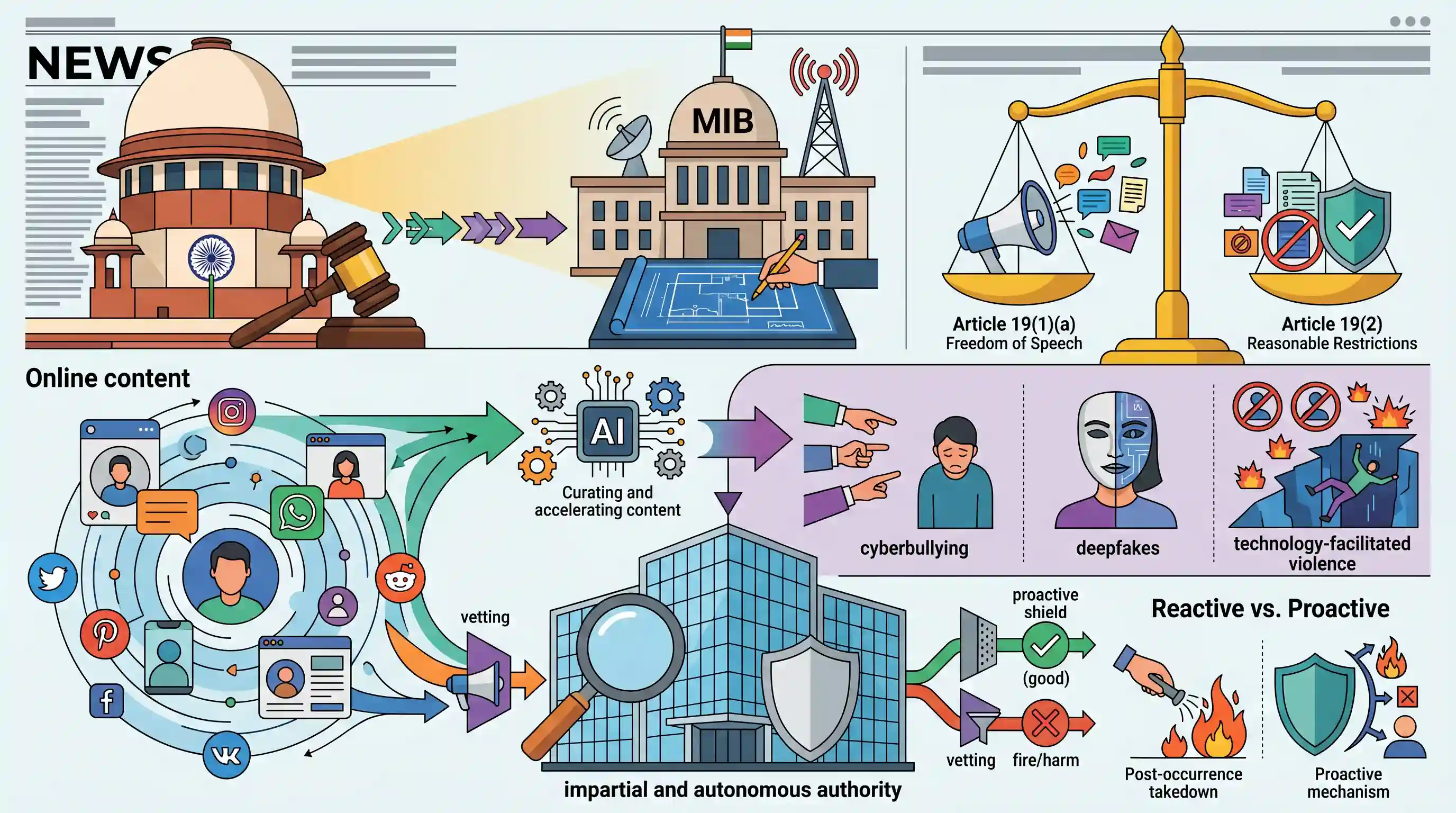
The Supreme Court of India has directed the Ministry of Information and Broadcasting to formulate guidelines to regulate abusive and damaging user-generated content (UGC) online. Emphasizing the need to balance freedom of speech under Article 19(1)(a) with reasonable restrictions under Article 19(2), the Court proposed the creation of an impartial and autonomous authority to vet online content. The bench highlighted the inadequacy of post-occurrence takedowns in the age of rapid social media proliferation and AI-driven curation, stressing the necessity for effective, proactive mechanisms to protect individuals from cyberbullying, deepfakes, and technology-facilitated online violence without resorting to pre-censorship.
Key Points
- The Supreme Court has directed the Ministry of Information and Broadcasting to frame guidelines regulating user-generated content (UGC) to curb online abuse and obscenity.
- The Court proposed establishing an impartial and autonomous regulatory authority to vet online content and protect innocent individuals.
- Current reactive 'post-occurrence' takedown mechanisms are deemed insufficient due to the rapid, algorithmic spread of content; proactive or 'effective' mechanisms are required.
- The debate underscored the tension between the Fundamental Right to free speech (Article 19(1)(a)) and the need for reasonable restrictions (Article 19(2)) to prevent harm.
Important Terms
Article 19(1)(a)

Constitutional provision guaranteeing all Indian citizens the right to express views and opinions freely through speech, writing, or digital media.
UPSC context
GS Paper II (Fundamental Rights). Tests the balance between individual liberty and democratic accountability.
Article 19(2)
Constitutional clause permitting the State to impose 'reasonable restrictions' on free speech based on grounds like public order, security, and decency.
UPSC context
GS Paper II (Constitution). Essential for understanding the limits of fundamental rights in the public interest.
Ministry of Information and Broadcasting (I&B Ministry)
The nodal Union ministry responsible for regulating broadcasting, print media, films, and digital news/OTT platforms in India.
UPSC context
GS Paper II (Governance). Relevant for media ethics and government oversight of digital content.
User-Generated Content (UGC)
Digital content (videos, posts, images) created and shared by users rather than the platform owners themselves.
UPSC context
GS Paper III (IT & Security). Key to debates on social media accountability and IT Rules 2021.
Deepfakes
AI-generated synthetic media that realistically replaces a person's likeness or voice to spread misinformation or cause harm.
UPSC context
GS Paper III (Science & Technology). Concerns cybersecurity, privacy, and the ethical use of artificial intelligence.
Technology-facilitated Online Violence (TFOV)
Harassment, stalking, or abuse (e.g., doxing, deepfakes) perpetrated against individuals using digital communication technologies.
UPSC context
GS Paper II (Social Justice). Relevant to the protection of women and vulnerable groups from cyber-harm.
Safe Harbour
Legal immunity under Section 79 of the IT Act protecting platforms from liability for user content, provided they follow due diligence.
UPSC context
GS Paper III (Cyber Security). Tests knowledge of intermediary liability and the digital legal framework in India.
Prelims Trap
The Supreme Court mandated strict pre-censorship for all user-generated content to curb cyberbullying.
The Court explicitly warned against pre-censorship, instead advocating for an impartial autonomous authority and proactive algorithmic checks that don't violate free speech.
Static Concepts Connected
What is the 'Safe Harbour' provision under the Information Technology Act?
- Section 79: Grants conditional immunity to intermediaries (like social media platforms) from legal liability for third-party user-generated content.
- Due Diligence: Protection applies only if platforms observe prescribed due diligence and do not initiate or modify the transmission.
- Loss of Immunity: Under modern IT Rules, failing to appoint grievance officers or promptly remove illegal content revokes this legal shield.
What are the grounds for restricting free speech under Article 19(2)?
- State Security: Sovereignty and integrity of India, security of the State, and friendly relations with foreign States.
- Public Order: Maintaining public order, decency, or morality, and preventing incitement to an offence.
- Judicial & Personal: Contempt of court and defamation are explicit constitutional grounds for reasonable restriction.
Cross-Topic Patterns
Safe Harbour vs. Deepfakes
Links GS2 fundamental rights with GS3 cybersecurity. The algorithmic spread of AI deepfakes is forcing a global shift from reactive takedowns to proactive platform liability.
Broadcasting Bill & UGC Regulation
The SC's call for an autonomous regulator intersects with ongoing debates surrounding the Broadcasting Services (Regulation) Bill and the contested IT Rules 2021 framework.

Expect a GS2 question linking the dilution of Safe Harbour provisions to AI deepfakes and the 'Shreya Singhal' free speech precedent.
Linked PYQs · 3
Linked PYQs · 3
- 2024MainsGS3
Social media and encrypting messaging services pose a serious security challenge. What measures have been adopted at various levels to address the security implications of social media? Also suggest any other remedies to address the problem.
- 2016MainsGS3
Use of Internet and social media by non-state actors for subversive activities is a major security concern. How have these been misused in the recent past? Suggest effective guidelines to curb the above threat.
- 2014MainsGS2
What do you understand by the concept "freedom of speech and expression"? Does it cover hate speech also ? Why do the films in India stand on a slightly different plane from other forms of expression ? Discuss.
