NEET SS In Service Candidates Percentile Reduction Plea
Source:The Hindu ↗
ఇది ఎందుకు ముఖ్యం
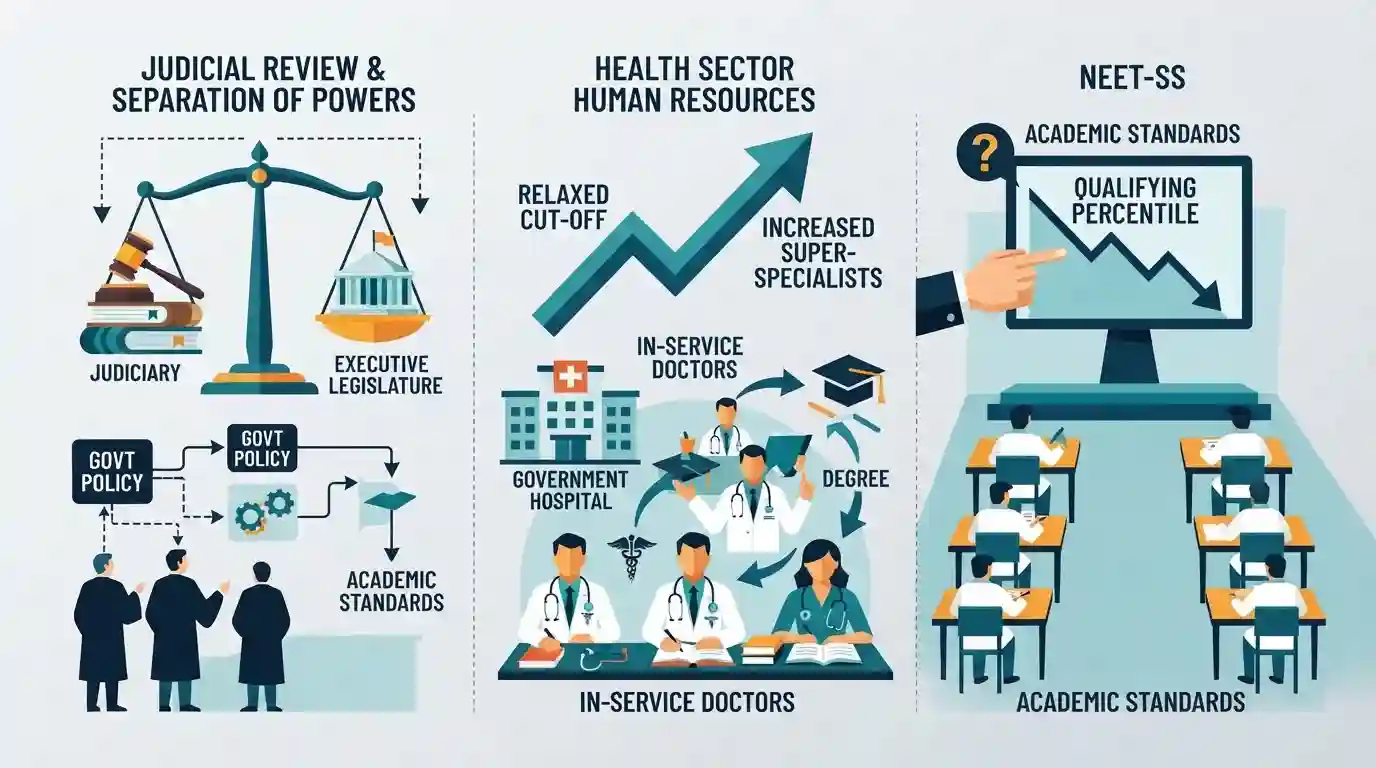
This issue intersects medical education reform, public health human resources, and judicial review. It illustrates the tension between maintaining strict meritocratic standards in entrance exams and addressing the practical deficit of specialized doctors in the government healthcare system.
సారాంశం
The Supreme Court has sought a response from the Central Government regarding a plea to reduce the qualifying percentile for in-service doctors in the NEET-Super Specialty (NEET-SS) exam. In-service candidates are doctors currently employed in government hospitals seeking advanced degrees. Relaxing the cut-off aims to ensure government facilities retain and produce more super-specialists, addressing severe human resource shortages in public healthcare. The case also touches upon the scope of judicial intervention in academic standards and executive policy domains.
ముఖ్య అంశాలు
- The Supreme Court has asked the Centre to respond to a petition seeking a reduction in the qualifying percentile for in-service candidates appearing for the NEET-SS examination.
- In-service candidates are doctors already serving in government healthcare facilities who wish to pursue super-specialty medical degrees.
- The plea underlines the broader challenge of acute shortages of specialist and super-specialist doctors in public and rural healthcare settings.
- The issue highlights the balance between maintaining strict academic merit (exam cut-offs) and fulfilling public health human resource requirements through incentives.
- The case involves the Supreme Court examining an administrative/academic policy domain typically managed by the executive branch and bodies like the National Medical Commission (NMC).
ముఖ్యమైన పదాలు
NEET-SS (National Eligibility cum Entrance Test - Super Specialty)

A single national-level entrance examination conducted by the National Board of Examinations for admission to advanced super-specialty medical courses (DM/MCh and DNB) in India.
UPSC context
GS Paper 2: Social Sector and Health; tests regulatory policy and education quality control.
National Medical Commission (NMC)
A statutory body established under the National Medical Commission Act, 2019, that regulates medical education, professionals, and medical institutions in India, replacing the Medical Council of India.
UPSC context
GS Paper 2: Statutory and Regulatory Bodies; tests health governance and professional licensing reforms.
In-Service Candidate Reservation
A policy allowing governments to reserve a percentage of post-graduate or super-specialty medical seats for doctors working in public health institutions to ensure human resource retention.
UPSC context
GS Paper 2: Health, Federalism; tests legislative competence under Entry 25 of List III.
Supreme Court of India
The apex judicial court of India, serving as the ultimate custodian of the Constitution, final court of appeal, and protector of fundamental rights.
UPSC context
GS Paper 2: Judiciary; tests judicial review, separation of powers, and limits on policy intervention.
ప్రిలిమ్స్ ఉచ్చు
States cannot reserve post-graduate medical seats for in-service doctors because education standards fall exclusively under the Union List.
Aspirants confuse standard-setting authority with admission channels, wrongly assuming the Supreme Court barred states from creating post-graduate in-service quotas under List III.
అనుసంధానమైన స్థిర భావనలు
How does the Constitution divide legislative power regarding medical education?
- Entry 66 List I: Grants the Union exclusive power to coordinate and determine standards in higher education and scientific/technical institutions.
- Entry 25 List III: Placed in the Concurrent List, allowing both Union and States to legislate on medical education, subject to Union standards.
- Judicial Balance: Courts permit states to create reservation policies for public health needs (like in-service quotas) if they do not dilute core central standards.
What is the statutory mandate of the National Medical Commission?
- Statutory Origin: Established under the National Medical Commission Act, 2019, replacing the Medical Council of India.
- Key Mandates: Regulates medical education, medical professionals, and institutions, while overseeing common medical entrance and exit examinations.
- Autonomous Structure: Operates through four autonomous boards handling undergraduate/postgraduate standards, assessment and rating, and medical ethics/registration.
అంతర-అంశ నమూనాలు
Judicial review vs academic policymaking
Courts balancing strict educational standard-setting with socioeconomic objectives tests the Separation of Powers doctrine, specifically reviewing expert administrative choices under Article 14.
Human resource crisis in rural health
Acute specialist shortages at Community Health Centres showcase how educational incentive structures (like in-service quotas) are vital to achieving Article 21 public health mandates.

Expect a question combining federal division of education powers (List I vs III) with judicial guidelines on in-service medical quotas.
అనుసంధాన PYQలు · 3
అనుసంధాన PYQలు · 3
- 2023MainsGS2
The crucial aspect of development process has been the inadequate attention paid to Human Resource Development in India. Suggest measures that can address this inadequacy.
- 2020MainsGS2
Judicial Legislation is antithetical to the doctrine of separation of powers as envisaged in the Indian Constitution. In this context justify the filing of large number of public interest petitions praying for issuing guidelines to executive authorities.
- 2020MainsGS2
In order to enhance the prospects of social development, sound and adequate health care policies are needed particularly in the fields of geriatric and maternal health care. Discuss.
