Supreme Court Directs States to Notify Cancer for Early Detection
Source:The Hindu ↗
ఇది ఎందుకు ముఖ్యం
It provides an excellent contemporary example of Judicial Activism via PILs enforcing executive guidelines on health policy. It is highly relevant for GS2 answers regarding the right to health (Article 21) and the challenges of healthcare administration in a federal setup (health being a state subject).
సారాంశం
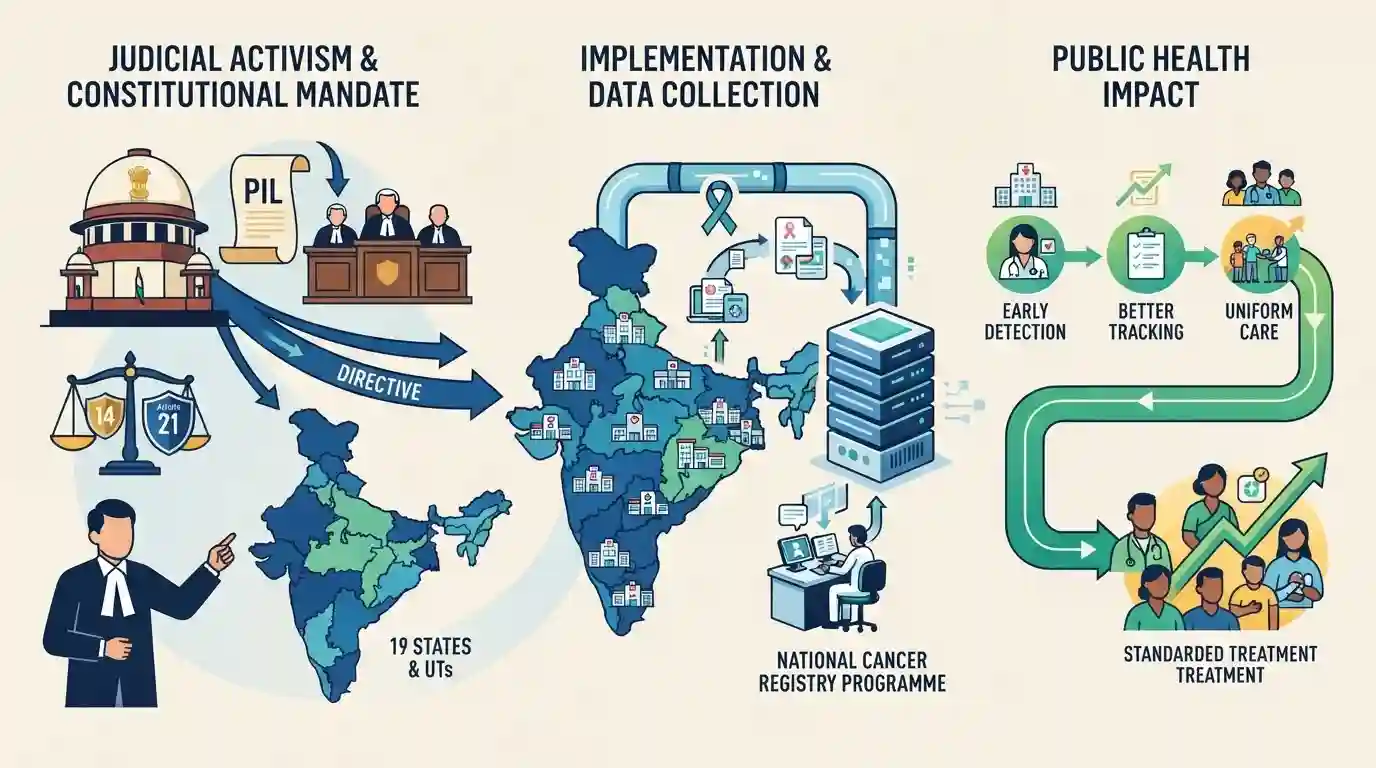
The Supreme Court of India has directed 19 States and Union Territories to declare cancer a "notifiable disease". This judicial intervention stems from a Public Interest Litigation (PIL) which highlighted that non-notification violates fundamental rights under Articles 14 (Equality) and 21 (Life and Personal Liberty). By declaring cancer notifiable, all healthcare facilities are mandated to report cases to state registries, leading to early detection, better tracking via the National Cancer Registry Programme, and uniform care. The case underscores the interplay between judicial activism, constitutional rights, and decentralized state-level public healthcare systems.
ముఖ్య అంశాలు
- The Supreme Court directed 19 States and Union Territories to officially declare cancer a 'notifiable disease'.
- The move follows a Public Interest Litigation (PIL) noting that 17 out of 36 States/UTs had already complied based on a parliamentary standing committee recommendation.
- Declaring a condition a 'notifiable disease' requires medical practitioners to report every case to state authorities, facilitating data collection for the National Cancer Registry Programme.
- The PIL argued that the lack of uniform notification violates patients' right to equality (Article 14) and right to health and life with dignity (Article 21).
- The directive highlights the Supreme Court's use of judicial review and PILs to enforce public health policy directives across all states, despite 'Health' being a State subject.
ప్రిలిమ్స్ ఉచ్చు
The Right to Health is an explicitly enumerated Fundamental Right, and declaring a disease 'notifiable' is an exclusive Union List power.
Right to health is implicitly read into Article 21 by courts. Public health is primarily a State subject (List II, Entry 6), meaning state governments hold the notifying authority.
అనుసంధానమైన స్థిర భావనలు
What is a 'notifiable disease' and how is public health distributed in the Constitution?
- Definition: Any disease that clinicians are legally mandated to report to local health authorities to facilitate epidemiological monitoring and control.
- Constitutional division: Public health and sanitation is a State Subject (List II, Entry 6), giving state governments the primary legislative power over notifications.
- Concurrent jurisdiction: Entry 29 of List III allows both Center and States to legislate on preventing the spread of infectious or contagious diseases.
అంతర-అంశ నమూనాలు
Judicial activism and Seventh Schedule boundaries
SC's health directives to states show judicial PILs overriding legislative divisions of the Seventh Schedule to ensure nationwide fundamental rights compliance under Article 21.
Data registries and healthcare design
Linking mandatory reporting to ICMR’s National Cancer Registry Programme highlights how clinical data-sharing frameworks are vital for targeted, non-communicable disease policy planning.

Supreme Court directives on List II health matters via Article 21 and federal divisions are highly likely GS-2 mains themes in 2026.
అనుసంధాన PYQలు · 5
అనుసంధాన PYQలు · 5
- 2024MainsGS2
Explain the reasons for the growth of public interest litigation in India. As a result of it, has the Indian Supreme Court emerged as the world's most powerful judiciary ?
- 2020MainsGS2
Judicial Legislation is antithetical to the doctrine of separation of powers as envisaged in the Indian Constitution. In this context justify the filing of large number of public interest petitions praying for issuing guidelines to executive authorities.
- 2024MainsGS2
In a crucial domain like the public healthcare system the Indian State should play a vital role to contain the adverse impact of marketisation of the system. Suggest some measures through which the State can enhance the reach of public healthcare at the grassroots level.
- 2021MainsGS2
“Besides being a moral imperative of a Welfare State, primary health structure is a necessary precondition for sustainable development.” Analyze.
- 2024MainsGS2
Right to privacy is intrinsic to life and personal liberty and is inherently protected under Article 21 of the constitution. Explain. In this reference discuss the law relating to D.N.A. testing of child in the womb to establish its paternity.
