Supreme Court Directive to Declare Cancer Notifiable Disease
Source:The Hindu ↗
কেন এটি গুরুত্বপূর্ণ
This development highlights the critical intersection of constitutional rights (Articles 14 & 21) and public health administration in India. It illustrates the role of judicial intervention in standardizing healthcare policies, discusses federal dynamics in health governance, and emphasizes the strategic shift toward digital health registries and evidence-based medicine to tackle the growing non-communicable disease (NCD) epidemic.
সারসংক্ষেপ
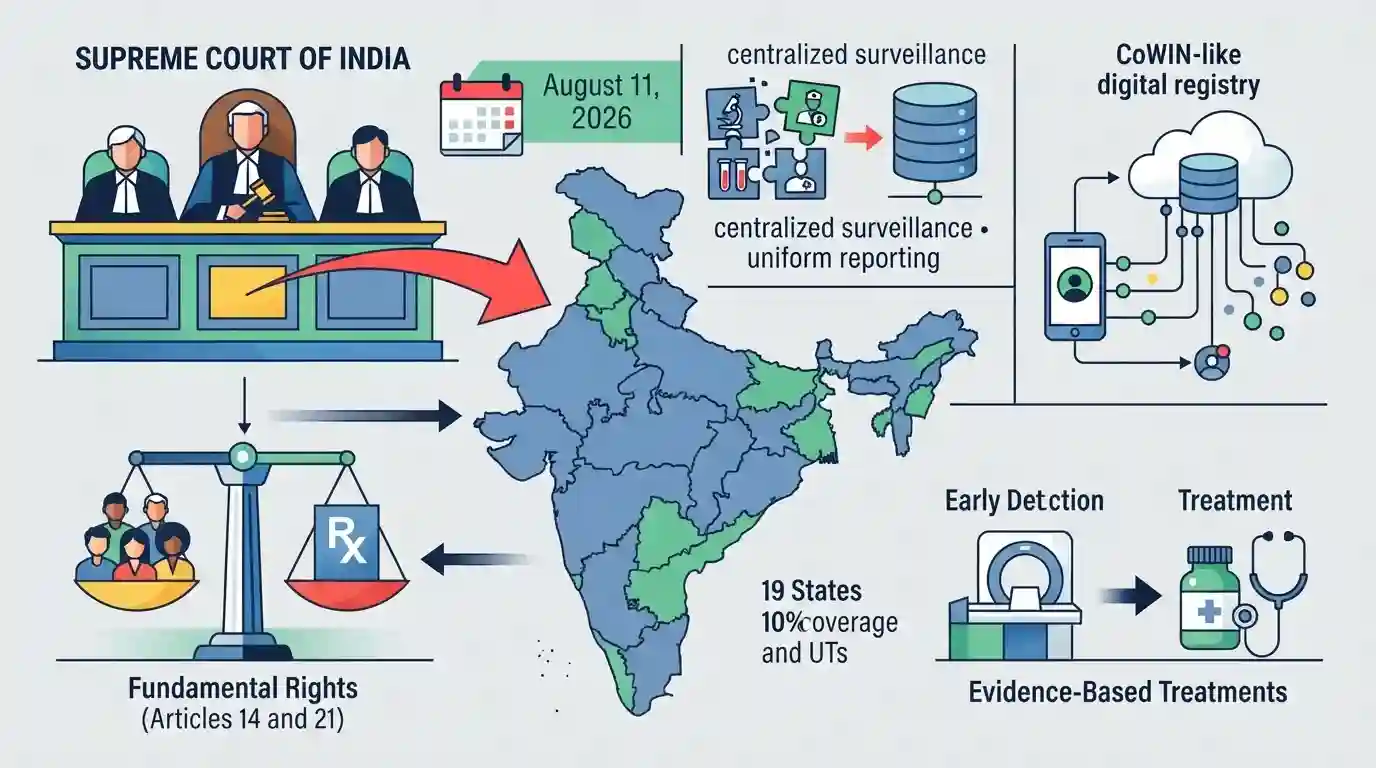
On August 11, 2026, a Supreme Court Bench led by Chief Justice Surya Kant directed the remaining 19 States and UTs to declare cancer a 'notifiable disease' to ensure early detection, uniform reporting, and centralized surveillance. This directive addresses a Public Interest Litigation (PIL) highlighting major gaps in the Indian Council of Medical Research's (ICMR) National Cancer Registry Programme, which covers only 10% of the population. The petition argues that the lack of uniform notification violates Articles 14 and 21 of the Constitution, emphasizing the need for a CoWIN-like digital registry and the strict enforcement of evidence-based medical treatments.
মূল বিষয়
- The Supreme Court directed the remaining 19 States and Union Territories to declare cancer a 'notifiable disease' for uniform reporting and early detection, following a PIL filed by Dr. Anurag Srivastava.
- Currently, only 17 of 36 States and UTs have notified cancer, leaving a stark disparity in cancer surveillance, delayed diagnoses, and fragmented data across the country.
- The petitioner argued that non-notification of cancer is a violation of Articles 14 and 21 of the Constitution, which protect the fundamental right to health and a life with dignity.
- While health is primarily a State subject under the Seventh Schedule, both the Centre and States hold concurrent authority to notify diseases, which has historically led to a 'legal vacuum' and policy inconsistency.
- The National Cancer Registry Programme (NCRP) run by ICMR currently covers only about 10% of India's population, with rural coverage as low as 1%. The PIL urges the creation of a centralized, real-time digital registry modeled after the CoWIN platform.
- The petition also calls for the regulation of unscientific and unverified alternative cancer treatments (e.g., claims about Gomutra) to promote evidence-based, scientifically-validated clinical therapies.
গুরুত্বপূর্ণ শব্দ
National Cancer Registry Programme

Initiated by ICMR in 1981, this flagship surveillance program tracks the magnitude and patterns of cancer across India via a network of population-based and hospital-based registries.
UPSC context
Health Governance (GS Paper 2). Tests knowledge of public health data gaps; it currently covers only 10% of India's population.
Indian Council of Medical Research
The apex body in India for the formulation, coordination, and promotion of biomedical research. It spearheads essential data collection and policy support for widespread diseases like cancer.
UPSC context
Statutory/Apex Bodies (GS Paper 2). Important for evaluating state capacity in disease surveillance and evidence-based public health interventions.
CoWIN platform
An Indian digital public health platform initially launched for COVID-19 vaccination management. It features comprehensive registration, real-time tracking dashboards, and digital certification capabilities.
UPSC context
Digital Public Infrastructure (GS Paper 2/3). Cited in the PIL as the ideal model framework for a unified, real-time national cancer registry.
National Institute of Cancer Prevention and Research
An ICMR institute based in Noida dedicated to basic, clinical, and applied research on prevalent Indian cancers. It focuses heavily on prevention, screening, and early detection strategies.
UPSC context
Health/Social Sector (GS Paper 2). Essential to understanding national frameworks for non-communicable disease control and localized cancer prevention strategies.
Union Ministry of Health and Family Welfare
The central government ministry responsible for steering India's national health policy, family welfare programs, and overall healthcare administration in coordination with state governments.
UPSC context
Federal Structure (GS Paper 2). Its failure to enact mandatory nationwide disease guidelines underscores center-state jurisdictional friction over concurrent health subjects.
প্রিলিমস ফাঁদ
The Union Government can unilaterally declare cancer a 'notifiable disease' across India using its powers under the Concurrent List.
Entry 29 of the Concurrent List (List III) only permits the Union to legislate on 'infectious or contagious' diseases. Because cancer is non-communicable, it falls strictly under 'Public Health' (Entry 6, List II), meaning the Centre cannot unilaterally declare it notifiable nationwide without state-level legislation.
সংযুক্ত স্থির ধারণা
What is a 'Notifiable Disease' and its legal mechanism in India?
- Definition: Any disease that is legally required to be reported to government authorities, enabling real-time monitoring, resource allocation, and early intervention.
- Legal Basis: India lacks a single, unified national public health law. Instead, states use state-specific Public Health Acts or the Epidemic Diseases Act, 1897 (primarily for infectious outbreaks) to declare notifications.
- Federal Split: While infectious disease control falls under the Concurrent List (Entry 29), general public health is a State Subject (List II, Entry 6), causing legislative fragmentation for non-communicable diseases.
What is the National Cancer Registry Programme (NCRP)?
- Origin & Agency: Initiated in 1981 by the Indian Council of Medical Research (ICMR) to collect reliable data on cancer occurrence.
- Dual Framework: Utilizes Population-Based Cancer Registries (PBCR) for epidemiological trends and Hospital-Based Cancer Registries (HBCR) to assess clinical management and survival rates.
- Data Gap: Currently covers only 10% to 15% of the Indian population, with negligible penetration in rural areas, hindering robust national-level policy formulation.
আন্তঃবিষয় প্যাটার্ন
Judicial Activism + Health Federalism
Judicial enforcement of Article 21 forces states to execute uniform health policies, highlighting how the judiciary acts as a federal bridge in the absence of central legislation on non-communicable diseases.
DPI + Chronic Disease Surveillance
Applying pandemic-era CoWIN/ABDM architectural success to chronic non-communicable diseases (NCDs) like cancer reflects a structural pivot from infectious emergency management to long-term digital public health tracking.

Constitutional friction between State List health powers and Article 21 health mandates is a prime candidate for a 2026 GS Paper 2 question.
সংযুক্ত PYQ · 3
সংযুক্ত PYQ · 3
- 2024MainsGS2
In a crucial domain like the public healthcare system the Indian State should play a vital role to contain the adverse impact of marketisation of the system. Suggest some measures through which the State can enhance the reach of public healthcare at the grassroots level.
- 2020MainsGS2
Judicial Legislation is antithetical to the doctrine of separation of powers as envisaged in the Indian Constitution. In this context justify the filing of large number of public interest petitions praying for issuing guidelines to executive authorities.
- 2021MainsGS2
Do Department-related Parliamentary Standing Committees keep the administration on its toes and inspire reverence for parliamentary control? Evaluate the working of such committees with suitable examples.
