Supreme Court Ruling on Book Cover and Public Health Laws
Source:Indian Express ↗
Why It Matters
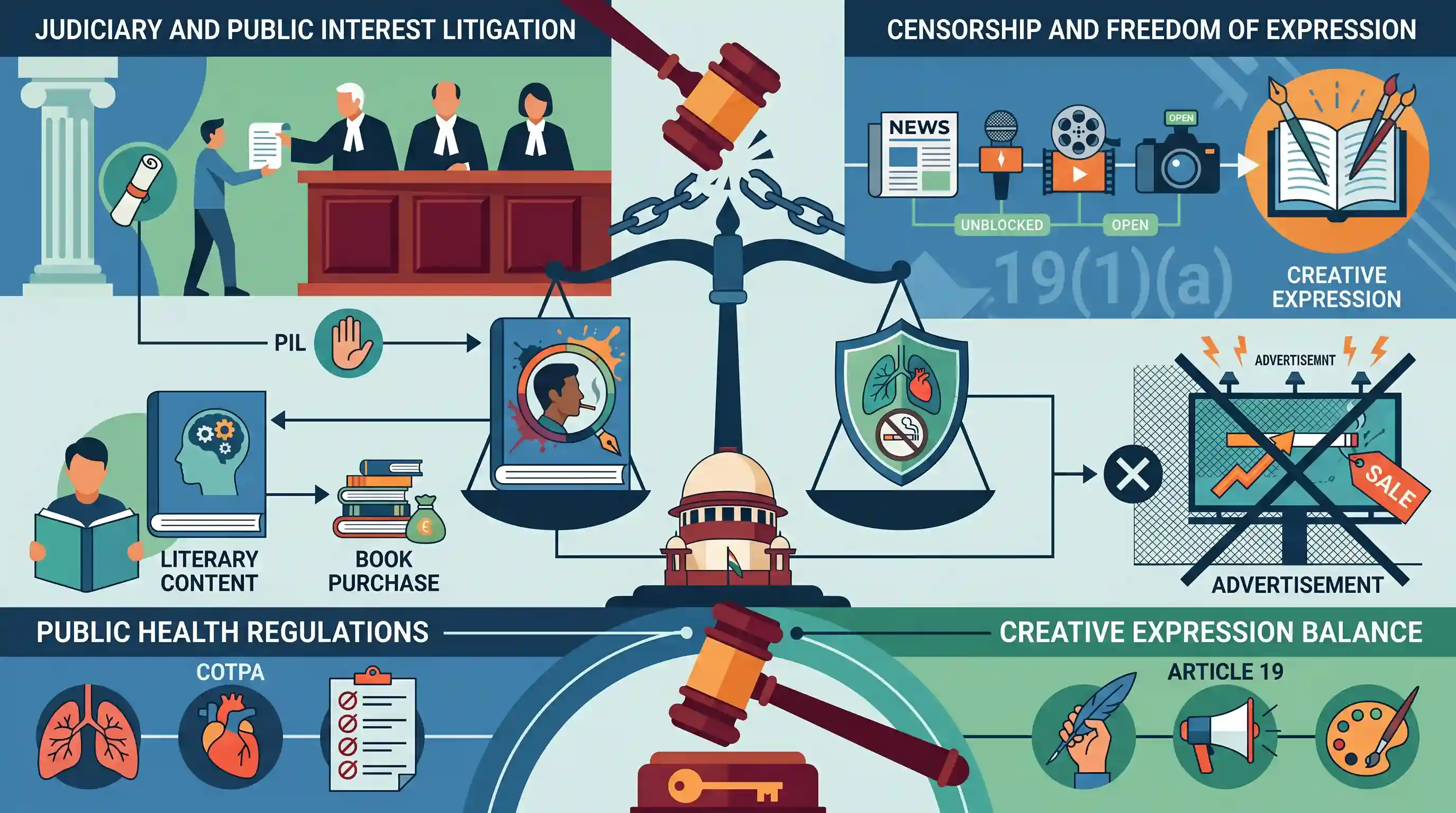
The ruling is a key example of the Supreme Court interpreting public health laws like COTPA in a manner that protects artistic freedom, preventing regulatory overreach and frivolous litigation aimed at restricting creative expression.
Summary
The Supreme Court of India dismissed a petition alleging that the cover of Arundhati Roy's book, which features a photograph of her smoking, contravened the Cigarettes and Other Tobacco Products Act (COTPA). A bench led by CJI Surya Kant ruled that the image does not constitute an advertisement or promote smoking, affirming that readers purchase books for their literary content rather than the cover photograph. The judgment highlights the balance between public health regulations and creative expression.
Key Points
- The Supreme Court dismissed a plea claiming that the cover of Arundhati Roy's book 'Mother Mary Comes to Me,' which depicts her smoking, violates the COTPA 2003.
- The Court clarified that the book's cover is not a commercial advertisement and does not actively promote smoking.
- The ruling distinguishes between statutory public health warnings mandated for actual tobacco products or promotional material, and artistic or biographical expression in literary publishing.
- The decision reflects the judiciary's role in preventing the misuse of public health regulations to impose unwarranted censorship on authors.
Important Terms
COTPA 2003

A 2003 central law regulating tobacco trade, prohibiting public smoking and advertisements, and mandating health warnings. It aims to protect public health by discouraging tobacco consumption.
UPSC context
GS Paper II/III: Government policies and public health. Tests understanding of statutory regulations versus creative freedoms.
Public Interest Litigation (PIL)
A legal mechanism allowing any citizen to approach courts for the protection of public interest. Courts recently cautioned against its misuse for "self-publicity" or "personal slander."
UPSC context
GS Paper II: Judicial activism and the evolution of legal remedies in India.
Freedom of Speech and Expression (Article 19)
The constitutional right to voice opinions and ideas through speech, writing, or art. In this case, it protected an author’s artistic choice on a book cover.
UPSC context
GS Paper II: Fundamental Rights. Tests the balance between individual liberties and reasonable restrictions.
Section 5 of COTPA
A specific provision of the COTPA 2003 that prohibits direct and indirect advertisement of tobacco products. The Court ruled this does not apply to literary depictions.
UPSC context
GS Paper II: Statutory bodies and law. Relevant for understanding legislative intent versus judicial interpretation.
Special Leave Petition (SLP)
A discretionary power of the Supreme Court under Article 136 to grant leave to appeal against any judgment or order from any court or tribunal in India.
UPSC context
GS Paper II: Structure and functioning of the Judiciary. Tests knowledge of the Supreme Court's appellate jurisdiction.
Supreme Court of India
The highest judicial body in India. It clarified that "advertisement" under tobacco laws does not include artistic representations by renowned authors on book covers.
UPSC context
GS Paper II: Judiciary. Tests the Court's role as the final interpreter of the Constitution and statutes.
Prelims Trap
"The COTPA 2003 prohibits any visual depiction of smoking in print and electronic media, including book covers and films."
COTPA prohibits direct and indirect *advertisements* of tobacco, not all artistic, biographical, or literary depictions of smoking.
Static Concepts Connected
Is commercial speech protected under Article 19(1)(a) of the Constitution?
- Tata Press Case: In the Tata Press Ltd. v. MTNL (1995) case, the Supreme Court ruled that commercial speech/advertisements are a part of freedom of speech and expression.
- Reasonable Restrictions: Commercial speech can be restricted under Article 19(2) on grounds like public order, decency, or morality (e.g., banning tobacco ads for public health).
What are the key regulatory provisions of the COTPA, 2003?
- Advertisement Ban: Section 5 prohibits both direct and indirect (surrogate) advertisement of cigarettes and other tobacco products.
- Public Smoking: It bans smoking in public places, barring specifically designated smoking zones in certain establishments.
- Sales Restrictions: Prohibits the sale of tobacco products to minors (under 18) and within a 100-yard radius of educational institutions.
Cross-Topic Patterns
Article 19(1)(a) vs. DPSP (Article 47)
The tension between freedom of speech and the State's DPSP obligation to improve public health (Art 47) frequently underpins questions on surrogate advertising, censorship, and tobacco bans.
Misuse of Public Interest Litigation (PIL)
The Court's swift dismissal highlights the ongoing judicial pushback against frivolous PILs used for censorship or publicity rather than addressing genuine marginalization.

Expect a prelims statement interlinking Article 19(1)(a)'s protection of commercial speech with COTPA's advertisement restrictions.
Linked PYQs · 2
Linked PYQs · 2
- 2014MainsGS2
What do you understand by the concept "freedom of speech and expression"? Does it cover hate speech also ? Why do the films in India stand on a slightly different plane from other forms of expression ? Discuss.
- 2024MainsGS2
Explain the reasons for the growth of public interest litigation in India. As a result of it, has the Indian Supreme Court emerged as the world's most powerful judiciary ?
