Supreme Court Clears Women Advocates As Kerala Judges
Source:Indian Express ↗
Why It Matters
The piece highlights the functioning of the Supreme Court Collegium in recommending appointments and elevations in the High Courts. The specific inclusion of women advocates for elevation connects to the recurring UPSC theme regarding diversity and gender representation in the higher judiciary.
Summary
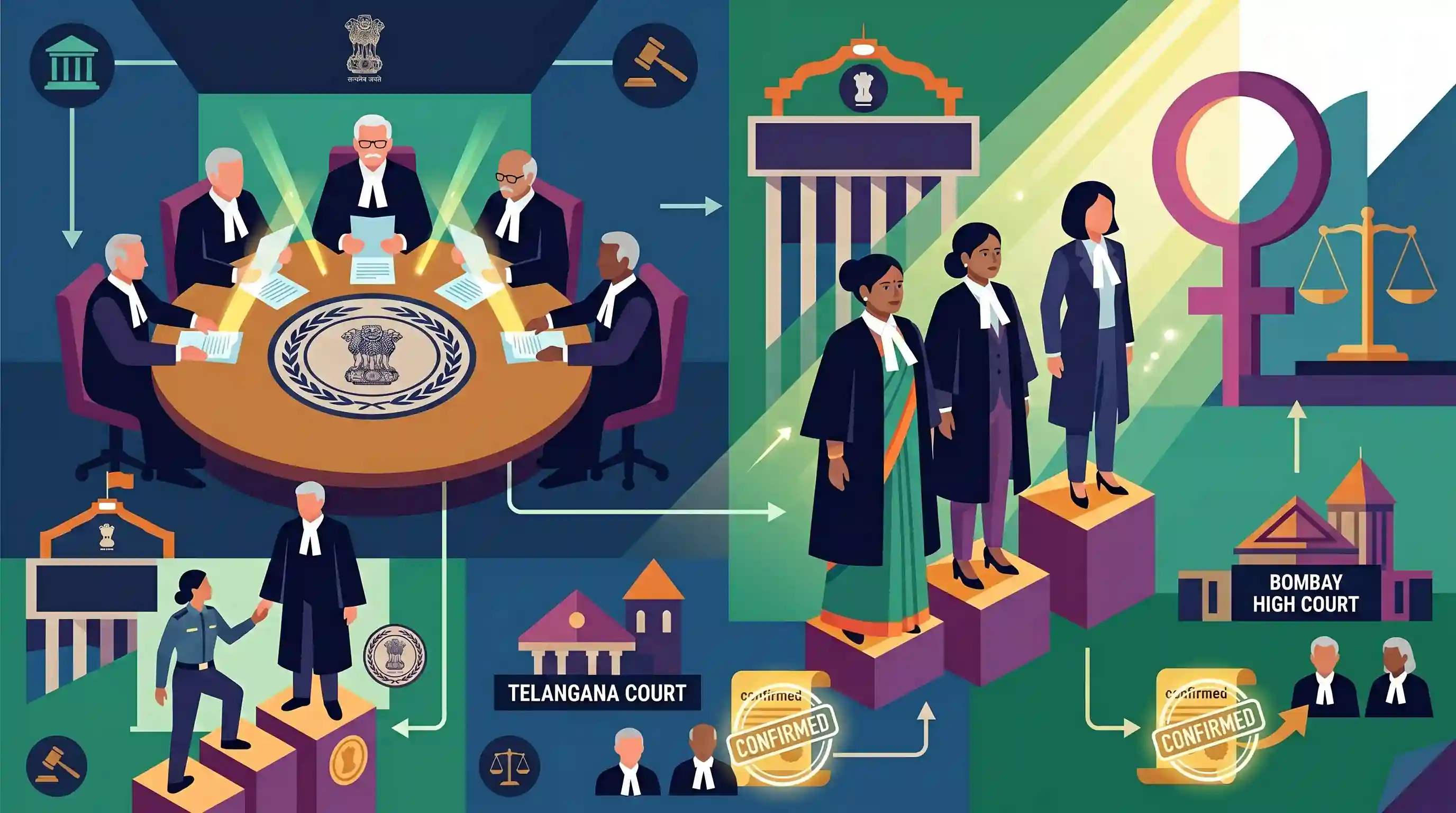
The Supreme Court Collegium has formally approved the elevation of two women advocates, Preeta Aravindan Krishnamma and Liz Mathew Anthraper, as judges of the Kerala High Court. In addition to the Kerala appointments, the collegium also cleared proposals for elevating judicial officers to the Karnataka High Court and confirming additional judges as permanent judges in the Telangana and Bombay High Courts.
Key Points
- The Supreme Court collegium approved the appointment of two women advocates, Preeta Aravindan Krishnamma and Liz Mathew Anthraper, as judges of the Kerala High Court.
- Three judicial officers—Rajeshwari Narayana Hegde, Kedambadi Ganesh Shanthi, and Mahadevappa Brungesh—were recommended for elevation as judges in the Karnataka High Court.
- Four additional judges of the Telangana High Court and one additional judge of the Bombay High Court (Justice Manjusha Ajay Deshpande) were recommended to be made permanent judges.
Important Terms
Collegium System

A non-constitutional mechanism for appointing and transferring judges to the Supreme Court and High Courts, consisting of the Chief Justice of India and senior-most judges.
UPSC context
GS Paper 2: Judiciary. Essential for understanding judicial independence and the evolution through the Three Judges Cases.
Supreme Court of India
The highest judicial body in India, established in 1950, acting as the final court of appeal and the ultimate interpreter and guardian of the Constitution.
UPSC context
GS Paper 2: Indian Constitution. Core topic regarding judicial review and fundamental rights protection.
Article 217
Constitutional provision governing the appointment of High Court judges by the President in consultation with the CJI, State Governor, and Chief Justice of the concerned High Court.
UPSC context
GS Paper 2: Constitutional Provisions. Vital for understanding the procedure and criteria for High Court judicial appointments.
Kerala High Court
The highest court in Kerala and the Union Territory of Lakshadweep, established in 1956 and headquartered in Kochi.
UPSC context
GS Paper 2: State Judiciary. Tests knowledge of territorial jurisdiction covering multiple administrative units.
Bombay High Court
One of India\'s oldest High Courts (est. 1862), having jurisdiction over Maharashtra, Goa, and the Union Territories of Dadra and Nagar Haveli and Daman and Diu.
UPSC context
GS Paper 2: Judiciary. Notable for its expansive multi-state/UT jurisdiction and historical significance.
Karnataka High Court
The highest judicial authority in Karnataka, established in 1884, with its principal bench in Bengaluru and additional benches in Dharwad and Kalaburagi.
UPSC context
GS Paper 2: State Judiciary. Relevant for administrative structure and jurisdictional history.
Telangana High Court
The High Court for Telangana, established in 2019 following the bifurcation of the state, serving as the highest judicial body in the state.
UPSC context
GS Paper 2: Federalism. Important regarding the impact of state reorganization on the judiciary.
Prelims Trap
The SC Collegium for recommending High Court judges comprises the CJI and the four senior-most judges.
This is a common trap. The SC Collegium for High Court appointments consists of the CJI and only the TWO senior-most judges. CJI+4 is for SC.
Static Concepts Connected
What are the constitutional qualifications to become a High Court judge?
- Citizenship: The candidate must be a citizen of India.
- Judicial Office: Must have held a judicial office in the territory of India for at least ten years.
- Advocate Experience: Alternatively, must have been an advocate of a High Court for at least ten years.
- No Jurist Provision: Unlike the Supreme Court, the Constitution does not permit the appointment of a 'distinguished jurist' as an HC judge.
How are Additional Judges appointed to High Courts under Article 224?
- Trigger Condition: They are appointed to handle a temporary increase in court business or to clear significant arrears of work.
- Tenure Limit: They are appointed by the President for a temporary period not exceeding two years.
- Age Cap: An additional judge cannot hold office after attaining the mandatory retirement age of 62 years.
Cross-Topic Patterns
Women's representation in higher judiciary
Despite constitutional equality, women make up only ~14% of HC judges. This highlights structural barriers, linking to GS-1/GS-2 debates on institutional patriarchy and the glass ceiling in legal practice.
Evolution of Collegium structures
The 'plurality of judges' doctrine from the Third Judges Case (1998) created distinct collegium structures: CJI+4 for Supreme Court appointments, but CJI+2 for High Court appointments and transfers.

A multi-statement Prelims question testing the difference between the SC collegium composition for SC judges vs HC judges is highly likely.
Linked PYQs · 3
Linked PYQs · 3
- 2025MainsGS2
Discuss the evolution of collegium system in India. Critically examine the advantages and disadvantages of the system of appointment of the Judges of the Supreme Court of India and that of the USA.
- 2017MainsGS2
Critically examine the Supreme Court's judgement on 'National Judicial Appointments Commission Act, 2014' with reference to appointment of judges of higher judiciary in India.
- 2021MainsGS2
Discuss the desirability of greater representation to women in the higher judiciary to ensure diversity, equity and inclusiveness.
