Judicial review evaluates executive powers in Waqf Act amendments
Source:Indian Express ↗
Why It Matters
The Waqf Act amendments and the subsequent Supreme Court stay are central to understanding the limits of state intervention in religious administration. It touches upon core GS2 themes including the separation of powers (executive vs. judiciary), the rights of minorities (Article 26), and the functioning of statutory bodies.
Summary
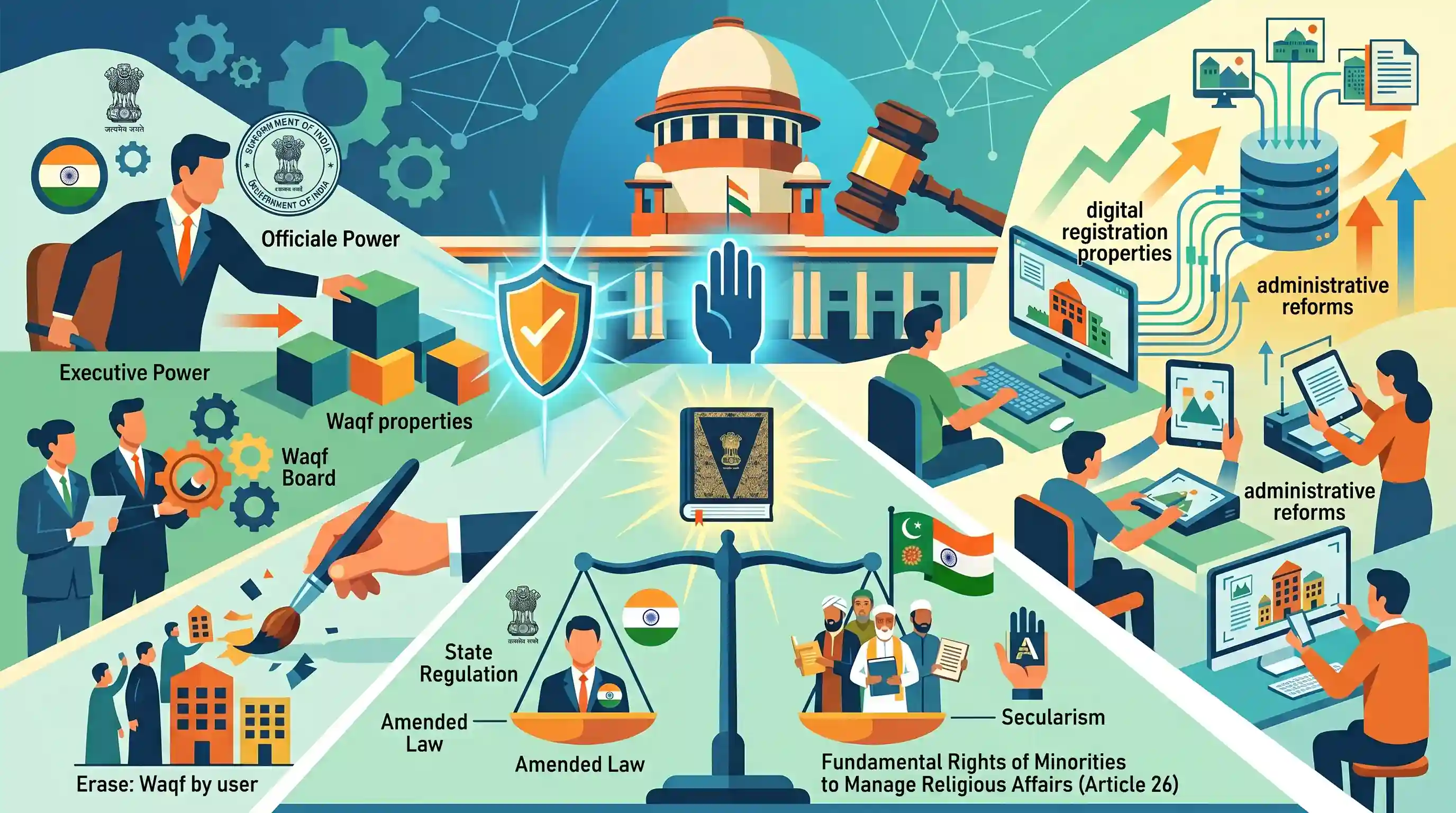
The Supreme Court of India has placed an interim stay on select provisions of the recently amended Waqf Act following constitutional challenges. The stayed sections primarily deal with the expansion of executive power, notably the authority given to District Magistrates to decide property disputes between the Waqf Board and the government. Other contentious issues include changes to the composition of Waqf bodies and the removal of the 'Waqf by user' concept. However, administrative reforms like the digital registration of properties remain in effect. The case represents a significant constitutional test of the state's ability to regulate religious endowments versus the fundamental right of minorities to manage their religious affairs under Article 26.
Key Points
- The Supreme Court of India has issued an interim stay on certain contentious provisions of the Waqf (Amendment) Act while reviewing petitions challenging its constitutional validity.
- A key stayed provision involves granting the District Magistrate (executive) the adjudicatory power to determine whether a disputed property is Waqf or government land, raising concerns about the separation of powers.
- The amendments also sparked debate over the removal of the 'Waqf by user' principle and the mandate to include non-Muslim members in Waqf administrative bodies.
- Non-contentious and procedural aspects of the amendment, such as digital registration of Waqf properties to enhance transparency, remain operational.
- The judicial scrutiny of the Act highlights the delicate balance between the state's intent to reform statutory bodies for accountability and the minority community's right to manage religious endowments under Article 26 of the Constitution.
Important Terms
Waqf

Permanent dedication of movable or immovable property for purposes recognized by Muslim law as pious, religious, or charitable; ownership is transferred from the individual to Allah.
UPSC context
GS Paper II: Essential for topics on Secularism, Minority Rights, and Government Policies regarding religious endowments.
Waqf (Amendment) Act 2024
2024 legislation (renamed 'Unified Waqf Management Act') seeking to reform property registration, change board compositions, and transfer dispute-resolution powers from Tribunals to District Collectors.
UPSC context
GS Paper II: Tests 'Government Policies and Interventions' and 'Separation of Powers' due to executive vs judicial roles.
Waqf by User
A legal doctrine where property is deemed Waqf based solely on long-term, uninterrupted religious use, even without a formal deed or 'Waqfnama'.
UPSC context
GS Paper II: Relevant for Judiciary and Law; tests understanding of customary vs statutory religious law.
Central Waqf Council
A statutory body under the Ministry of Minority Affairs that advises the Central Government and State Waqf Boards on administrative matters.
UPSC context
GS Paper II: Statutory, Regulatory, and various Quasi-judicial Bodies; tests administrative oversight mechanisms.
Article 26
A constitutional right granting religious denominations the power to manage their own affairs in matters of religion and to administer property in accordance with law.
UPSC context
GS Paper II: Fundamental Rights; central to debates on state interference in religious management.
State Waqf Boards
Corporate bodies established in each state to protect, manage, and supervise Waqf properties; the 2024 Act proposes including non-Muslim members.
UPSC context
GS Paper II: Governance; tests the federal and administrative structure of minority endowment management.
Waqf Tribunal
A specialized quasi-judicial body created under the 1995 Act to resolve disputes; its authority was significantly curtailed by the 2024 Amendment.
UPSC context
GS Paper II: Quasi-judicial Bodies; focuses on the dilution of specialized judicial oversight in favor of executive authority.
Prelims Trap
The Supreme Court has struck down the Waqf (Amendment) Act for violating the secular basic structure.
The SC only placed an interim stay on select provisions (like DM's powers). Administrative reforms like digital registration remain legally operational.
Static Concepts Connected
How does Article 26 differ from Article 25 regarding religious freedom?
- Individual vs Denomination: Article 25 protects individual freedom of conscience, while Article 26 protects the collective rights of a religious denomination (or any section thereof).
- Property Administration: Article 26 specifically grants denominations the right to establish institutions and administer movable/immovable property in accordance with law.
- Constitutional Restrictions: Both are subject to public order, morality, and health, but Article 25 is additionally subject to other Fundamental Rights (Part III).
How does the Constitution address the Separation of Powers at the administrative level?
- Article 50: Article 50 (DPSP) explicitly directs the State to take steps to separate the judiciary from the executive in the public services of the State.
- Basic Structure Doctrine: Recognized as a basic structure feature, it limits laws from arbitrarily transferring core adjudicatory functions to executive officers (like District Magistrates).
Cross-Topic Patterns
Executive Adjudication & Tribunals
Granting District Magistrates adjudicatory powers over Waqf properties mirrors the broader constitutional friction over Tribunalisation (Article 323A/B) and the dilution of judicial independence by the executive.
Indian Secularism & State Intervention
The Waqf reforms reflect India's 'principled distance' model of secularism, linking conceptually to the ongoing legal debates around state management of Hindu religious endowments (HRCE Acts).

A 2026 Prelims polity question will likely contrast Article 26 (denominational property rights) with Article 50 (separation of powers).
Linked PYQs · 3
Linked PYQs · 3
- 2024MainsGS2
Discuss India as a secular state and compare with the secular principles of the US constitution.
- 2024MainsGS2
Public charitable trusts have the potential to make India's development more inclusive as they relate to certain vital public issues. Comment.
- 2023PrelimsGS1
Consider the following organizations/bodies in India: 1. The National Commission for Backward Classes 2. The National Human Rights Commission 3. The National Law Commission 4. The National Consumer Disputes Redressal Commission How many of the above are constitutional bodies?
