Green Firecrackers in Delhi NCR: Judicial Balancing and Air Quality
Source:The Hindu ↗
Why It Matters
This article is crucial for UPSC as it illustrates the practical challenges of enforcing environmental regulations (the failure of blanket bans) and the role of the Supreme Court in environmental governance. It serves as an excellent case study for GS2 (Judicial intervention/Public interest) and GS3 (Air pollution control measures and technological solutions like green crackers).
Summary
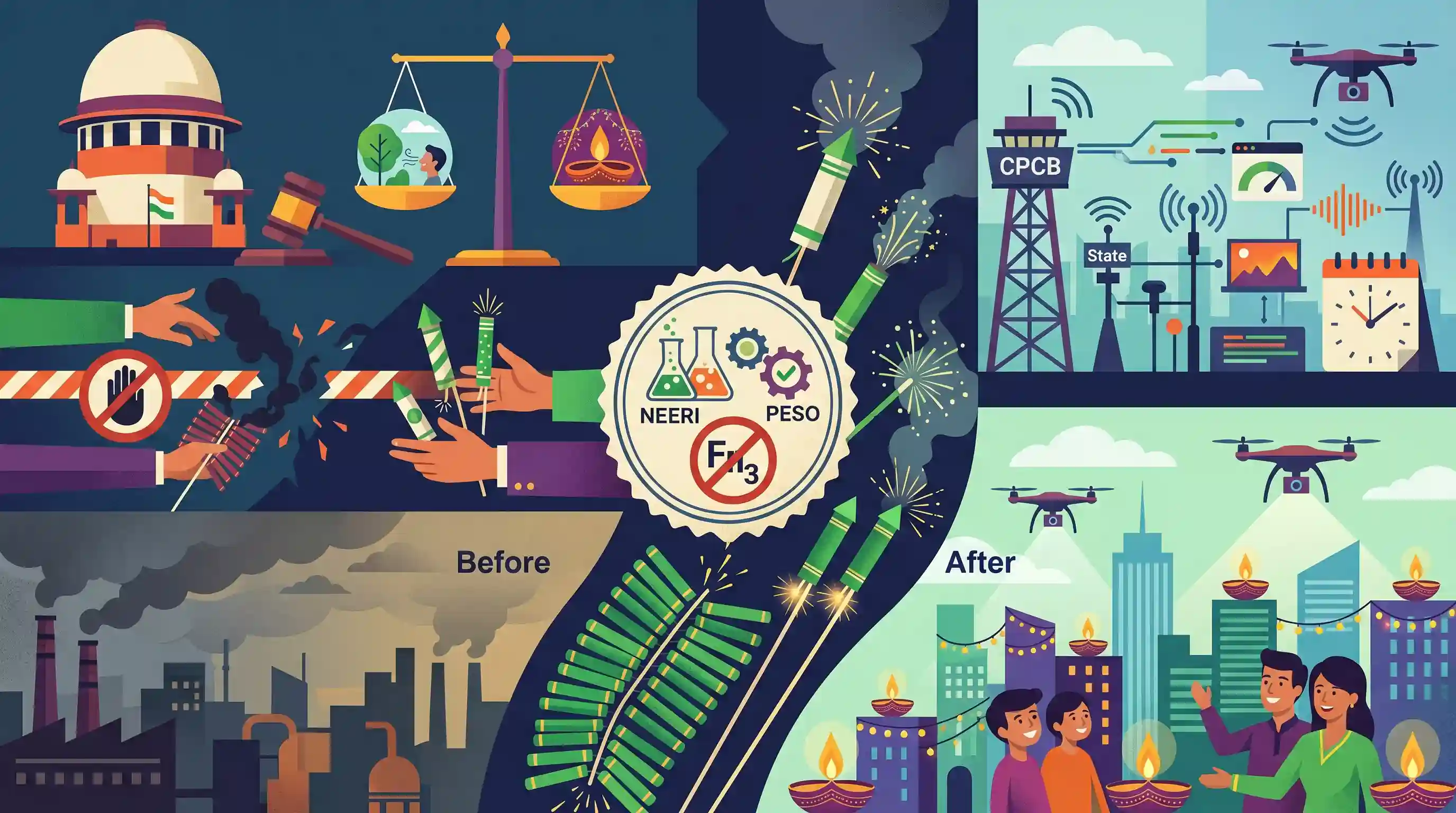
The Supreme Court relaxed the absolute ban on firecrackers in Delhi-NCR for Deepavali, allowing the sale and use of certified 'green crackers.' The Court recognized that total bans often fail in practice and inadvertently encourage the smuggling and bursting of highly polluting conventional fireworks. To ensure accountability and evaluate this approach, the Court directed the Central Pollution Control Board (CPCB) and State bodies to monitor air and noise pollution levels. This decision reinforces the judiciary's 2018 push for 'green crackers'—formulations certified by NEERI and PESO that eliminate toxic heavy metals—as a middle path between environmental protection and cultural celebrations.
Key Points
- The Supreme Court permitted the sale and bursting of 'green crackers' during specific time windows in Delhi-NCR for Deepavali, easing previous blanket bans.
- The Court observed that absolute bans are often counterproductive, leading to the illegal smuggling and use of highly toxic, conventional firecrackers.
- The Central Pollution Control Board (CPCB) and State Pollution Control Boards were directed to strictly monitor air and noise pollution levels to assess the impact of this relaxation.
- Green crackers are designed to have a reduced emission footprint (eliminating chemicals like barium) and require certification from NEERI and PESO.
- This measured approach traces back to the 2018 Arjun Gopal v. Union of India judgment, which sought to balance public health concerns with cultural traditions through technological solutions.
Important Terms
Green Crackers

Low-emission fireworks developed by CSIR-NEERI that reduce particulate matter by ~30%, exclude toxic barium salts, and use water vapor or dust suppressants to mitigate air and noise pollution.
UPSC context
GS Paper III: Environmental Pollution and Degradation. Critical for understanding technical solutions to seasonal air quality crises in Delhi-NCR.
Central Pollution Control Board (CPCB)
A statutory body established under the Water Act, 1974, responsible for monitoring air and water quality and advising the government on pollution control nationwide.
UPSC context
GS Paper II & III: Governance and Environment. Tests knowledge of statutory bodies and environmental regulation frameworks.
Petroleum and Explosives Safety Organization (PESO)
A statutory body under the Ministry of Commerce and Industry that regulates hazardous substances and certifies firecracker manufacturers for safety and chemical compliance.
UPSC context
GS Paper II: Statutory, Regulatory, and Quasi-judicial bodies. Relevant for industrial safety and product certification standards.
National Environmental Engineering Research Institute (NEERI)
A constituent laboratory of CSIR based in Nagpur that conducts research in environmental science and developed the specific formulations (SWAS, STAR, SAFAL) for green crackers.
UPSC context
GS Paper III: Science and Technology/Environment. Highlights the role of R&D in solving environmental governance challenges.
Judicial Activism
The proactive role of the judiciary in interpreting laws and issuing directives—often via PILs and Article 21—to address executive or legislative inaction in environmental protection.
UPSC context
GS Paper II: Polity/Separation of Powers. Examines the Supreme Court's expanding role in policy-making and environmental rights.
Prelims Trap
PESO regulates and certifies green crackers under the mandate of the Ministry of Environment, Forest and Climate Change.
PESO operates under the Ministry of Commerce and Industry (DPIIT), not MoEFCC. Examiners frequently swap ministries in environment-adjacent governance topics.
Static Concepts Connected
What are the key variants of Green Crackers developed by CSIR-NEERI?
- SWAS (Water Releaser): Suppresses dust by releasing water vapour when burst, completely avoiding the use of potassium nitrate and sulphur.
- STAR (Thermite Cracker): Designed as a safe thermite cracker that significantly lowers noise levels and particulate matter emissions without using potassium nitrate.
- SAFAL (Minimal Aluminium): Reduces metallic particulate matter by substituting magnesium for aluminium in its chemical formulation.
What constitutional balancing was established in the Arjun Gopal v. UoI (2018) judgment?
- Article 21 Supremacy: The Court ruled that the right to a healthy, pollution-free environment overrides competing rights when public health is severely threatened.
- Article 25 (Religion): Bursting firecrackers is not an 'essential religious practice', and the right is explicitly subject to public order, morality, and health.
- Article 19(1)(g) (Trade): The right to manufacture or sell fireworks can be reasonably restricted under Article 19(6) to protect the general public's health.
Cross-Topic Patterns
Fundamental Rights vs. Environmental Ethics
The SC's balancing act echoes previous jurisprudence on Jallikattu (culture vs animal welfare) and loudspeaker bans (religion vs noise pollution), testing the 'essential religious practice' doctrine.
NCR Air Quality Governance Matrix
This judicial intervention operates alongside statutory mechanisms like the CAQM and GRAP, illustrating the multi-pronged (judicial, technological, and statutory) approach to mitigating Delhi's winter smog.

Expect a 2026 Prelims statement mixing PESO's parent ministry (Commerce, not MoEFCC) with the specific heavy metals (Barium) banned by SC.
Linked PYQs · 3
Linked PYQs · 3
- 2022MainsGS2
“The most significant achievement of modern law in India is the constitutionalization of environmental problems by the Supreme Court.” Discuss this statement with the help of relevant case laws.
- 2020MainsGS3
What are the key features of the National Clean Air Programme (NCAP) initiated by the Government of India?
- 2021MainsGS3
Describe the key points of the revised Global Air Quality Guidelines (AQGs) recently released by the World Health Organisation (WHO). How are these different from its last update in 2005? What changes in India's National Clean Air Programme are required to achieve these revised standards?
