Judicial Balancing of Religious Rights at Heritage Sites
Source:Indian Express ↗
Why It Matters
The ruling illustrates the judiciary's delicate balancing of competing religious rights under Article 25 while managing historical disputes over places of worship. It highlights administrative mechanisms to uphold India's secular fabric and communal harmony during sensitive religious events.
Summary
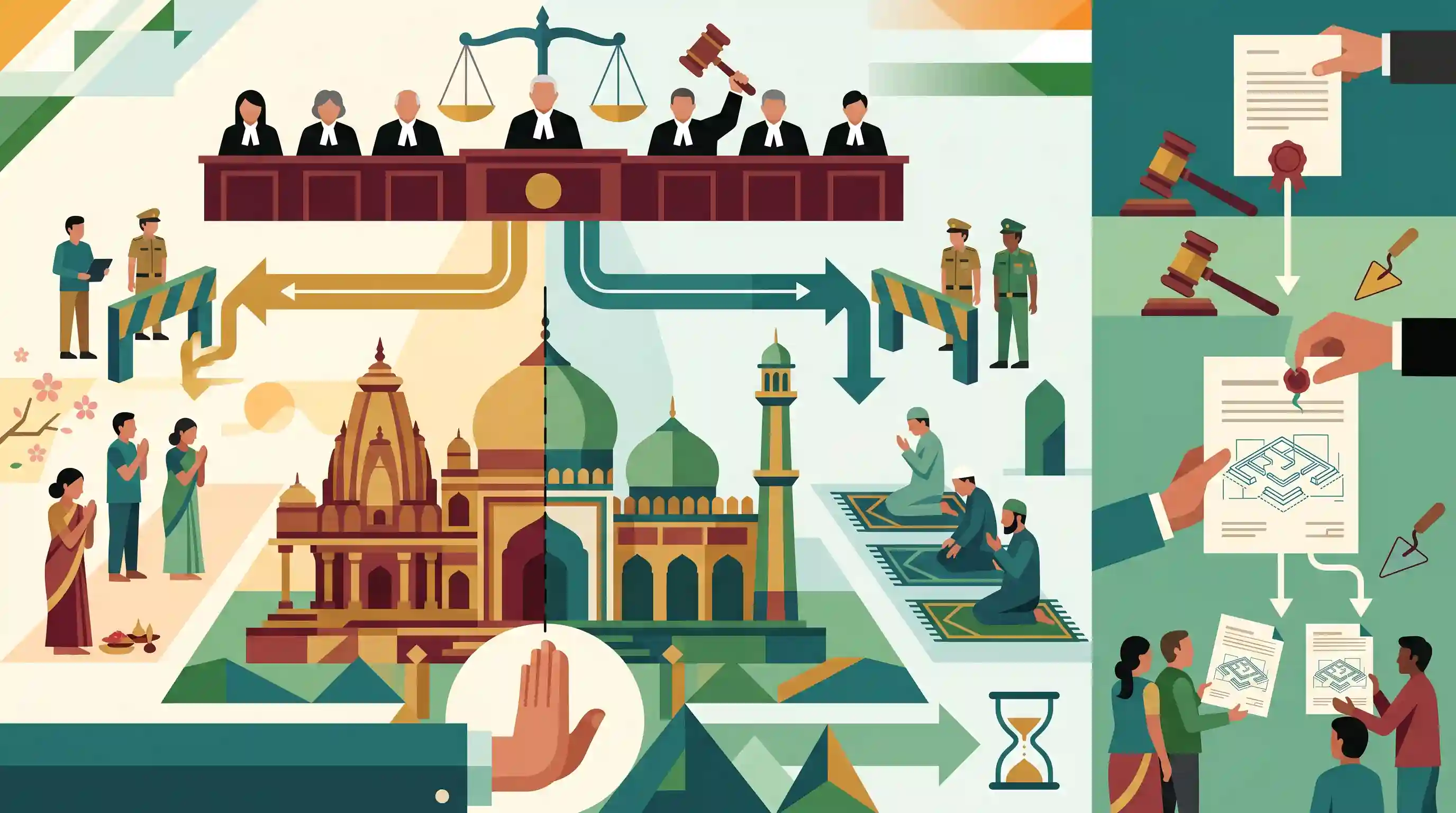
The Supreme Court of India allowed simultaneous Hindu puja and Muslim Friday namaz at the contested Bhojshala Temple/Kamal Maula Mosque site in Dhar, Madhya Pradesh, on the occasion of Basant Panchami. The Court ordered the district administration to arrange separate access points to maintain law and order and communal harmony. In addition, the Court instructed the Madhya Pradesh High Court to unseal the Archaeological Survey of India's (ASI) scientific survey report on the site and distribute copies to the involved parties. The apex court also directed that the status quo regarding the physical character of the monument must be preserved until a final verdict is reached.
Key Points
- The Supreme Court permitted both Hindu puja for Basant Panchami and Muslim Friday namaz to be held simultaneously at the disputed Bhojshala site.
- To maintain law and order, the Court directed the district administration to set up separate entry and exit points for the two communities.
- The SC ordered the Madhya Pradesh High Court to unseal the ASI's scientific survey report of the site and share copies with the contesting parties.
- A strict status quo on the physical character of the Bhojshala complex has been mandated pending the final outcome of the litigation.
Important Terms
Archaeological Survey of India (ASI)

An attached office of the Ministry of Culture, responsible for archaeological research and the conservation and preservation of cultural heritage and national monuments.
UPSC context
GS Paper I (Culture) & Paper II (Institutions); tests role in scientific surveys and heritage protection.
Places of Worship (Special Provisions) Act, 1991
A 1991 law that freezes the religious character of any place of worship as it existed on August 15, 1947, to prevent communal conflict and historical reversals.
UPSC context
GS Paper II (Polity/Laws); vital for understanding the legal barrier to religious site litigation.
Article 25 (Freedom of Religion)
A fundamental right guaranteeing freedom of conscience and the right to freely profess, practice, and propagate religion, subject to public order, morality, and health.
UPSC context
GS Paper II (Fundamental Rights); tests the limits and balancing of religious rights by the judiciary.
Supreme Court of India
The apex judicial body in India and final interpreter of the Constitution, possessing original, appellate, and advisory jurisdictions to protect fundamental rights and resolve disputes.
UPSC context
GS Paper II (Judiciary); tests judicial overreach vs. judicial activism in sensitive socio-religious matters.
Secularism
In the Indian context, it refers to the equal treatment of all religions (Sarva Dharma Sambhava) and principled distance of the state from religious affairs.
UPSC context
GS Paper I (Social Issues) & Paper II (Preamble); tests the unique Indian model of religious pluralism.
Bhojshala Complex
An 11th-century monument in Dhar, MP, built by Raja Bhoj (Paramara dynasty), serving as a Sanskrit center/temple and also claimed as the Kamal Maula Mosque.
UPSC context
GS Paper I (Art & Culture); tests knowledge of Paramara dynasty architecture and medieval educational centers.
Prelims Trap
The Places of Worship Act, 1991 freezes the religious character of all disputed structures, including ASI-protected historical monuments.
Section 4(3)(a) of the Places of Worship Act, 1991 expressly exempts ancient and historical monuments covered by the AMASR Act, 1958 (like Bhojshala).
Static Concepts Connected
How does the Places of Worship Act, 1991 interface with ancient monuments?
- Cut-off Date: The Act freezes the religious character of places of worship as it existed on August 15, 1947, barring any legal proceedings to change it.
- AMASR Exemption: Ancient and historical monuments, and archaeological sites covered by the AMASR Act, 1958, are completely exempted from this freeze.
- Ayodhya Exception: The Ram Janmabhoomi-Babri Masjid dispute in Ayodhya was specifically excluded from the Act's purview.
Who was King Bhoja and what is his cultural legacy?
- Paramara Dynasty: Ruled the Malwa region (capital Dhara) in the 11th century; renowned for both military conquests and immense cultural patronage.
- Literary Contributions: Authored highly influential texts on architecture (Samarangana Sutradhara), poetics (Sarasvatikanthabharana), and yoga.
- Bhojshala Foundation: Established as a premier center for Sanskrit learning and a shrine to Vagdevi (Goddess Saraswati).
Cross-Topic Patterns
Tech-driven archaeology in legal disputes
The application of Ground Penetrating Radar (GPR) and carbon dating by the ASI bridges Science & Tech with Art & Culture, a recurring theme in modern heritage disputes (Gyanvapi, Bhojshala).
Syncretic sites & Article 25 balancing
The judiciary's balancing of competing religious claims via shared access highlights practical constitutional secularism and the intricacies of Article 25 (Freedom of Religion).

Expect a tricky 2026 Prelims statement testing the specific exemptions under the Places of Worship Act, 1991 alongside ASI's AMASR mandate.
Linked PYQs · 3
Linked PYQs · 3
- 2024MainsGS2
Discuss India as a secular state and compare with the secular principles of the US constitution.
- 2020MainsGS2
Judicial Legislation is antithetical to the doctrine of separation of powers as envisaged in the Indian Constitution. In this context justify the filing of large number of public interest petitions praying for issuing guidelines to executive authorities.
- 2020MainsGS1
Indian philosophy and tradition played a significant role in conceiving and shaping the monuments and their art in India. Discuss.
