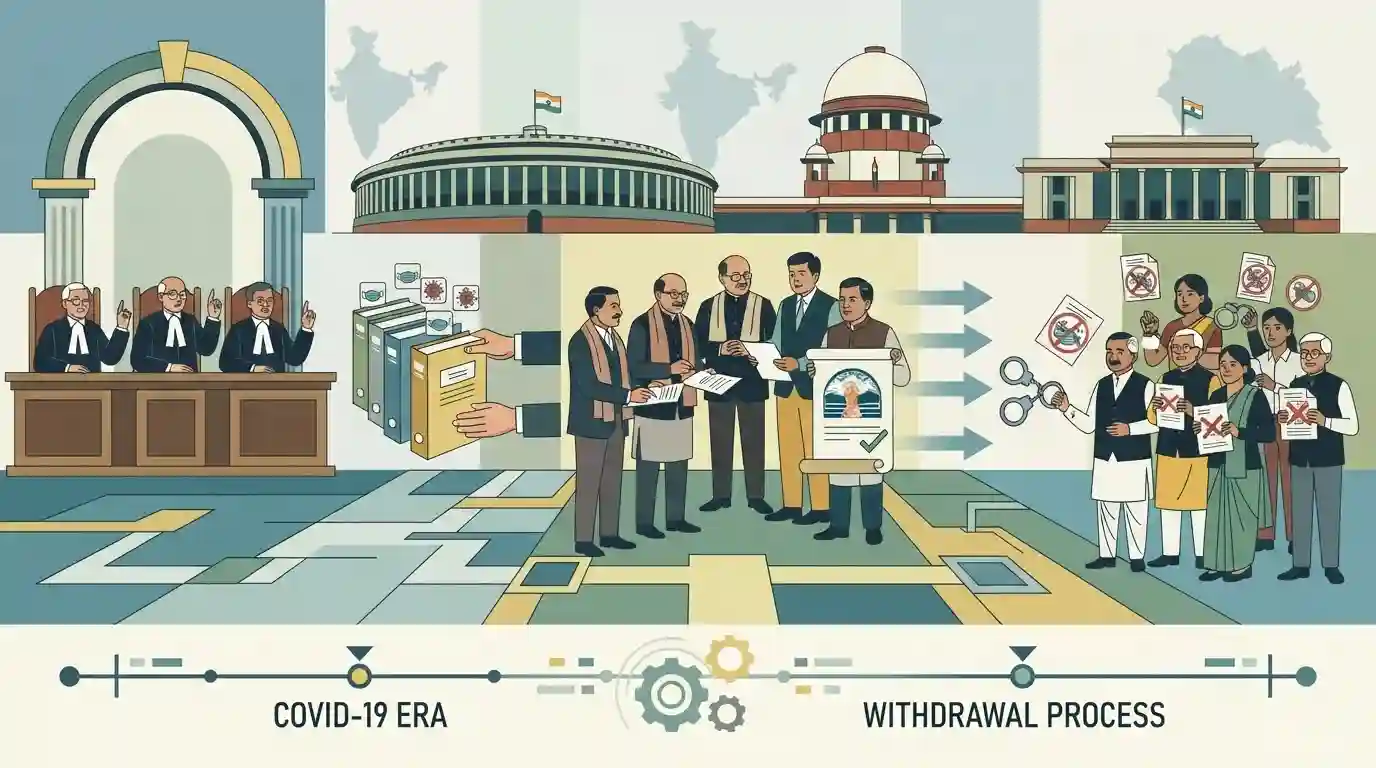
Supreme Court permits withdrawal of pandemic cases against legislators
Source:The Hindu ↗
Why It Matters
This case highlights the legal framework governing the withdrawal of criminal prosecutions under Section 321 of the CrPC, judicial oversight on executive decisions regarding lawmakers, and managing legacy cases from extraordinary situations like the COVID-19 pandemic.
Summary
The Supreme Court of India permitted the Himachal Pradesh government to withdraw COVID-19 pandemic-era criminal cases filed against several sitting and former MLAs, involving relatively minor infractions and lockdown or guideline violations.
Key Points
- The Supreme Court allowed the Himachal Pradesh government to withdraw COVID-19 era criminal cases registered against sitting and former Members of Legislative Assembly (MLAs).
- The withdrawal involves minor or petty violations and administrative infractions logged during the pandemic restrictions.
- Section 321 of the CrPC empowers the public prosecutor, with the consent of the court, to withdraw from the prosecution of any person.
Important Terms
Section 321 of the Code of Criminal Procedure (CrPC)

A legal provision under the Code of Criminal Procedure empowering a Public Prosecutor to withdraw from prosecution at any stage before judgment, subject to the consent of the court.
UPSC context
HPAS GS Paper II (Indian Judiciary / Criminal Justice System): Tests understanding of prosecutorial discretion, executive powers, and judicial oversight in criminal cases.
Supreme Court
The apex judicial body of India, which possesses ultimate constitutional authority to interpret laws, review executive actions, and ensure the administration of justice.
UPSC context
HPAS GS Paper II (Indian Polity): Tests knowledge of judicial review, apex court jurisdiction, and federal balance between state governance and central rule of law.
Himachal Pradesh Government
The elected state executive body of Himachal Pradesh, responsible for policy formulation, administration, and governance within the state jurisdiction.
UPSC context
HPAS GS Paper II & Himachal-specific GK: Tests awareness of state executive decisions, regional governance, and local policy implementation.
Static Concepts Connected
What are the key legal parameters of Section 321 of the CrPC regarding withdrawal from prosecution?
- Prosecutor Independence: Public Prosecutor in charge of the case must initiate the application independently, not under direct executive dictation.
- Judicial Consent: The trial court must apply judicial mind and give consent; it is not a rubber-stamping authority.
- Stage of Withdrawal: Can be executed at any stage before the judgment is pronounced in the criminal trial.
Cross-Topic Patterns
Section 321 CrPC vs Executive Clemency
Section 321 CrPC withdrawal powers interact directly with the Governor's pardon under Article 161 and the separation of powers doctrine tested in HPAS polity papers.

Expect a statement-based question combining Section 321 CrPC powers, judicial consent, and politician immunity/prosecution withdrawal.
Linked PYQs · 2
Linked PYQs · 2
- 2020HPAS_PRELIMSGS1
Which of the following officers can be removed from his office by the Governor?
- 2020HPAS_PRELIMSGS1
Consider the given four statements and choose the correct answer from the given options. 1. Justice Deepak Misra has been instrumental in the creation of Public Interest Litigation (PIL). 2. Justice Ranjan Gogoi joined Rajya Sabha after retirement from Supreme Court. 3. Justice P.N. Bhagwati introduced PIL. 4. Justice V.K. Krishna Iyer resigned before time.
