Withdrawal of Prosecution Against Lawmakers and Executive Powers
Source:The Hindu ↗
ఇది ఎందుకు ముఖ్యం
It highlights the complex interplay between executive power to withdraw prosecutions under Section 321 of the CrPC and judicial oversight, particularly when cases involve lawmakers, touching on debates surrounding accountability and rule of law.
సారాంశం
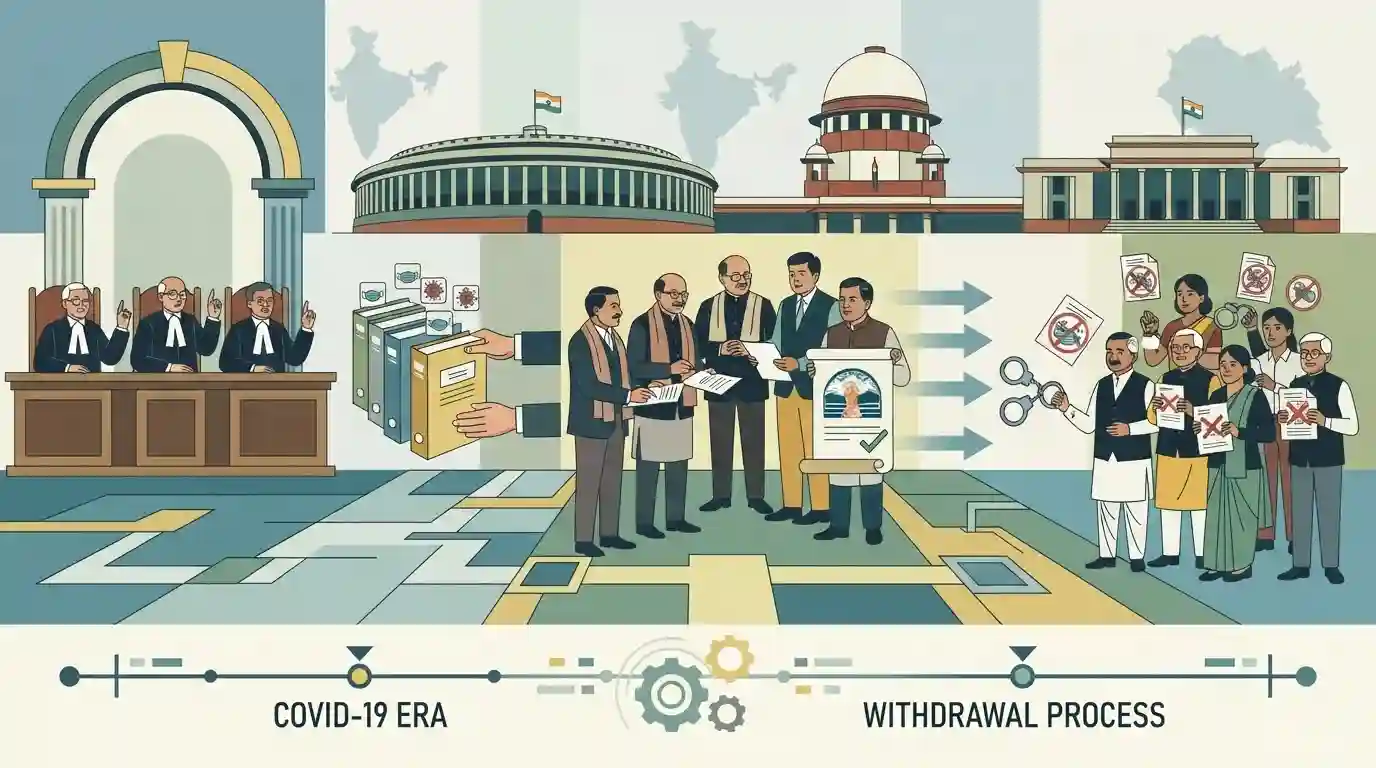
The Supreme Court of India allowed the Himachal Pradesh government to withdraw criminal cases registered during the COVID-19 pandemic era against various sitting and former MLAs for violations of pandemic-related restrictions, raising questions about executive discretion under Section 321 of the CrPC and judicial oversight.
ముఖ్య అంశాలు
- The Supreme Court permitted the Himachal Pradesh government to withdraw COVID-19 pandemic-era criminal cases filed against sitting and former MLAs.
- The cases involved violations of pandemic regulations and restrictions during the lockdown period.
- The decision touches upon the scope of executive power under Section 321 of the CrPC regarding the withdrawal of prosecution and judicial oversight over such executive decisions.
ముఖ్యమైన పదాలు
Code of Criminal Procedure Section 321

A statutory provision empowering a public prosecutor, with the consent of the court, to withdraw from the prosecution of any person at any stage before the judgment is pronounced.
UPSC context
UPSC Polity and Governance (GS-II): Tests understanding of separation of powers, executive discretion in criminal justice, and judicial oversight over withdrawal of prosecutions against lawmakers.
Supreme Court
The apex judicial tribunal of India established under Article 124 of the Constitution, possessing extensive appellate, original, and advisory jurisdictions as the ultimate guardian of the Constitution.
UPSC context
UPSC Judiciary and Executive Relations (GS-II): Tests the role of the apex court in maintaining constitutional checks and balances and monitoring criminal cases against legislators.
Himachal Pradesh government
The elected provincial government of Himachal Pradesh exercising executive power within the state under Article 162 of the Constitution of India.
UPSC context
UPSC Governance and Polity (GS-II): Illustrates state-level executive decision-making, prosecutorial policy, and federal dynamics regarding criminal law enforcement during exceptional crises like COVID-19.
అనుసంధానమైన స్థిర భావనలు
What is the legal scope and judicial oversight of Section 321 of the CrPC (now corresponding to BNSS) regarding withdrawal of prosecution?
- Prosecutor Role: Public prosecutor power: Can withdraw from prosecution with the consent of the court at any stage before judgment is delivered.
- Judicial Check: Judicial consent: Courts are not a rubber stamp; they must independently assess if withdrawal serves public justice and prevents abuse of process.
- Legislator Rule: High Court clearance: Per Supreme Court directions (Ashwini Upadhyay case), withdrawal of cases against MPs/mLA requires prior permission of the High Court.
అంతర-అంశ నమూనాలు
Executive Discretion vs. Judicial Review
The balance between executive discretion under CrPC Section 321 and judicial oversight reflects similar tensions seen in governor's pardoning powers under Article 161.
Criminalization of Politics vs. Judicial Oversight
Special fast-track courts for MPs and MLAs intersect with executive withdrawal powers, testing judicial oversight on criminalization of politics.

CrPC Sec 321 / BNSS withdrawal powers for legislators + High Court clearance rule under Ashwini Upadhyay case will form a 2-statement MCQ.
అనుసంధాన PYQలు · 2
అనుసంధాన PYQలు · 2
- 2020MainsGS2
There is a need for simplification of procedure for disqualification of persons found guilty of corrupt practices under the Representation of Peoples Act". Comment.
- 2020MainsGS2
Judicial Legislation is antithetical to the doctrine of separation of powers as envisaged in the Indian Constitution. In this context justify the filing of large number of public interest petitions praying for issuing guidelines to executive authorities.
