Supreme Court to Hear Plea on MP Remarks Against Judiciary
Source:The Hindu ↗
Why It Matters
The event underscores the persistent tension between the Legislature and the Judiciary over the separation of powers. It provides a practical context for studying the Contempt of Courts Act (especially the requirement of the Attorney General's consent for criminal contempt), judicial independence, and constitutional provisions regarding the President and Governors' assent to Bills.
Summary
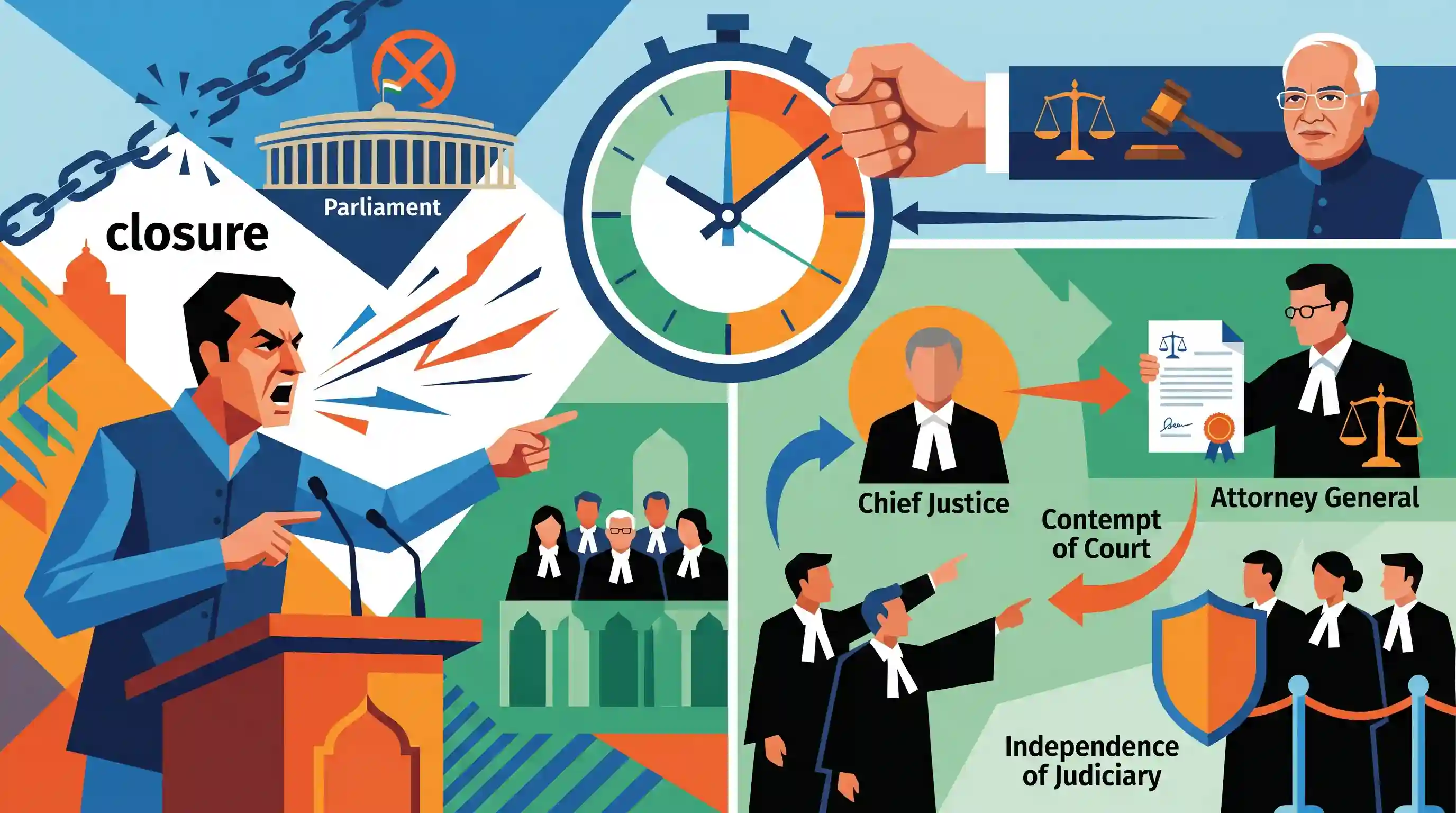
The Supreme Court of India will hear a plea seeking action against BJP MP Nishikant Dubey for making derogatory remarks against the judiciary and Chief Justice Sanjiv Khanna. Dubey accused the court of judicial overreach, specifically citing a recent judicial directive that imposed a three-month timeline on the President and Governors to decide on pending Bills. He remarked that Parliament should be shut down if the top court continues to dictate laws. In response, advocates have sought the Attorney General's consent to initiate criminal contempt of court proceedings, and prominent legal bodies like the Supreme Court Bar Association have passed resolutions defending judicial independence.
Key Points
- The Supreme Court agreed to list a plea concerning derogatory remarks made by BJP MP Nishikant Dubey against the judiciary and CJI Sanjiv Khanna.
- Dubey criticized the Supreme Court for allegedly overstepping its bounds by issuing a three-month timeline for the President and Governors to decide on pending Bills.
- He claimed that if the Supreme Court dictates laws and causes 'civil wars', Parliament and State assemblies might as well be shut down.
- Advocates are seeking the mandatory consent of the Attorney General of India to initiate criminal contempt proceedings against the MP.
- Bar associations (SCBA and SCAORA) passed resolutions condemning the MP's remarks and strongly defending the independence of the judiciary.
Important Terms
Contempt of Courts Act, 1971

Statute governing the power of courts to punish for contempt. Under Section 15, a private individual requires the written consent of the Attorney General to initiate criminal contempt proceedings in the Supreme Court.
UPSC context
GS Paper II: Judiciary. Tests knowledge of judicial powers, accountability, and the procedural role of law officers in contempt cases.
Attorney General for India
The Union government's chief legal advisor. For criminal contempt, the AG acts as a gatekeeper to prevent frivolous litigation against the judiciary by granting or withholding consent for prosecution.
UPSC context
GS Paper II: Constitutional Bodies. Relevant for the AG's statutory functions and role in maintaining the dignity of the court.
Judicial Overreach
When the judiciary interferes with the legislative or executive domain, often by making laws or directing constitutional functionaries on matters of policy or internal procedure.
UPSC context
GS Paper II: Separation of Powers. A recurring theme regarding judicial activism vs. legislative sovereignty.
Article 200
Constitutional provision outlining the Governor’s options for Bills passed by state legislatures: grant assent, withhold assent, return for reconsideration, or reserve for the President’s consideration.
UPSC context
GS Paper II: Federalism & Executive. Important for understanding the Governor's role and recent judicial interpretations of timelines for Bill assent.
Separation of Powers
A democratic doctrine ensuring that the Executive, Legislature, and Judiciary function within their own spheres to prevent the concentration of power and provide checks and balances.
UPSC context
GS Paper II: Constitutional Framework. Fundamental concept testing the balance between different organs of the State.
Supreme Court Bar Association (SCBA)
A representative body of advocates practicing in the Supreme Court of India. It often passes resolutions on matters concerning the independence of the judiciary and the conduct of its members.
UPSC context
GS Paper II: Judiciary. Relevant for the role of bar associations in upholding judicial independence and professional ethics.
Prelims Trap
The Supreme Court cannot initiate criminal contempt proceedings without the prior written consent of the Attorney General.
AG's consent is only mandatory for private individuals under the 1971 Act. The SC holds inherent power under Article 129 to initiate suo motu criminal contempt without the AG's permission.
Static Concepts Connected
What are the Governor's options regarding assent to State Bills under Article 200?
- Assent or Withhold: The Governor can grant assent or withhold it, effectively ending the Bill's progress unless it's sent back.
- Return for Reconsideration: The Governor can return a non-Money Bill to the State Legislature for reconsideration, though re-passage makes assent mandatory.
- Reserve for President: The Governor must reserve Bills that derogate the High Court's powers, and may reserve others, transferring the final decision to the President.
- No Strict Timeline: The Constitution uses 'as soon as possible', lacking a rigid numerical deadline for assent, which leads to frequent state-governor friction.
What is the distinction between Civil and Criminal Contempt of Court?
- Civil Contempt: Defined as the wilful disobedience of any judgment, decree, direction, order, writ, or other process of a court.
- Criminal Contempt: Any publication or act that scandalizes the court, prejudices judicial proceedings, or interferes with the administration of justice.
- Constitutional Backing: Under Articles 129 and 215, the Supreme Court and High Courts act as Courts of Record, possessing inherent powers to punish for contempt.
Cross-Topic Patterns
Judicial Review vs. Judicial Legislation
Setting strict timelines for constitutional functionaries (Governors/President) touches the fine line between judicial review (resolving constitutional deadlocks) and judicial legislation (violating separation of powers).
AG's gatekeeping role in Contempt
The requirement for the Attorney General's consent to initiate criminal contempt acts as a critical statutory filter to prevent frivolous, politically motivated petitions from clogging the apex court.

Expect a 2026 Mains question linking Article 200 (Governor's assent delays), judicial review, and the separation of powers doctrine.
Linked PYQs · 4
Linked PYQs · 4
- 2020MainsGS2
Judicial Legislation is antithetical to the doctrine of separation of powers as envisaged in the Indian Constitution. In this context justify the filing of large number of public interest petitions praying for issuing guidelines to executive authorities.
- 2022PrelimsGS1
Consider the following statements: 1. Pursuant to the report of H.N. Sanyal Committee, the Contempt of Courts Act, 1971 was passed. 2. The Constitution of India empowers the Supreme Court and the High Courts to punish for contempt of themselves. 3. The Constitution of India defines Civil Contempt and Criminal Contempt. 4. In India, the Parliament is vested with the powers to make laws on Contempt of Court. Which of the statements given above is/are correct?
- 2025MainsGS2
“The Attorney General of India plays a crucial role in guiding the legal framework of the Union Government and ensuring sound governance through legal counsel.” Discuss his responsibilities, rights and limitations in this regard.
- 2023MainsGS2
“Constitutionally guaranteed judicial independence is a prerequisite of democracy.” Comment.
