Supreme Court scrutiny of political freebies and fiscal health
Source:The Hindu ↗
Why It Matters
The 'freebies vs welfare' debate is central to Indian electoral democracy. It directly impacts state fiscal management, electoral integrity, and the constitutional limits of political campaigning. Understanding the regulatory powers of the ECI and the legislative/judicial limitations in curbing populist expenditure is vital for GS Paper II (Polity & Governance).
Summary
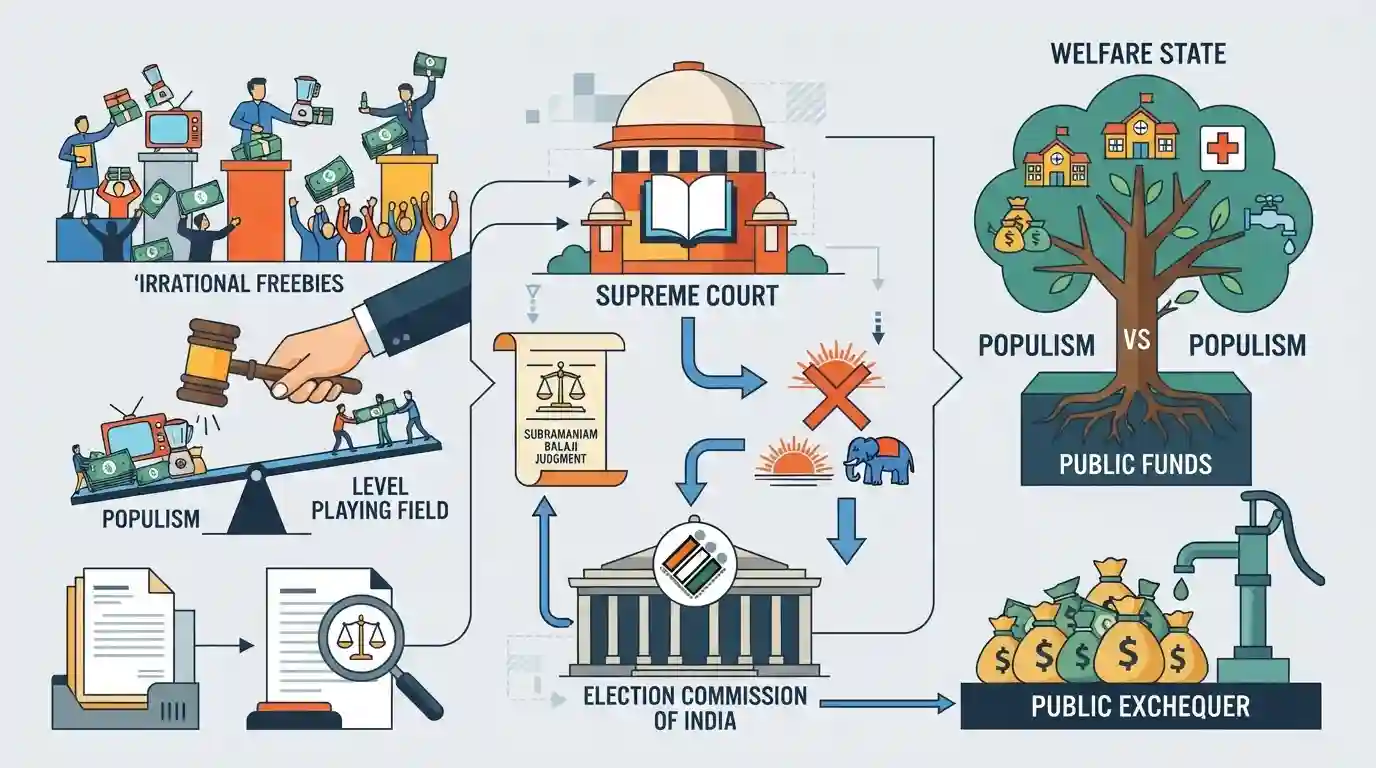
The Supreme Court has agreed to hear a Public Interest Litigation (PIL) challenging the practice of political parties promising 'irrational freebies' during elections. The petitioner argues that such populism, funded by the public exchequer, violates several constitutional principles (including Articles 14, 162, 266(3), and 282), compromises electoral integrity, and disrupts the level playing field. The PIL seeks a directive to the Election Commission of India (ECI) to deregister offending parties or seize their symbols, bringing the 2013 Subramaniam Balaji judgment (which held that manifesto promises are not corrupt practices under the RPA 1951) back under judicial scrutiny.
Key Points
- The Supreme Court agreed to hear a PIL seeking directions to the Election Commission of India (ECI) to deregister political parties or seize their symbols if they promise or distribute irrational freebies from public funds before elections.
- The petition argues that promising 'irrational freebies' using public exchequer funds violates Articles 14 (Equality), 162 (Executive power), 266(3) (Appropriation of funds), and 282 (Discretionary grants/public purpose spending) of the Constitution.
- The petition contends that distributing private utilities from public funds destroys the level playing field, acts as a bribe to voters, and threatens the fiscal health of states.
- The debate references the Subramaniam Balaji v. State of Tamil Nadu (2013) judgment, where the Supreme Court held that manifesto promises do not amount to 'corrupt practices' under Section 123 of the Representation of the People Act (RPA) 1951, but directed the ECI to frame guidelines for manifestos.
- The PIL challenges this existing framework, arguing that the ECI's guidelines under the Model Code of Conduct have proved ineffective in curbing fiscal populism.
Important Terms
Representation of the People Act 1951

A key Indian legislation governing the actual conduct of elections, candidate qualifications/disqualifications, electoral offenses like corrupt practices, and the resolution of election disputes.
UPSC context
GS Paper II (Polity); explicitly listed under "Salient features of the Representation of People’s Act."
Election Commission of India
An autonomous constitutional authority established under Article 324 to manage and conduct free, fair, and transparent elections to Parliament, State Legislatures, and high offices.
UPSC context
GS Paper II (Polity & Governance); tests electoral reforms, institutional independence, and constitutional bodies.
Model Code of Conduct
A set of consensus-driven, non-statutory guidelines issued by the Election Commission to regulate the behavior of political parties and candidates during election periods.
UPSC context
GS Paper II (Polity); critical for questions on level playing fields, moral consensus, and campaign discipline.
Supreme Court of India
The highest judicial court in India, acting as the ultimate interpreter of laws, protector of fundamental rights, and custodian of the Constitution.
UPSC context
GS Paper II (Polity); tests judicial review, judicial activism, and constitutional dispute resolution.
Constitution of India
The supreme legal instrument establishing the political framework, powers of state organs, and fundamental rights and principles governing India.
UPSC context
GS Paper II (Polity); foundational to the entire syllabus, testing basic structure, constitutionalism, and statutory alignment.
Prelims Trap
The Election Commission of India has the power to deregister a political party for violating the Model Code of Conduct.
The Supreme Court ruled that ECI cannot deregister political parties except under three narrow grounds. ECI can only derecognize recognized status under the Symbols Order.
Static Concepts Connected
How do Deregistration and Derecognition of political parties differ under Indian law?
- Deregistration scope: Cancelling a party's legal existence. The ECI lacks general statutory powers under the RPA 1951 to deregister a party except in highly restrictive, specific circumstances.
- Derecognition scope: Withdrawing recognized State or National status. The ECI holds this power under Paragraph 16A of the Election Symbols (Reservation and Allotment) Order, 1968.
What is the scope of discretionary spending under Article 282?
- Legislative bypass: Permits both Union and States to make grants for any public purpose, regardless of whether they have legislative competence over the subject.
- Judicial test: The definition of 'public purpose' is highly elastic, making it difficult for courts to legally distinguish legitimate welfare from electoral populism.
Cross-Topic Patterns
Competitive populism and FRBM fiscal limits
Unfunded election freebies directly strain state finances, challenging the fiscal deficit targets mandated by state FRBM Acts and monitored by the Finance Commission.
DPSP welfare vs. RPA corrupt practices
Balancing Article 39 (distributive justice) with RPA Section 123 (corrupt practices) tests whether providing individual goods constitutes genuine state-led development or illegal voter inducement.

Expect a multi-statement UPSC question testing ECI's lack of deregistration powers alongside the constitutional bounds of Article 282.
Linked PYQs · 3
Linked PYQs · 3
- 2017PrelimsGS1
Consider the following statements: 1. The Election Commission of India is a five-member body. 2. Union Ministry of Home Affairs decides the election schedule for the conduct of both general elections and bye-elections. 3. Election Commission resolves the disputes relating to splits/mergers of recognised political parties. Which of the statements given above is/are correct?
- 2022MainsGS2
Discuss the role of the Election Commission of India in the light of the evolution of the Model Code of Conduct.
- 2020MainsGS2
There is a need for simplification of procedure for disqualification of persons found guilty of corrupt practices under the Representation of Peoples Act". Comment.
