Supreme Court to Hear TN Plea on VC Appointments
Source:The Hindu ↗
Why It Matters
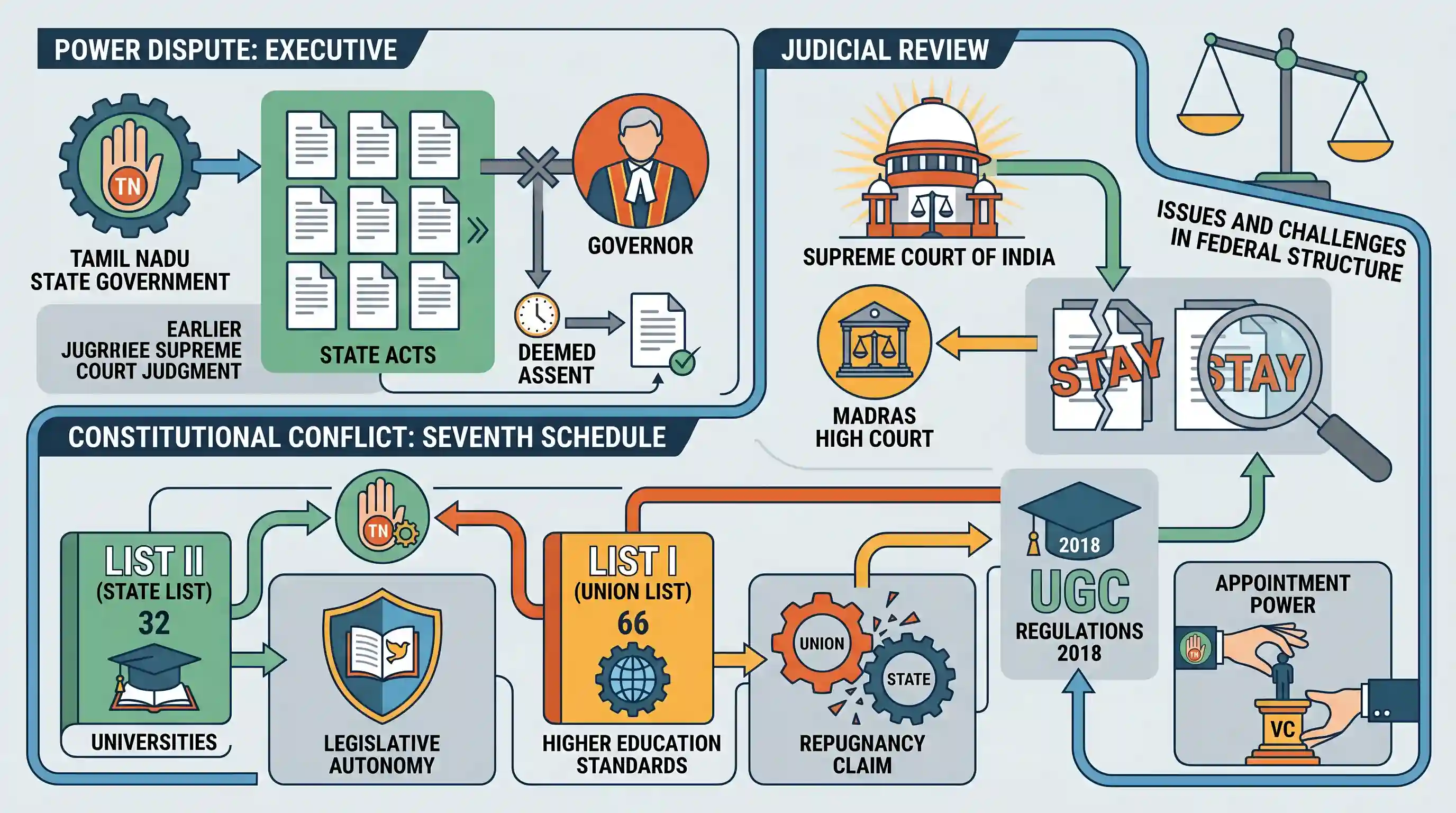
The controversy highlights ongoing friction between Governors and State governments regarding administrative control of state-run universities, touching upon broader themes of federalism, the concept of "deemed assent" to Bills under Article 200, and resolving repugnancy between state laws and central regulations.
Summary
The Supreme Court has agreed to examine the Tamil Nadu government's plea against a Madras High Court interim order that stayed nine State Acts aimed at transferring the power to appoint Vice-Chancellors in State-run universities from the Governor to the State government. The dispute highlights a clash over federalism, with the UGC claiming the State Acts are repugnant to its 2018 Regulations, and Tamil Nadu asserting its legislative autonomy under Entry 32, List II of the Seventh Schedule. Additionally, the State noted the Bills had received "deemed assent" by the Governor following an earlier Supreme Court judgment.
Key Points
- The Supreme Court agreed to hear Tamil Nadu's plea against a Madras High Court stay on nine Acts transferring Vice-Chancellor appointment powers from the Governor to the State government.
- Tamil Nadu argues the Bills had already received 'deemed assent' from Governor R.N. Ravi following an earlier Supreme Court judgment.
- The Solicitor General argued that the State Acts are completely repugnant to the UGC Regulations of 2018.
- The State invoked federalism and State autonomy to establish and regulate universities under Entry 32, List II of the Seventh Schedule.
Important Terms
University Grants Commission (UGC)

A statutory body established under the UGC Act, 1956, responsible for coordinating and maintaining standards of higher education, providing recognition, and disbursing funds to Indian universities.
UPSC context
GS Paper II: Statutory bodies; Education. Key for understanding federal regulatory frameworks and disputes over academic standards versus state autonomy.
Seventh Schedule (Entry 32, List II)
Constitutional provision granting State Legislatures exclusive power over the 'incorporation, regulation, and winding up' of corporations and universities (excluding those of national importance in List I).
UPSC context
GS Paper II: Federal structure. Tests knowledge of the division of powers and the extent of state control over public institutions.
UGC Regulations of 2018
Guidelines prescribing minimum qualifications and procedures for academic appointments; they mandate that Vice-Chancellors be appointed by the Chancellor from panels formed by committees including a UGC nominee.
UPSC context
GS Paper II: Federalism issues. These regulations are central to legal 'repugnancy' battles between state university laws and central standards.
Office of the Governor (as Chancellor)
The Governor’s statutory role in state-run universities, where they traditionally exercise independent discretion in appointments and administration, separate from the 'aid and advice' of the Council of Ministers.
UPSC context
GS Paper II: Constitutional posts and powers. Tests the distinction between a Governor's constitutional duties and their statutory roles in universities.
Doctrine of Repugnancy
Legal principle under Article 254 stating that if a State law is inconsistent with a Central law on a Concurrent subject, the Central law prevails to the extent of conflict.
UPSC context
GS Paper II: Legislative relations. Essential for understanding how the Supreme Court resolves clashes between state and central statutes.
The Tamil Nadu Universities Laws (Amendment) Act, 2022
Legislation passed by the Tamil Nadu Assembly to empower the State Government, rather than the Governor, to appoint Vice-Chancellors to state-run universities.
UPSC context
GS Paper II: State Legislature/Federalism. A case study on state efforts to limit gubernatorial discretion in university governance.
Prelims Trap
The Governor acts as the ex-officio Chancellor of state universities by virtue of a mandate in the Constitution of India.
The Chancellor role is statutory, created by individual state university laws, not the Constitution. In this specific capacity, the Governor can act independently of the Council of Ministers.
Static Concepts Connected
What happens when State education laws conflict with Union laws like UGC Regulations?
- Doctrine of Repugnancy: Under Article 254, if a State law on a concurrent/overlapping subject conflicts with a Union law, the Union law prevails, rendering the State law void.
- Entry Overlaps: States regulate universities under Entry 32 (State List), but this is subordinate to Entry 66 (Union List), which grants the Centre power to coordinate higher education standards.
What are the Governor's powers over State Bills under Article 200?
- Four Alternatives: The Governor may grant assent, withhold assent, return the Bill (if not a Money Bill) for reconsideration, or reserve it for the President's consideration.
- No Deemed Assent: The Constitution prescribes no fixed timeline for the Governor to act. The Supreme Court recently clarified that 'deemed assent' does not exist in constitutional law.
Cross-Topic Patterns
Punchhi Commission + Governor's dual roles
The federal friction over V-C appointments perfectly illustrates the Punchhi Commission's recommendation: Governors should not be burdened with statutory Chancellor roles to avoid routine political clashes with elected governments.
Entry 66 dominance in higher education
Links to recurring UPSC themes on legislative supremacy, showing how the Centre leverages 'maintenance of standards' (Entry 66, Union List) to override State legislation on university administration via the UGC.

Expect a 2026 multi-statement question fusing Art 200 (Governor's assent), Doctrine of Repugnancy, and the statutory vs constitutional roles.
Linked PYQs · 2
Linked PYQs · 2
- 2022MainsGS2
Discuss the essential conditions for exercise of the legislative powers by the Governor. Discuss the legality of re-promulgation of ordinances by the Governor without placing them before the Legislature.
- 2024MainsGS2
What changes has the Union Government recently introduced in the domain of Centre-State relations ? Suggest measures to be adopted to build the trust between the Centre and the States and for strengthening federalism.
