University Vice Chancellor Appointments and Federal Autonomy
Source:The Hindu ↗
Why It Matters
The ongoing conflict highlights crucial constitutional issues, including the scope of the Governor's powers, the doctrine of repugnancy between Central regulations (UGC) and State laws, and the extent of State autonomy in higher education under the Seventh Schedule. This forms a vital case study for Center-State relations and federalism in India.
Summary
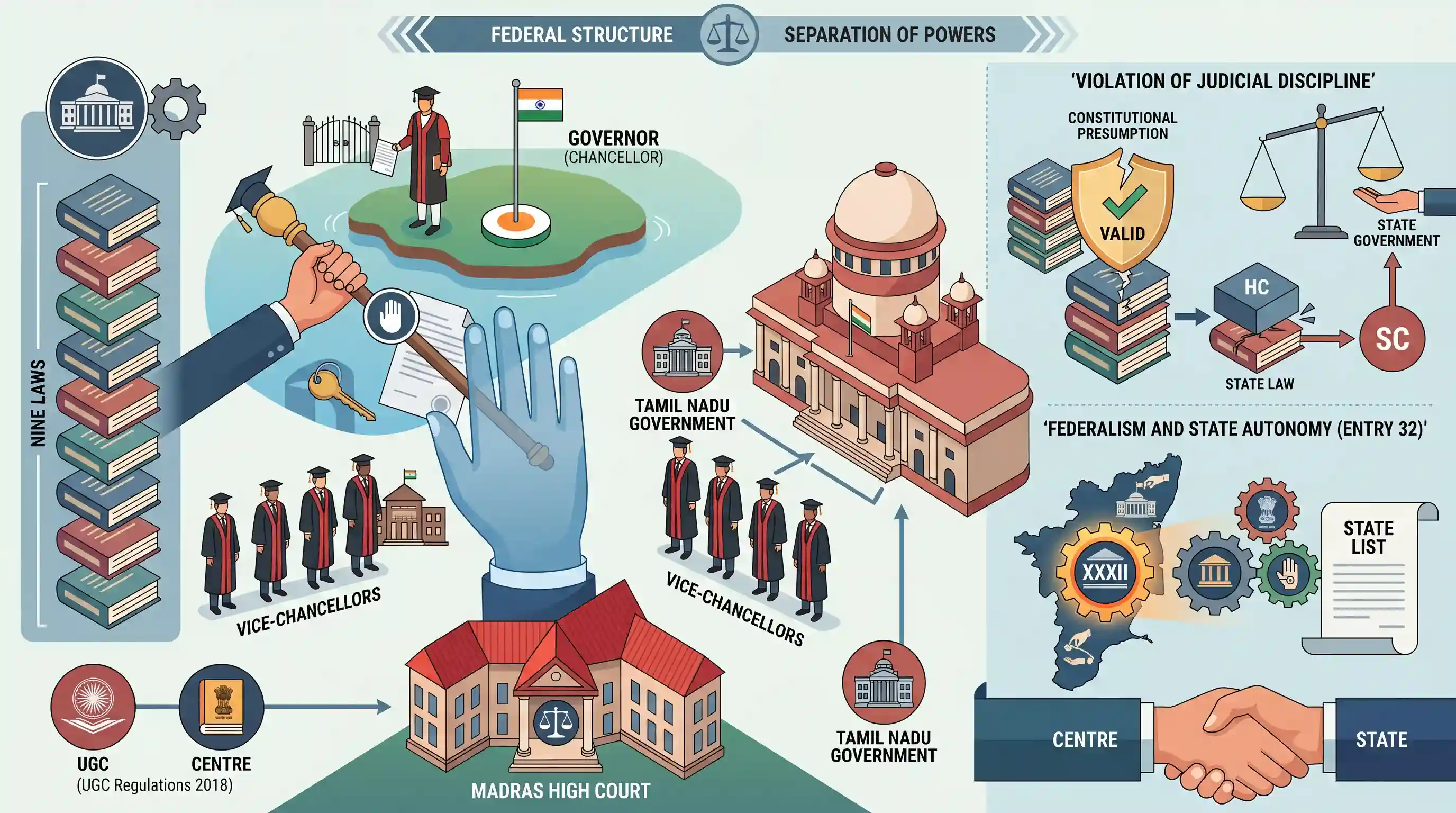
The Supreme Court has agreed to hear a petition by the Tamil Nadu government challenging a Madras High Court interim stay on nine state laws. These Acts transfer the authority to appoint Vice-Chancellors in state-run universities from the Governor (Chancellor) to the State government. While the Centre argues the laws are repugnant to the UGC Regulations of 2018, Tamil Nadu contends the stay violates judicial discipline by freezing legislation that carries a presumption of constitutionality. The State further argues the matter raises profound questions about federalism and the autonomy of States to regulate universities under Entry 32 of the State List.
Key Points
- The Supreme Court will examine Tamil Nadu's plea against a Madras High Court stay on 9 state Acts that transfer the power of appointing university Vice-Chancellors from the Governor to the State government.
- The Solicitor General argued that the State Acts are repugnant to the UGC Regulations of 2018, which dictate the standards for higher education.
- Tamil Nadu emphasized that the Supreme Court had previously noted the Bills were granted 'deemed assent' by Governor R.N. Ravi.
- The State asserts that staying legislative acts at an interim stage ignores the legal presumption of constitutionality and undermines State autonomy over universities under Entry 32 of List II.
Important Terms
UGC Regulations, 2018

Statutory rules by the UGC prescribing minimum qualifications for academic appointments (including Vice-Chancellors) and standards for higher education, binding on all universities as per Supreme Court rulings.
UPSC context
GS-II (Education/Federalism); tests the intersection of Central regulatory standards and State-run university administration.
Entry 32, List II (State List)
A subject in the Seventh Schedule's State List granting State Legislatures the power to regulate the 'incorporation, regulation, and winding up' of universities within their territory.
UPSC context
GS-II (Seventh Schedule); evaluates State autonomy in managing institutions of higher learning.
Entry 66, List I (Union List)
A Union List entry empowering Parliament to coordinate and determine standards in higher education or research and scientific and technical institutions across India.
UPSC context
GS-II (Federal Structure); central to disputes where Union 'standards' override State legislative powers.
Doctrine of Repugnancy
A constitutional principle under Article 254 where a Central law prevails over a State law in the Concurrent List if they conflict on the same subject.
UPSC context
GS-II (Centre-State Relations); critical for understanding legislative hierarchy in educational governance.
Presumption of Constitutionality
A legal doctrine where courts assume a statute is constitutionally valid unless proven otherwise, placing the burden of proof on the challenger to show a clear violation.
UPSC context
GS-II (Judiciary); relevant when discussing judicial stays on legislation before a final hearing on merits.
University Grants Commission (UGC)
A statutory body established under the UGC Act, 1956, responsible for the coordination, determination, and maintenance of standards of university education and grant distribution in India.
UPSC context
GS-II (Statutory Bodies); assesses the role of regulatory authorities in shaping national education policy.
Prelims Trap
"The Governor is bound by the aid and advice of the Council of Ministers when appointing Vice-Chancellors to state universities."
The Governor acts as Chancellor under statutory authority (State University Acts), not constitutional mandate. Therefore, they exercise independent discretion and are not bound by ministerial advice.
Static Concepts Connected
How is legislative power over universities divided in the Seventh Schedule?
- Union List: Entry 66 grants Parliament exclusive power over the coordination and determination of standards in institutions for higher education or research.
- State List: Entry 32 covers the incorporation, regulation, and winding up of universities, granting States primary control over university administration.
- Concurrent List: Entry 25 covers general education, including technical and medical education, but is explicitly subject to the provisions of Entry 66 of the Union List.
What is the Doctrine of Repugnancy under Article 254?
- General Rule: If a State law on a Concurrent List subject conflicts with a Central law, the Central law prevails and the State law is void.
- Presidential Assent: The State law can prevail within that State if it was reserved for and received the President's assent under Article 254(2).
- Parliamentary Override: Even after Presidential assent to a State law, Parliament retains the power to enact a new law overriding that specific State legislation.
Cross-Topic Patterns
Gubernatorial Friction & Article 200
This connects to the broader theme of Governors withholding assent to Bills under Article 200, highlighting federal friction and the limits of discretionary power in opposition-ruled states.
Presumption of Constitutionality vs Judicial Stay
The argument against staying legislation at an interim stage relies on the legal 'Presumption of Constitutionality', a concept recently invoked in debates around judicial overreach and staying parliamentary acts.

Expect a 2026 Prelims question on Entry 66 vs Entry 32 (Education) combined with the Governor's statutory powers as university Chancellor.
Linked PYQs · 2
Linked PYQs · 2
- 2022MainsGS2
Discuss the essential conditions for exercise of the legislative powers by the Governor. Discuss the legality of re-promulgation of ordinances by the Governor without placing them before the Legislature.
- 2019MainsGS2
From the resolution of contentious issues regarding distribution of legislative powers by the courts, 'Principle of Federal Supremacy' and 'Harmonious Construction' have emerged. Explain.
