Judicial review powers and quashing of criminal proceedings
Source:The Hindu ↗
Why It Matters
Highlights the inherent powers of High Courts to quash criminal proceedings to prevent the abuse of law, the application of the SC/ST Act, and the accountability of high-ranking UT administrators.
Summary
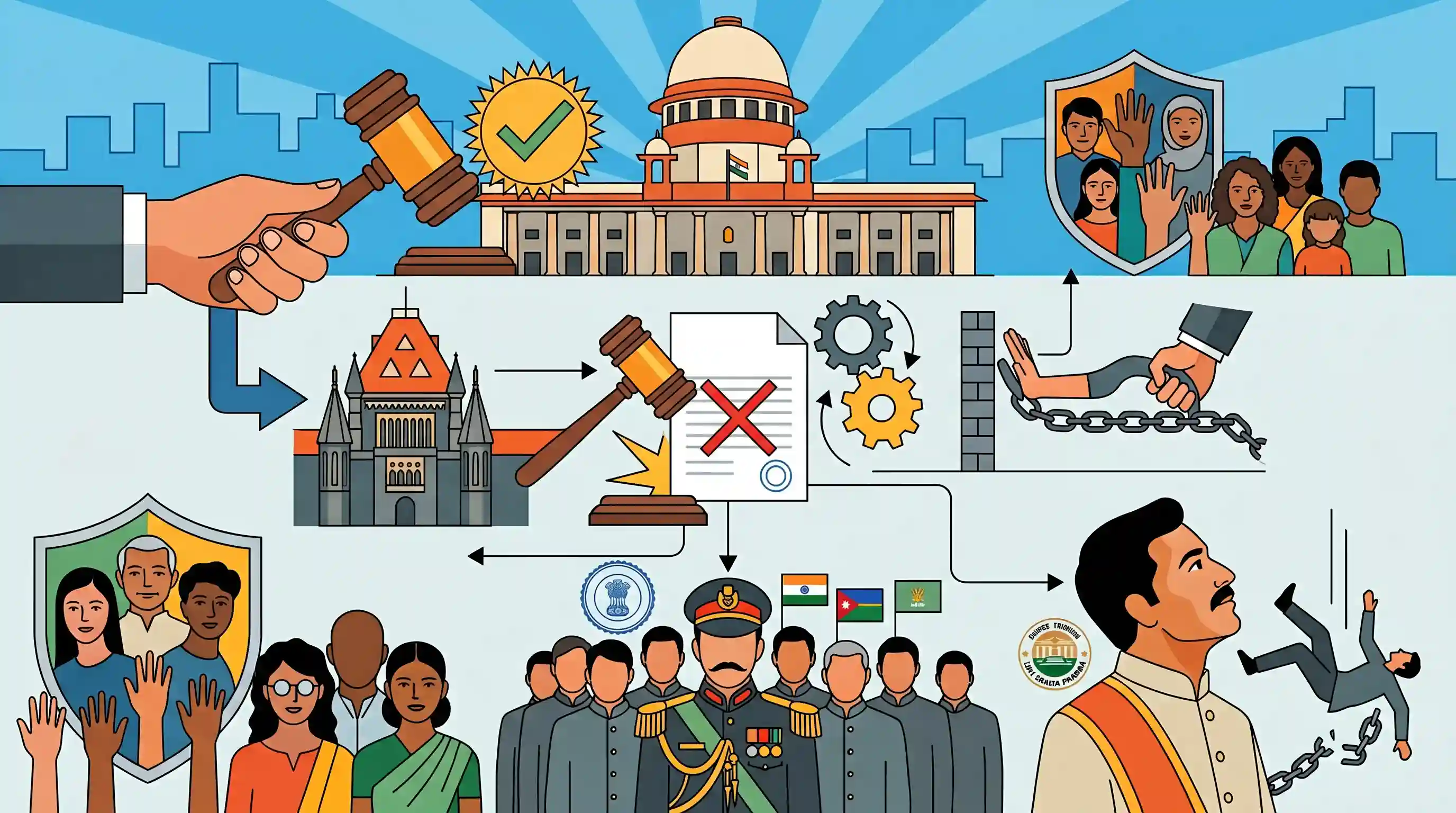
The Supreme Court has upheld the Bombay High Court's 2022 decision to quash the FIR in the suicide abetment case of former Lok Sabha MP Mohan Delkar. The FIR was originally filed under the IPC and the SC/ST (Prevention of Atrocities) Act against nine individuals, including the Administrator of several Union Territories, Praful Khoda Patel. The High Court had dismissed the case on the grounds of preventing the abuse of law, a decision now validated by the apex court.
Key Points
- The Supreme Court affirmed a Bombay High Court order quashing the FIR in the suicide abetment case of former MP Mohan Delkar.
- The FIR had named nine individuals, including Praful Khoda Patel, the Administrator of Dadra and Nagar Haveli, Daman and Diu, and Lakshadweep.
- Charges were filed under IPC sections for abetment to suicide, criminal intimidation, and extortion, alongside the SC/ST (Prevention of Atrocities) Act.
- The High Court had previously quashed the case to prevent the abuse of the legal process.
Important Terms
Scheduled Caste and Scheduled Tribe (Prevention of Atrocities) Act, 1989

A 1989 Act protecting SCs and STs from discrimination and violence by defining specific "atrocities." It bars anticipatory bail and provides for special courts to ensure social justice and victim rehabilitation.
UPSC context
GS Paper 2 (Welfare schemes for vulnerable sections). Tests understanding of social justice legislation and judicial safeguards for marginalized groups.
Indian Penal Code (IPC)
The primary 1860 criminal code of India, defining various offenses and punishments. It is currently being replaced by the Bharatiya Nyaya Sanhita (BNS) to modernize the criminal justice framework.
UPSC context
GS Paper 2 (Criminal Justice Reforms). Tests transition from colonial-era laws to contemporary legal frameworks like the BNS and BNSS.
Administrator (Union Territory)
An official appointed by the President under Article 239 to head a Union Territory. They act as the President's agent, exercising executive powers independently of a state-style Council of Ministers.
UPSC context
GS Paper 2 (Polity/Federalism). Tests the constitutional status of UTs and the executive relationship between the Center and UT administrations.
Quashing of FIR
The power of High Courts (under Section 482 CrPC) to nullify a criminal complaint or FIR to prevent abuse of the legal process or to secure the ends of justice.
UPSC context
GS Paper 2 (Judiciary). Tests the concept of judicial review, inherent powers of higher courts, and the prevention of malicious prosecution.
Supreme Court of India
The highest judicial court in India, serving as the final court of appeal and guardian of the Constitution. It possesses extraordinary powers to ensure complete justice under Article 142.
UPSC context
GS Paper 2 (Judiciary). Essential for understanding the separation of powers, judicial overreach, and the apex court's constitutional jurisdiction.
Abetment of Suicide
A criminal offense under Section 306 of the IPC where an individual instigates or assists another in committing suicide, requiring proof of active incitement or a direct act.
UPSC context
GS Paper 2 (Legal/Polity). Tests understanding of specific criminal liability thresholds and judicial interpretation of "abetment" versus general harassment.
Prelims Trap
"The Administrator of a Union Territory enjoys the same constitutional immunity from criminal proceedings as a State Governor."
Article 361 grants immunity from criminal proceedings to the President and Governors. It does not explicitly extend this constitutional protection to Administrators or Lieutenant Governors of Union Territories.
Static Concepts Connected
How is the administration of Union Territories structured under the Constitution?
- Presidential control: Under Article 239, every UT is administered directly by the President acting through an Administrator appointed with a specific designation.
- Dual role: Under Article 239(2), a State Governor can be appointed as Administrator of an adjoining UT, acting independently of their State Council of Ministers.
What are the inherent powers of High Courts regarding criminal proceedings?
- Statutory basis: Previously under Section 482 CrPC, now Section 528 of the BNSS 2023, granting HCs wide powers to secure the ends of justice.
- Quashing FIRs: HCs can quash FIRs—even under stringent laws like the SC/ST Act—if the offence is purely private or to prevent the abuse of the legal process.
Cross-Topic Patterns
Special Laws vs. Inherent Judicial Powers
The friction between statutory safeguards (like the SC/ST Act) and the judiciary's inherent power to quash politically motivated FIRs remains a standard GS2 analytical theme.
UT Administrators & Federal Friction
Cases involving Administrators (Lakshadweep, D&NH, Delhi) frequently test the constitutional limits of the Centre's direct governance over Union Territories.

Expect a 2026 Prelims statement comparing High Courts' inherent powers to quash FIRs (now BNSS Sec 528) with SC's Article 142 powers.
Linked PYQs · 1
Linked PYQs · 1
- 2018MainsGS2
Whether National Commission for Scheduled Castes (NCSC) can enforce the implementation of constitutional reservation for the Scheduled Castes in the religious minority institutions? Examine.
