WhatsApp Meta Privacy Policy and CCI Penalty Legal Dispute
Source:The Hindu ↗
Why It Matters
This case intersects the fundamental Right to Privacy (Article 21) with digital market regulation. It highlights the evolving challenges of data sovereignty, consumer protection in the digital era, and the role of statutory bodies like the CCI in curbing the abuse of dominant market positions by multinational tech corporations.
Summary
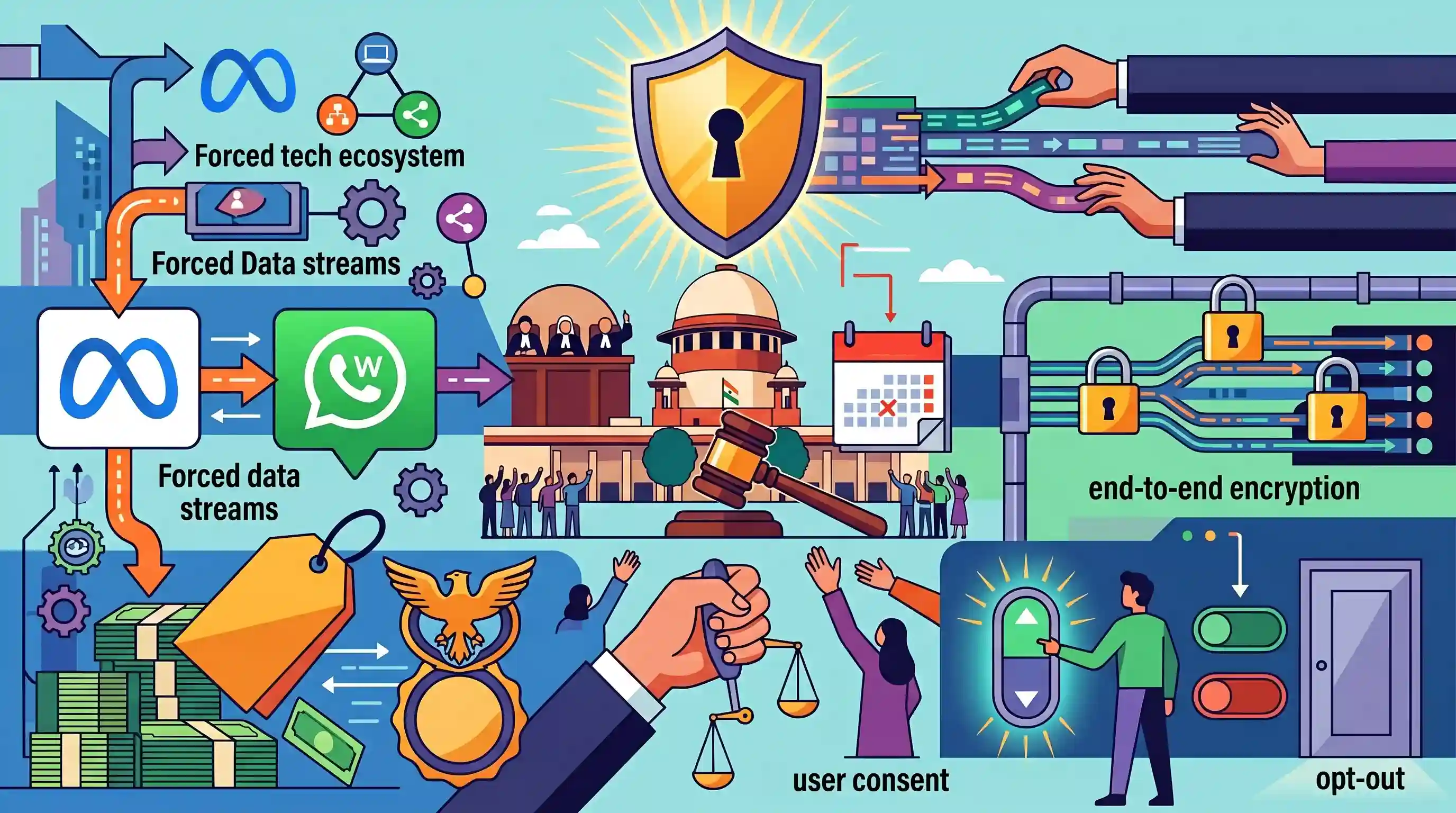
The Supreme Court of India has adjourned the hearing of a case involving Meta and WhatsApp's challenge to a ₹213.14 crore penalty imposed by the Competition Commission of India (CCI) to February 23. The CCI had penalized the tech giants over their 2021 privacy policy, which mandated data sharing across Meta companies. During the proceedings, the Supreme Court strongly criticized the potential commercial exploitation of personal data, likening unauthorized sharing of private information to theft and reaffirming the fundamental right to privacy for millions of consumers. In defense, the companies argued that their platform maintains end-to-end encryption and that users are provided with prior consent and opt-out mechanisms.
Key Points
- The Supreme Court adjourned the hearing on appeals by WhatsApp and Meta against a ₹213.14 crore penalty imposed by the Competition Commission of India (CCI).
- The penalty relates to the controversial 2021 WhatsApp privacy policy update and the sharing of user data across Meta-owned entities.
- The Supreme Court emphasized that tech platforms cannot breach the right to privacy of consumers by commercially exploiting their personal data without explicit consent.
- Meta and WhatsApp defended their policy, citing the presence of an opt-out clause, user consent, and the preservation of end-to-end encryption for messages.
Important Terms
Competition Commission of India (CCI)

A statutory body established under the Competition Act, 2002, to prevent anti-competitive practices, promote fair competition, and protect consumer interests in Indian markets.
UPSC context
GS Paper 2 (Statutory Bodies) and GS Paper 3 (Economy). Tests understanding of regulatory oversight in digital monopolies.
Right to Privacy
An intrinsic part of the Right to Life and Personal Liberty (Article 21), as declared by the Supreme Court in the landmark K.S. Puttaswamy judgment (2017).
UPSC context
GS Paper 2 (Polity/Fundamental Rights). Tests knowledge of judicial interpretations and the evolution of individual rights in the digital age.
Digital Personal Data Protection (DPDP) Act, 2023
A legal framework enacted to regulate the processing of digital personal data, balancing individuals' rights to protect their data with the need for lawful processing.
UPSC context
GS Paper 2 (Governance) and GS Paper 3 (Internal Security/Cyber). Tests awareness of legislative measures for data sovereignty.
Abuse of Dominant Position
Prohibited under Section 4 of the Competition Act, it occurs when a firm uses its market leadership to impose unfair conditions or restrict competition.
UPSC context
GS Paper 3 (Economy). Tests the ability to analyze market distortions created by Big Tech platforms.
End-to-End Encryption (E2EE)
A security mechanism where only the communicating users can access data, preventing intermediaries or service providers from reading the content of messages.
UPSC context
GS Paper 3 (Science and Technology). Tests technical understanding of data security versus national security/regulatory requirements.
Prelims Trap
"The CCI cannot penalize companies for privacy policy violations as data protection falls exclusively under the DPDP Act."
CCI has jurisdiction if a privacy policy (e.g., coercive data sharing) constitutes an "abuse of dominant market position" under the Competition Act, 2002. It is not exclusively a DPDP issue.
Static Concepts Connected
What is the Puttaswamy test for restricting the Right to Privacy?
- Legality: Any restriction must be backed by a valid, constitutionally sound law.
- Legitimate Aim: The restriction must serve a compelling public interest or legitimate state objective.
- Proportionality: The extent of the restriction must be strictly proportionate to the targeted need, without overreaching.
How does the Competition Act define 'abuse of dominant position'?
- Unfair Conditions: Imposing unfair or discriminatory conditions, such as "take-it-or-leave-it" terms, on the purchase or sale of goods/services.
- Market Leveraging: Using a dominant position in one relevant market to protect or enter into another relevant market.
- Denial of Access: Practices that restrict market access for new entrants, often achieved in tech via data hoarding.
Cross-Topic Patterns
Competition Law + Privacy Intersection
Data is now treated as a market asset. Coercive privacy policies are not just fundamental rights violations; they are anti-competitive tools that cement tech monopolies via network effects.
E2EE vs. Metadata Monetization
While End-to-End Encryption secures message content (Science & Tech), it does not shield metadata (frequency, locations, contacts) from commercial extraction and exploitation (Economy/Polity).

Expect a 2026 prelims question linking the DPDP Act's 'consent' clauses with CCI's mandate on data-driven market monopolies.
Linked PYQs · 5
Linked PYQs · 5
- 2017MainsGS2
Examine the scope of Fundamental Rights in the light of the latest judgement of the Supreme Court on Right to Privacy.
- 2024MainsGS2
Right to privacy is intrinsic to life and personal liberty and is inherently protected under Article 21 of the constitution. Explain. In this reference discuss the law relating to D.N.A. testing of child in the womb to establish its paternity.
- 2023MainsGS2
Discuss the role of the Competition Commission of India in containing the abuse of dominant position by the Multi-National Corporations in India. Refer to the recent decisions.
- 2024PrelimsGS1
Under which of the following Articles of the Constitution of India, has the Supreme Court of India placed the Right to Privacy ?
- 2021PrelimsGS1
'Right to Privacy' is protected under which Article of the Constitution of India?
