Supreme Court Ruling on Spousal Maintenance Rights
Source:Indian Express ↗
Why It Matters
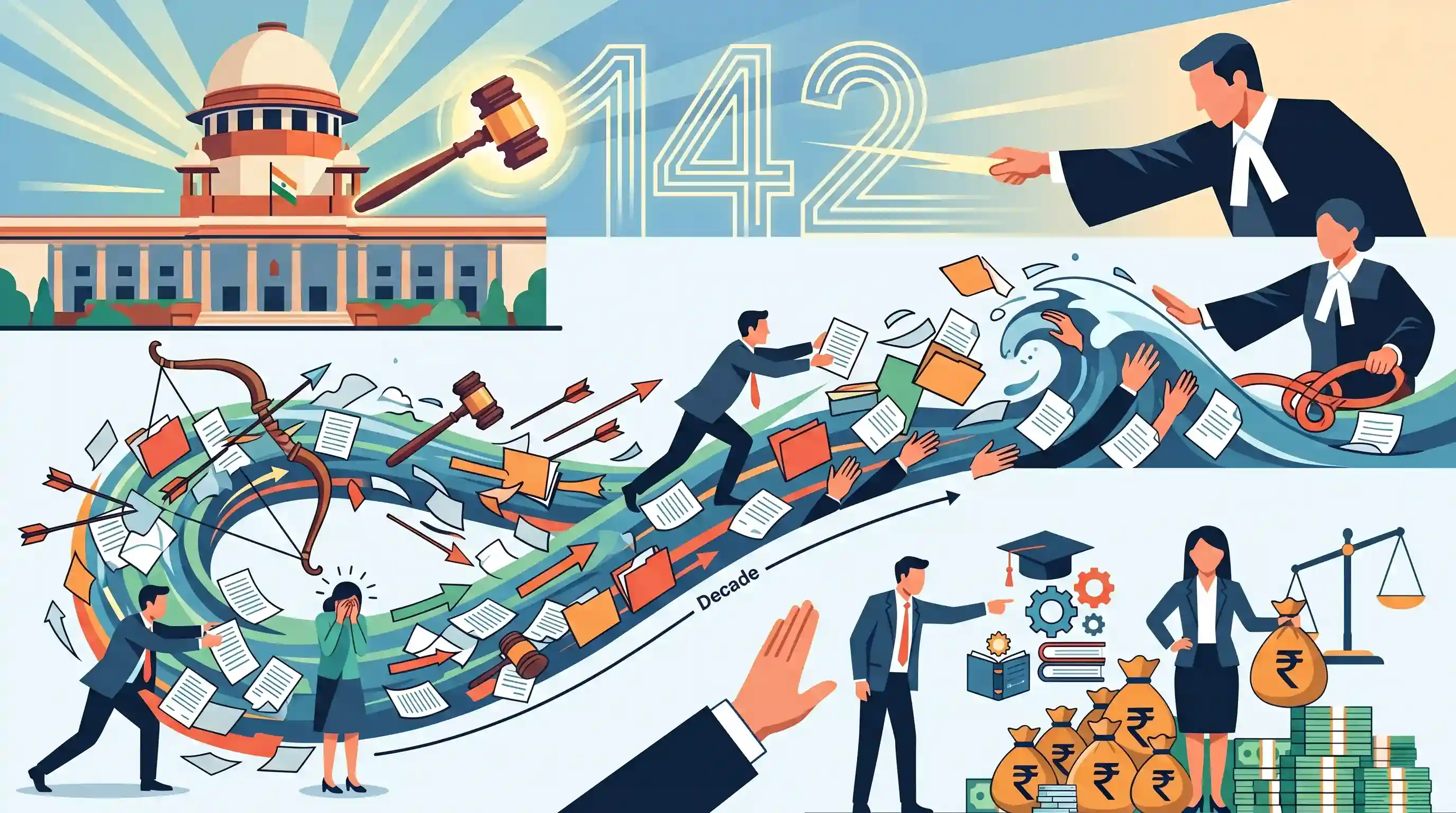
The ruling illustrates the practical application of Article 142 by the Supreme Court to circumvent systemic judicial delays and deliver 'complete justice'. It also reinforces the principles of gender justice by clarifying that a woman's educational qualifications do not negate her legal right to maintenance.
Summary
The Supreme Court invoked its extraordinary powers under Article 142 to dissolve a marriage due to its 'irretrievable breakdown' and quashed over 80 pending civil and criminal cases between the couple. Terming the decade-long legal battle a 'Mahabharata', the Court heavily criticized the husband for initiating vexatious litigations to harass his estranged wife. Emphasizing gender justice, the Court awarded Rs 5 crore as permanent alimony to the wife, rejecting the argument that her professional qualifications absolved the husband of financial liability.
Key Points
- The Supreme Court invoked Article 142 to dissolve a marriage on the ground of 'irretrievable breakdown', bypassing standard procedural delays to ensure 'complete justice'.
- The Court ruled that a wife's high educational or professional qualifications do not absolve the husband of his liability to pay maintenance or alimony.
- The bench quashed over 80 civil and criminal proceedings initiated by the husband, condemning the use of vexatious litigation to harass the wife and her family.
- The husband was directed to pay Rs 5 crore as permanent alimony to secure the future of the wife and their son.
Important Terms
Article 142 of the Constitution

A constitutional provision granting the Supreme Court extraordinary power to pass any decree or order necessary to ensure 'complete justice' in any case where statutory law may be silent or inadequate.
UPSC context
GS-II/Judiciary; tests understanding of judicial activism, 'complete justice,' and the Supreme Court’s discretionary powers vs. legislative domain.
Irretrievable Breakdown of Marriage
A legal doctrine where a marriage is functionally dead, with no possibility of reconciliation. While not a statutory ground for divorce in India, the SC uses Article 142 to grant it.
UPSC context
GS-II/Social Justice; concerns personal laws, judicial interpretation, and the evolving nature of matrimonial rights in India.
Vexatious Litigation
Legal actions initiated with mala fide intent to harass an opponent rather than resolve a genuine grievance. The SC may quash such cases to prevent abuse of the judicial process.
UPSC context
GS-II/Judiciary; relevant for discussions on judicial efficiency, case pendency, and preventing misuse of the legal system.
Permanent Alimony
A lump-sum or periodic financial payment ordered by a court during or after a divorce to provide financial security and maintain the recipient's standard of living.
UPSC context
GS-II/Social Justice; tests principles of equity, financial autonomy of women, and the interpretation of maintenance laws.
Gender Justice
The principle of ensuring equitable treatment and rights for all genders. In maintenance law, it implies that professional qualifications do not automatically disqualify a woman from receiving support.
UPSC context
GS-I/Social Issues and GS-II/Social Justice; a recurring theme in questions about women’s empowerment and judicial protection of vulnerable sections.
Prelims Trap
"Irretrievable breakdown of marriage is a statutory ground for divorce codified under the Hindu Marriage Act."
It is not a statutory ground. The Supreme Court grants divorce on this basis exclusively using its extraordinary constitutional powers under Article 142.
Static Concepts Connected
What are the contours of the Supreme Court's power under Article 142?
- Complete Justice: Empowers the Supreme Court to pass any decree necessary for doing 'complete justice' in any pending matter.
- Statutory Override: Can operate beyond the prohibitions of ordinary statutory laws, but cannot bypass fundamental rights or the Constitution's basic structure.
- Family Law Application: Increasingly used to waive the mandatory six-month cooling-off period required for mutual consent divorce under personal laws.
How is maintenance legally provided for women in India?
- Secular Law: Section 125 of CrPC (Section 144 of BNSS) provides a quick, secular remedy to prevent destitution of wives, children, and parents.
- Personal Laws: The Hindu Marriage Act and Hindu Adoptions and Maintenance Act allow alimony and maintenance claims based on personal laws.
- Actual vs Potential: Courts evaluate actual gainful employment to determine alimony, not merely the theoretical earning capacity or educational qualifications of the wife.
Cross-Topic Patterns
Article 142 & Separation of Powers
Waiving statutory requirements under the Hindu Marriage Act using Article 142 often sparks GS2 debates on the fine line between judicial activism and judicial overreach.
Unpaid Labour & Care Economy
Alimony jurisprudence treating marriage as an economic partnership links directly to GS1/GS3 themes on quantifying women's unpaid domestic work and the care economy.

Expect a Prelims statement testing if an educated wife is barred from maintenance under BNSS, paired with an Article 142 clause.
Linked PYQs · 3
Linked PYQs · 3
- 2019PrelimsGS1
With reference to the Constitution of India, prohibitions or limitations or provisions contained in ordinary laws cannot act as prohibitions or limitations on the constitutional powers under Article 142. It could mean which one of the following?
- 2023MainsGS2
Explain the constitutional perspectives of Gender Justice with the help of relevant Constitutional Provisions and case laws.
- 2024MainsGS2
Explain the reasons for the growth of public interest litigation in India. As a result of it, has the Indian Supreme Court emerged as the world's most powerful judiciary ?
